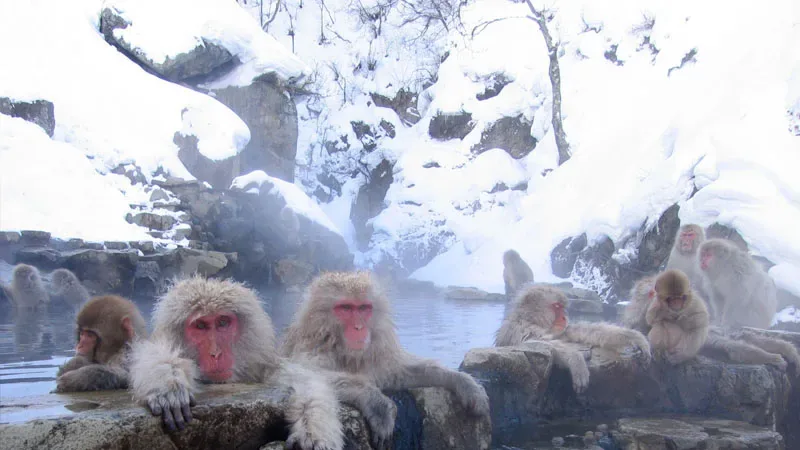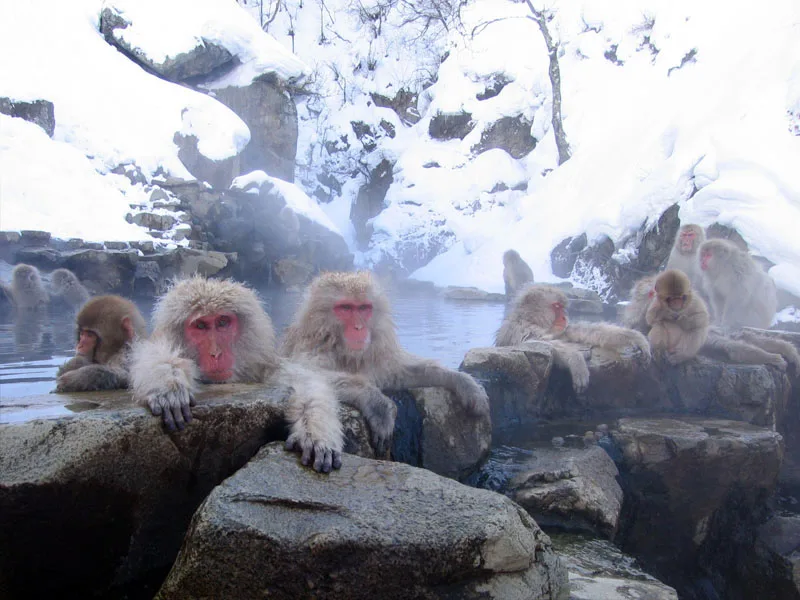
Japanese macaques relaxing in geothermal hot springs in Jigokudani
Field
notes
The Japanese Macaque (Macaca fuscata), also called the snow monkey, lives farther north than any other wild non-human primate on Earth, ranging across Honshu, Shikoku, and Kyushu up to the Shimokita Peninsula at Honshu’s northern tip. Males average 11.3 kg and about 57 cm in body length; females run smaller, at 8.4 kg and 52 cm. In the wild, the oldest known male reached 28 and the oldest known female 32.
Winter in Hell Valley
Winters in the Shiga Heights bring temperatures down to -20°C under snow that usually piles two to three meters deep. Researchers who studied adult males from a provisioned troop at Jigoku-Dani, or “Hell Valley,” found they held a steady rectal temperature of 38.3°C to 39.6°C at air temperatures from -1.4°C to 28.3°C, with no increase in metabolic rate in the cold. Their hair was significantly longer than that of monkeys living indoors, and the researchers suggested thick fur may account for their responses to the cold. An earlier study shows what the coat is worth: macaques with clipped coats needed to raise their metabolic rate by 53% at 5°C and 100% at 25°C to keep their body temperature steady. On windy, snowy days the monkeys often huddle, and when resting in snow they flex both limbs against the belly, cutting heat loss from the sparsely furred chest, abdomen, and groin.
Hot Spring Soaking At Jigoku-Dani, some macaques sit in a hot spring measured at 38 to 41°C. The researchers there called it a likely thermoregulatory behavior, noting from limited observations that how many sat in it, and for how long, seemed to track the weather.
Food and Predators
Japanese macaques are generalist omnivores, recorded eating more than 213 plant species, plus insects, fungi, eggs, and soil. The menu shifts with the seasons: mostly fruit in summer and autumn, mostly flowers and some nectar in April and May, and in the snow season, low-calorie bark and winter buds when food is extremely limited. Mountain hawk-eagles and feral dogs have been recorded preying on them, and raccoon dogs may too, especially on infants; a macaque that spots a predator gives a hollering call to warn the group. Humans are their most lethal predator: in 1998 alone, people killed more than 10,000 of them.
Rank, Kin, and Washed Potatoes
Females stay in their birth troop while males leave as they mature, and daughters inherit their mother’s rank. In one free-ranging troop, the alpha male kept his rank for 17 years, relying on female support, and held it even as his health failed before his death at 28. When the second-ranking male attacked him, the alpha female rescued him, and after that he screamed for her support whenever that rival approached. In one study of wild Yakushima macaques, scratching and, to a lesser extent, self-grooming rose with heat and humidity, while time spent grooming others was essentially unaffected, which the authors linked to that grooming having a social function as well as a hygienic one.
Several provisioned macaques have also been observed washing sand off sweet potatoes in water, a habit that spread among a number of individuals within a troop and was described as “pre-cultural.” Macaques in wild and feral groups have been known to build snowballs and repeatedly handle stones in stereotyped ways, and to pass these behaviors on to others.
Published Updated
Traits
Intel
& FAQ
Guess
first
How big is a Japanese Macaque, really? Slide, lock in, and see what the sources say. Every answer is a figure from this page, quoted from where it came from.
Sources
- 01Japanese macaque. Primate Info Net, Wisconsin National Primate Research Center, University of Wisconsin-Madison.
- 02Macaca fuscata (Japanese macaque). Animal Diversity Web, University of Michigan.
- 03Hori et al. (1977). Thermoregulation of the Japanese macaque living in a snowy mountain area. The Japanese Journal of Physiology.
- 04Nakamichi et al. (1995). Interactions among adult males and females before and after the death of the alpha male in a free-ranging troop of Japanese macaques. Primates.
- 05Ventura et al. (2005). Differential effects of ambient temperature and humidity on allogrooming, self-grooming, and scratching in wild Japanese macaques. American Journal of Physical Anthropology.
- 06Nakamichi & Shizawa (2003). Distribution of grooming among adult females in a large, free-ranging group of Japanese macaques. International Journal of Primatology.
- 07Watanabe & Tokita (2020). Macaca fuscata. The IUCN Red List of Threatened Species 2020: e.T12552A195347803.
What the sources say: 66 claims checked word for word against these sources →