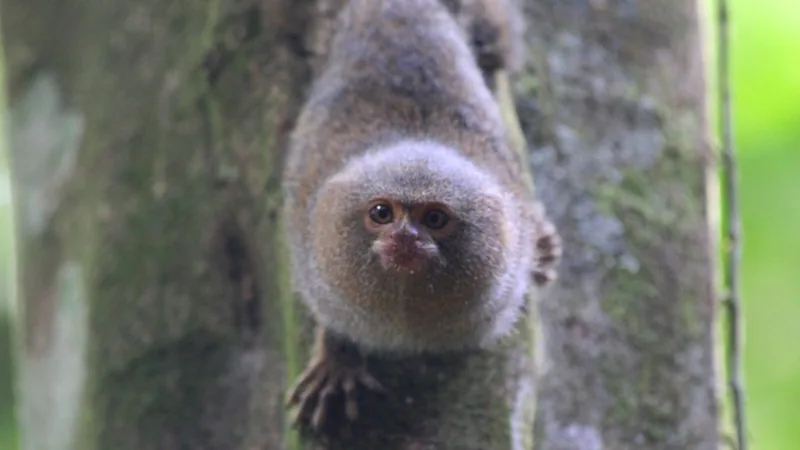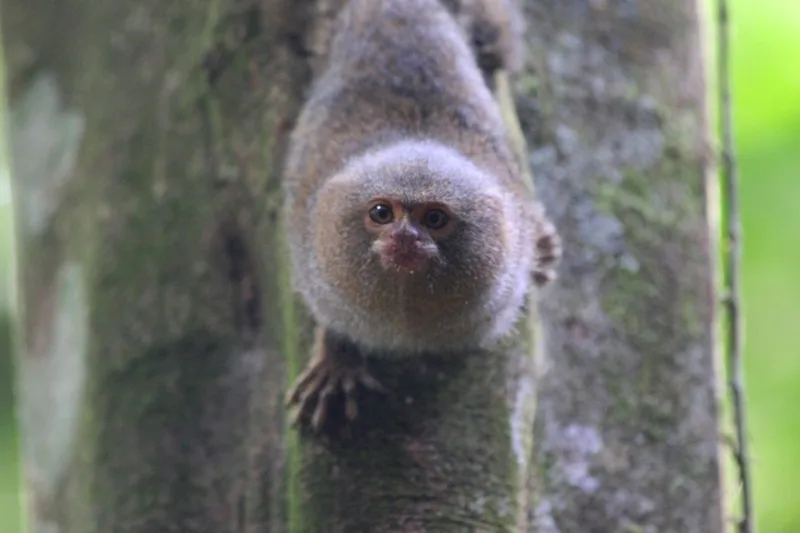
A western pygmy marmoset in Yasuní National Park, Ecuador.
Field
notes
A full-grown pygmy marmoset could fit in an adult’s hand and weighs about as much as a stick of butter. It is the world’s smallest monkey but not the smallest primate, a title that belongs to the mouse lemur. On average it weighs 119 grams and measures 136 millimetres, and adults have a tail longer than the rest of the body. They live up to 12 years, and up to 18 in zoos. They range across the Amazon basin of Brazil, Colombia, Ecuador, Peru, and northern Bolivia, in mature evergreen forests in and beside periodically flooded river floodplains.
The Living Sap Tap
Between 60 and 80 percent of a pygmy marmoset’s feeding time is spent on tree exudates such as gum, sap and resin. Its narrow, elongated lower incisors leave the five front teeth of the lower jaw all the same length, which helps it gnaw into trees and get sap flowing. The hole it drills is almost perfectly circular, and when sap puddles up inside, the marmoset laps it up with its tongue. A favourite tree can end up with as many as 1,300 holes. In most groups the oldest holes appear to be the lowest: the marmosets work their way up the tree until it stops yielding enough, then move to a new one.
A Jaw Built to Stretch A study compared the jaw muscles of 18 common and 5 pygmy marmosets with those of 13 cotton-top tamarins, which do not gouge trees. The marmosets’ fibres were relatively longer and their capacity for force reduced, a trade-off that likely helps them open their jaws relatively wide.
Claws, Head-Turns and Big Leaps
Most primates have flat nails, but a pygmy marmoset’s fingers carry long, sharp, claw-like nails called tegulae, which help it climb up and down tree trunks. Only its big toes keep a flat nail. While clinging upright to a tree, it can turn its head 180 degrees to scan for predators, and it can leap up to five metres.
Birds of prey, small wildcats, and climbing snakes are potential predators. Its agouti fur, each hair striped brown and black, gives it good camouflage. Sometimes the whole group mobs an intruder, calling loudly and attacking until it retreats; other times they freeze until the threat has passed.
A Troop That Talks All Day
Groups number two to nine, usually a breeding female, a breeding male and the offspring of one to four litters. In one study area of Amazonian floodplain forest, troops occupied exclusive home ranges of 0.2 to 0.4 hectares. Group members keep in touch throughout the day with trills, usually between animals no more than five metres apart, and J-calls at five to ten metres. Spread out beyond ten metres, they use a “long call” of repeated, high-pitched notes. In one captive group of three, the animals called in sequence more often than chance would predict, and the researchers concluded that pygmy marmosets appear to follow a conversational rule.
The IUCN Red List’s 2023 assessment lists the pygmy marmoset as Vulnerable. San Diego Zoo Wildlife Alliance names the pet trade as its largest threat, due to its tiny size and cuddly appearance. The United States has banned the import of primates, and most South American countries no longer allow primate exports.
Published Updated
Traits
Intel
& FAQ
Sources
- 01Callithrix pygmaea (pygmy marmoset). Animal Diversity Web, University of Michigan.
- 02Pygmy Marmoset. San Diego Zoo Wildlife Alliance.
- 03Primate Factsheets: Pygmy marmoset (Callithrix pygmaea). Primate Info Net, Wisconsin National Primate Research Center, University of Wisconsin-Madison.
- 04Taylor et al. (2009). The functional correlates of jaw-muscle fiber architecture in tree-gouging and nongouging callitrichid monkeys. American Journal of Physical Anthropology.
- 05Snowdon & Cleveland (1984). "Conversations" among pygmy marmosets. American Journal of Primatology.
- 06de la Torre & Snowdon (2009). Dialects in pygmy marmosets? Population variation in call structure. American Journal of Primatology.
- 07Soini (1982). Ecology and Population Dynamics of the Pygmy Marmoset, Cebuella pygmaea. Folia Primatologica.
- 08Torre et al. (2025). Cebuella pygmaea. The IUCN Red List of Threatened Species 2025: e.T136926A259089515.