Mantled howler
Field
notes
The monkey that answers back
Mantled howlers woof, grunt and bark as well as howl. The characteristic howls come at dusk and dawn, or whenever something disturbs the troop (a troop is a social group). Males’ calls seem to help neighbouring troops keep their distance from each other.
Size from sound In playback tests, males were less likely to approach recorded calls that sounded like a large rival, and approached small-sounding ones faster.
Researchers tested this on 11 adult males by playing them calls from strangers. The males always called back. The calls differed in formant spacing, a feature of a voice that tracks the caller’s body size, and the males also showed stronger hormone responses to the large-sounding calls. A comparison with its sister species, the black howler (Alouatta pigra), found that the black howler’s exaggerated roars seem better suited to contests between groups, while the mantled howler’s calls may suit attracting mates and competing within groups.
Leaves on a slow budget
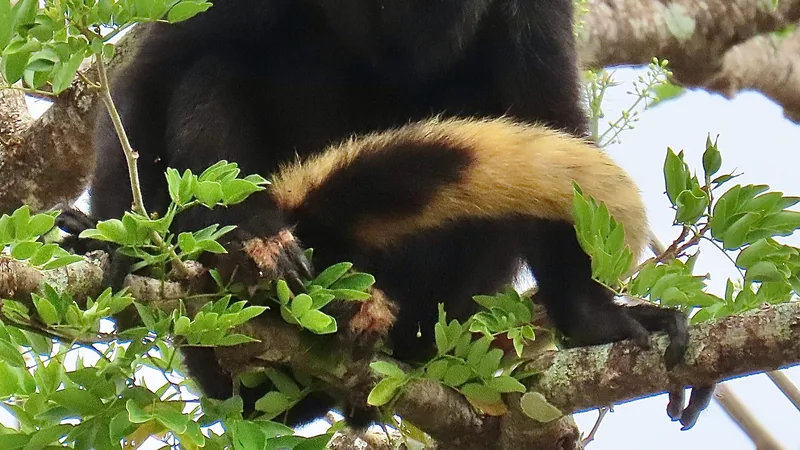
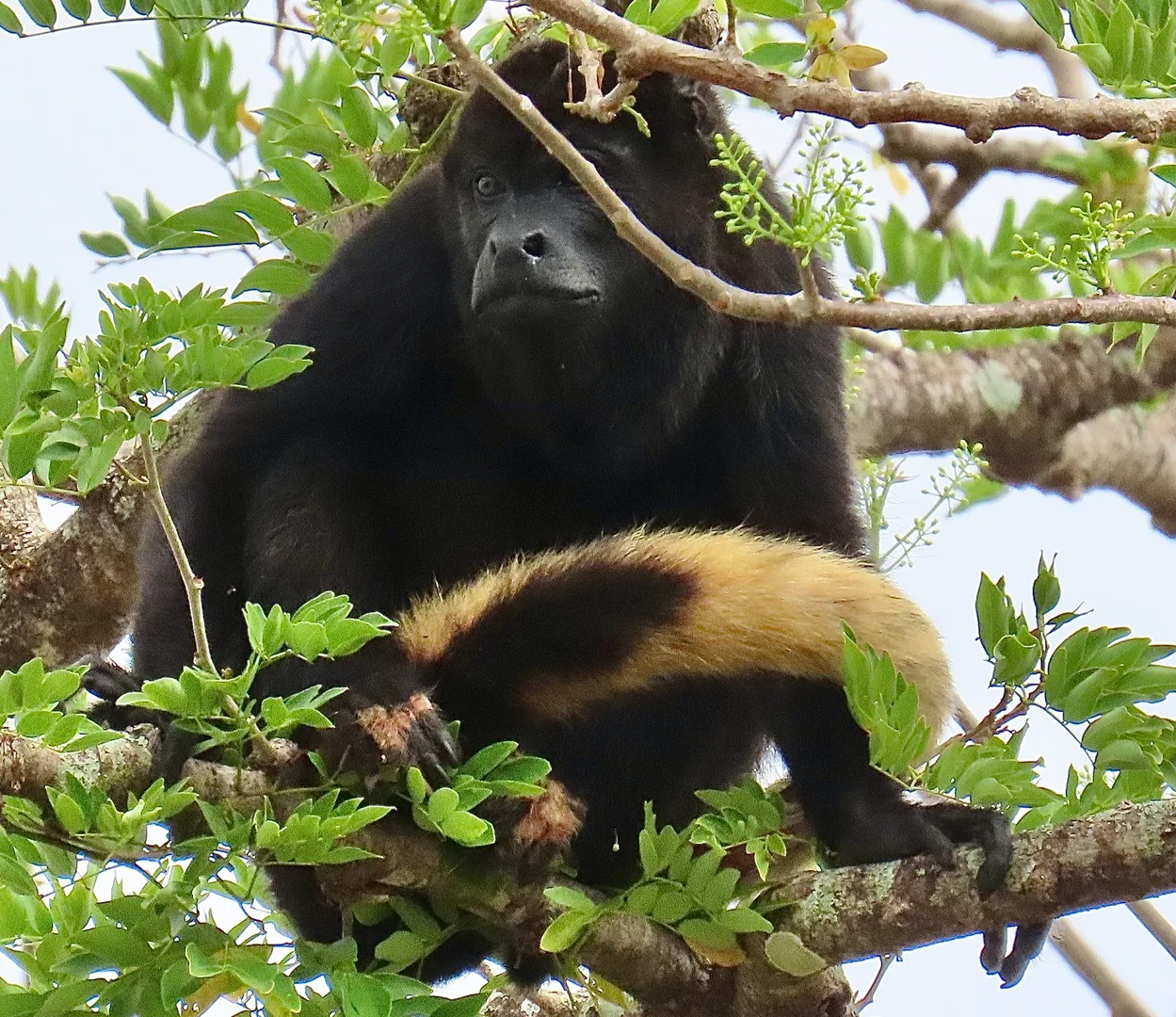
Males weigh 6 to 7 kg and adult females typically 4 to 5 kg. The body is 38 to 58 cm long, with a prehensile tail (one that can grip) of 52 to 67 cm. They are stocky and black, with long guard hairs on the flanks that give the “mantled” name, and most wear a yellow or brown saddle.
Leaves, fruit and flowers make up most of the menu, and howlers favour young leaves, which carry more protein for their fibre and less of the plant chemicals called tannins. They spend most of their time foraging, and their lifestyle is described as energetically conservative. At Los Tuxtlas in Mexico one study found them eating the fruit of 35 plant species and spreading the seeds of 28. Dung beetles then bury the droppings quickly: a clump stayed on the ground for only 2.5 hours on average.
Troop life
A troop of 10 to 20 monkeys usually holds 5 to 10 adult females and 1 to 3 adult males. Both sexes leave the group they were born in: in one study, 79% of males and 96% of females did. A female has her first baby at about 42 months, pregnancy lasts about 186 days, and births come about 22.5 months apart. The AnAge database estimates that wild adults live 16 years on average, and gives a captive maximum of 24 years.
From southern Mexico to Ecuador
The species lives in southern Mexico and from Honduras to Colombia and western Ecuador, in forest from sea level up to 2,500 m. The Red List rates it Vulnerable. Where rainforest has been chopped into fragments, especially in southern Mexico, many howlers have shifted into cacao and coffee plantations grown under shade trees.
Published
Traits
Intel
& FAQ
Guess
first
How big is a Mantled Howler Monkey, really? Slide, lock in, and see what the sources say. Every answer is a figure from this page, quoted from where it came from.
Sources
- 01Alouatta palliata (mantled howler monkey). Animal Diversity Web.
- 02AnAge entry for Alouatta palliata. Human Ageing Genomic Resources, AnAge.
- 03Cortes-Ortíz et al. (2021). Alouatta palliata. The IUCN Red List of Threatened Species 2021: e.T39960A190425583.
- 04Maya Lastra et al. (2024). Mantled howler monkey males assess their rivals through formant spacing of long-distance calls. Primates.
- 05Bergman et al. (2016). Striking differences in the loud calls of howler monkey sister species (Alouatta pigra and A. palliata). American Journal of Primatology.
- 06Estrada & Coates-Estrada (1991). Howler monkeys (Alouatta palliata), dung beetles (Scarabaeidae) and seed dispersal: ecological interactions in the tropical rain forest of Los Tuxtlas, Mexico. Journal of Tropical Ecology.
What the sources say: 41 claims checked word for word against these sources →