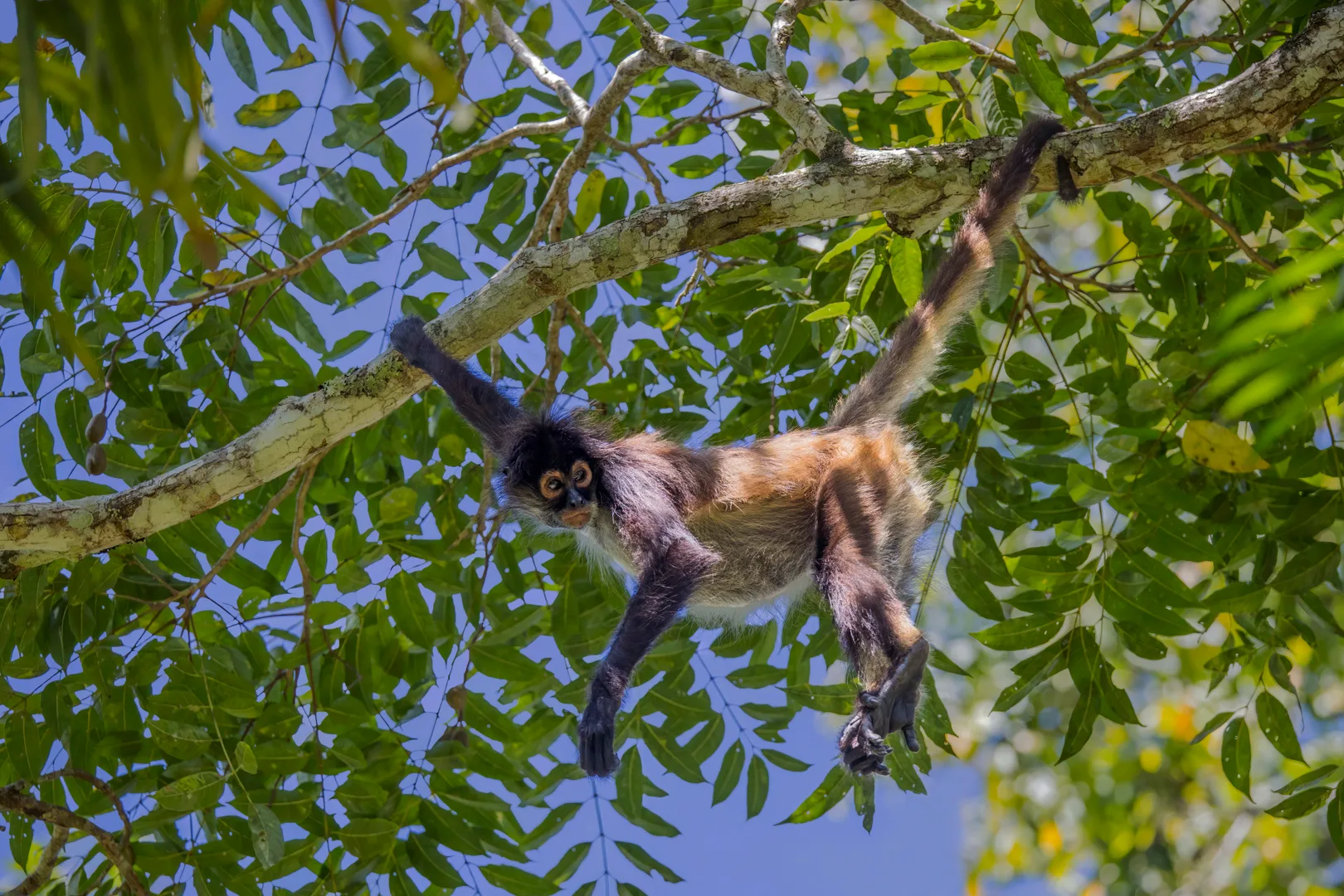
Tikal, Petén, Guatemala
Field
notes
A Tail That Works Like a Hand
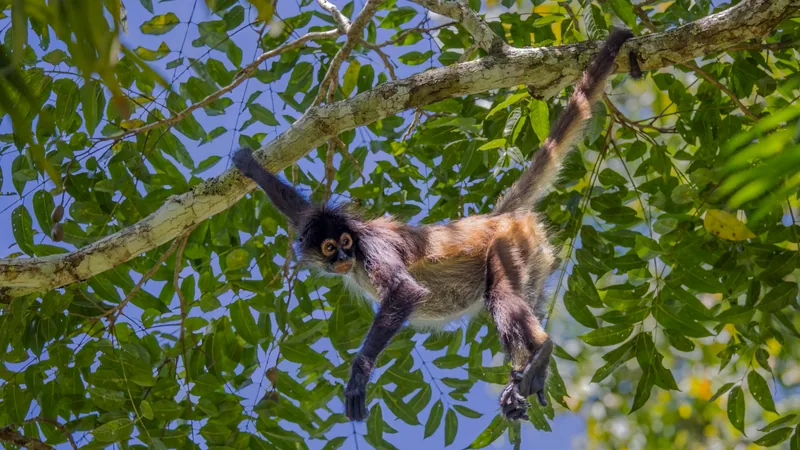
Geoffroy’s spider monkey is often seen dangling from a single arm or leg, or from its tail, which Animal Diversity Web says “essentially functions as a fifth limb”. It can pick things up with that tail too. The tail runs 635 to 840 millimetres, against a head-and-body length of 305 to 630. Next to its body, the monkey has extremely long limbs.
A study in Panama and Surinam, covering this species and its relative Ateles paniscus, sorted spider monkey movement into five patterns: walking and running on all fours, suspensory locomotion (moving while hanging), climbing, walking on two legs, and leaping. When feeding, climbing mattered most, especially what the study calls horizontal climbing.
Size and Staying Power
An adult averages about 7.3 kilograms (7,268 grams). Females mature at four years and males at five. A mother carries one baby for 226 to 232 days, and births come two to four years apart.
The ageing database AnAge lists a maximum longevity of 47.1 years in captivity, from one female that was at least that old when she died.
A Loud Crowd in the Canopy
Its range runs from Mexico’s two coasts (Tamaulipas in the northeast, Jalisco in the west) down to northwestern Colombia. These monkeys live in mature rainforest and montane forest, mainly in the top of the tree canopy.
Groups tend to hold about thirty animals, and groups of up to 100 have been reported. The crowd usually splits into smaller subgroups to forage, and the whole group is together for only a few weeks a year. They bark when threatened, and when people come close they often throw branches, jump up and down and shake tree limbs. Separated ones call with a sound like a whinny.
Fruit and Sleeping Trees
Ripe fruit is the main course, with leaves and flowers less often. Nuts, seeds, insects, arachnids and eggs may turn up too, in smaller amounts. A review of 22 diet samples from five countries counted 364 plant species from 76 families in the diet, yet the majority of feeding time went to a few species in two families, Moraceae and Fabaceae.
Nearest bed A community in Santa Rosa National Park, Costa Rica, repeatedly used 11 sleeping trees, and the monkeys tended to choose the one closest to where they were feeding.
Compared with one fixed sleeping site or a random pick, choosing a tree close to the current feeding area gave the lowest travel costs in the researchers’ model, and it best predicted how far the monkeys really travelled. The Red List rates the species Endangered.
Published
Traits
Intel
& FAQ
Guess
first
How big is a Geoffroy's Spider Monkey, really? Slide, lock in, and see what the sources say. Every answer is a figure from this page, quoted from where it came from.
Sources
- 01Cortes-Ortíz et al. (2021). Ateles geoffroyi. The IUCN Red List of Threatened Species 2021: e.T2279A191688782.
- 02Ateles geoffroyi (Central American spider monkey). Animal Diversity Web, University of Michigan.
- 03Ateles geoffroyi (Central American spider monkey). AnAge: The Animal Ageing and Longevity Database, Human Ageing Genomic Resources.
- 04Mittermeier (1978). Locomotion and Posture in Ateles geoffroyi and Ateles paniscus. Folia Primatologica.
- 05González‐Zamora et al. (2008). Diet of spider monkeys (Ateles geoffroyi) in Mesoamerica: current knowledge and future directions. American Journal of Primatology.
- 06Chapman, Chapman & McLaughlin (1989). Multiple central place foraging by spider monkeys: travel consequences of using many sleeping sites. Oecologia.
What the sources say: 36 claims checked word for word against these sources →