Tikal, Petén, Guatemala
Field
notes
A nose that works like a probe
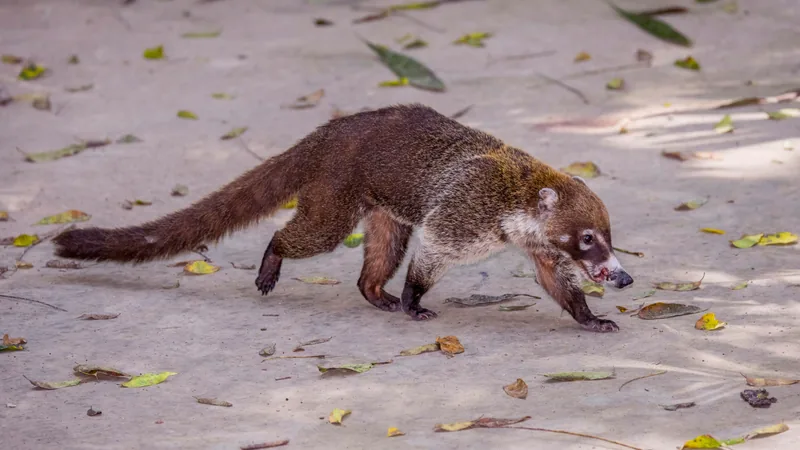
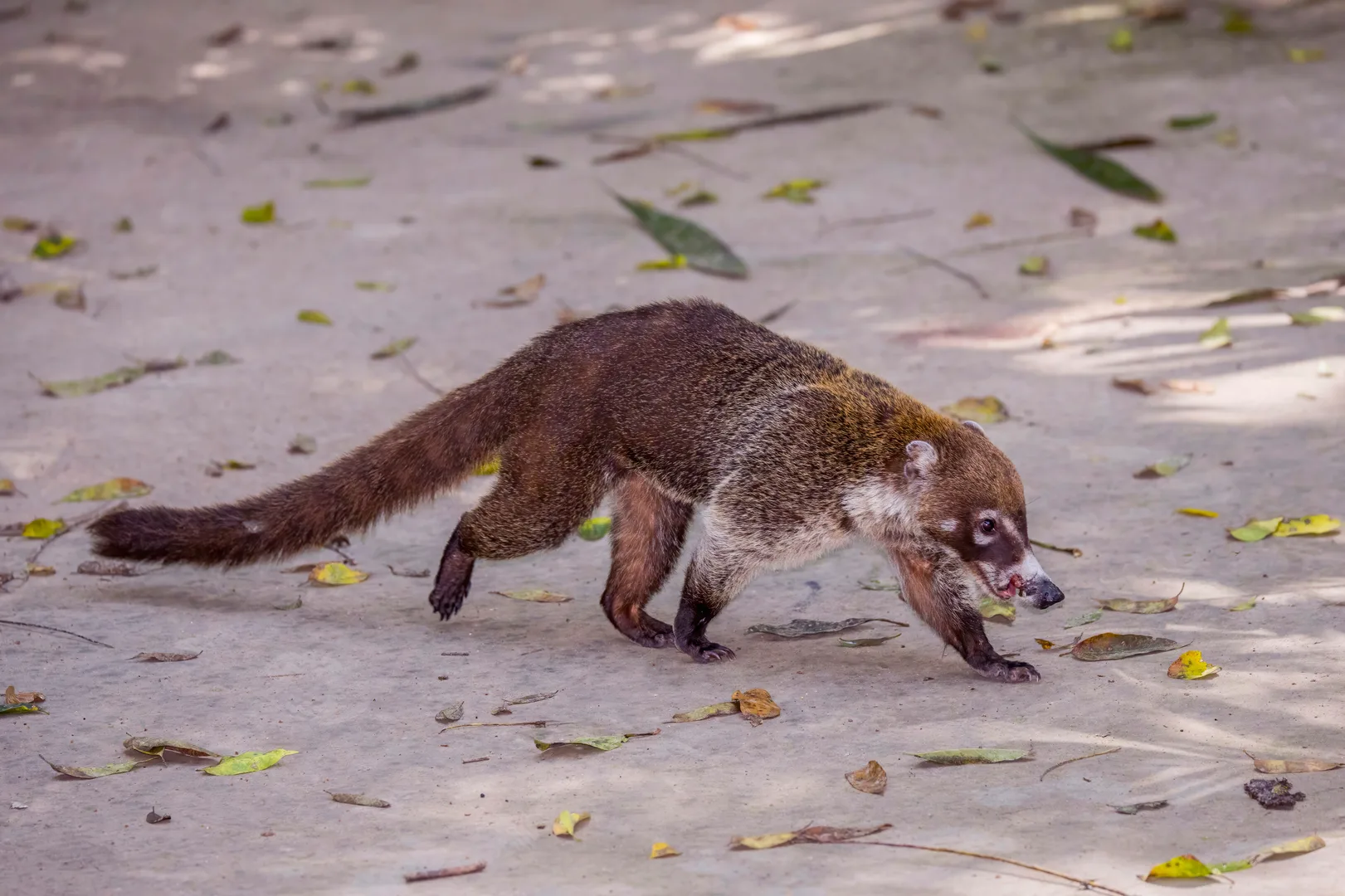
The white-nosed coati forages with its muzzle held low over the forest floor, sniffing out beetles, spiders, scorpions, ants, termites, grubs, centipedes and even land crabs. The snout is long and pointed with a flexible tip, and its strong claws are made for digging. It is an omnivore, meaning it eats both animals and plants, but insects are the main food, with fruit added when it is plentiful. Now and then it may go for a mouse, lizard or frog, pinning the prey to the ground with its paws and killing it with a bite to the head.
Daily distance In one day of searching for food, a coati can cover as much as 2,000 metres.
Built for the forest floor and the treetops
A white-nosed coati weighs roughly 3 to 6 kg. Its head and body measure about 66 cm, and the tail is almost as long as the body. The tail is semi-prehensile, meaning it can partly grip, and it is used for balance and is often held straight up. The face has a white spot above and below each eye and on each cheek. A coati is mostly active by day, when it stays mainly on the ground looking for food. At night it climbs into the treetops, where it is sheltered from most predators.
Its range runs from southeastern Arizona to western Colombia and Ecuador, taking in Mexico and Central America on the way. Habitats go from tropical lowlands to dry, high-altitude forests.
Bands of females, loners among males
Females and males younger than two years old group together in bands of four to 20, whether or not they are related. Adult males live alone, except in the breeding season. That split fooled biologists, who described the solitary males as a separate species. The word coatimundi means “lone coati” in Guarani, a native language of Brazil.
Ahead of the birth, a female leaves the band to build a nest, usually in a palm tree. Gestation lasts 10 to 11 weeks, and a litter holds two to seven young. Weaning comes at four months, and full adult size at 15 months.
How long they last
A wild coati can reach seven years. Coatis in human care average 14 years, and the oldest on record, in captivity, reached 26.4 years. Their natural predators include cats, boas and large birds. Numbers fell sharply in the 1960s but have since recovered, and the species has been spreading into the United States since the early twentieth century. The Red List rates it Least Concern.
Published
Traits
Intel
& FAQ
Guess
first
How big is a White-Nosed Coati, really? Slide, lock in, and see what the sources say. Every answer is a figure from this page, quoted from where it came from.
Sources
- 01Nasua narica. Animal Diversity Web.
- 02White-nosed coati. Smithsonian's National Zoo and Conservation Biology Institute.
- 03AnAge entry for Nasua narica. AnAge: The Animal Ageing and Longevity Database, Build 15, Human Ageing Genomic Resources.
- 04Cuarón et al. (2016). Nasua narica. The IUCN Red List of Threatened Species 2016: e.T41683A45216060.
What the sources say: 43 claims checked word for word against these sources →