Île Royale, French Guiana
Field
notes
A monkey with a toolkit
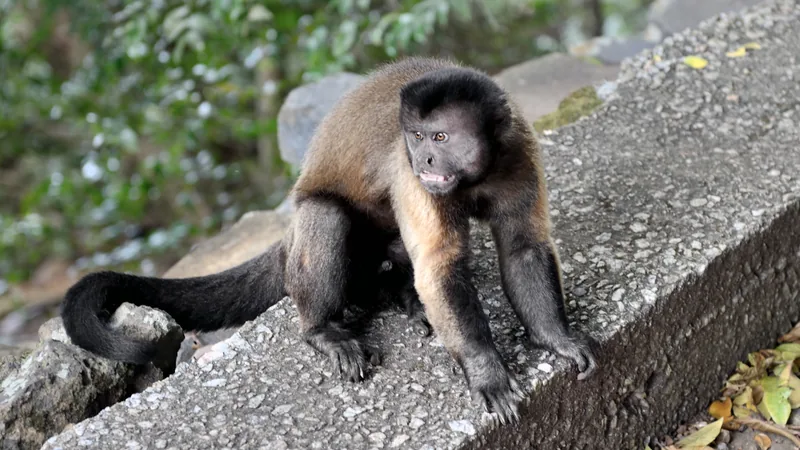
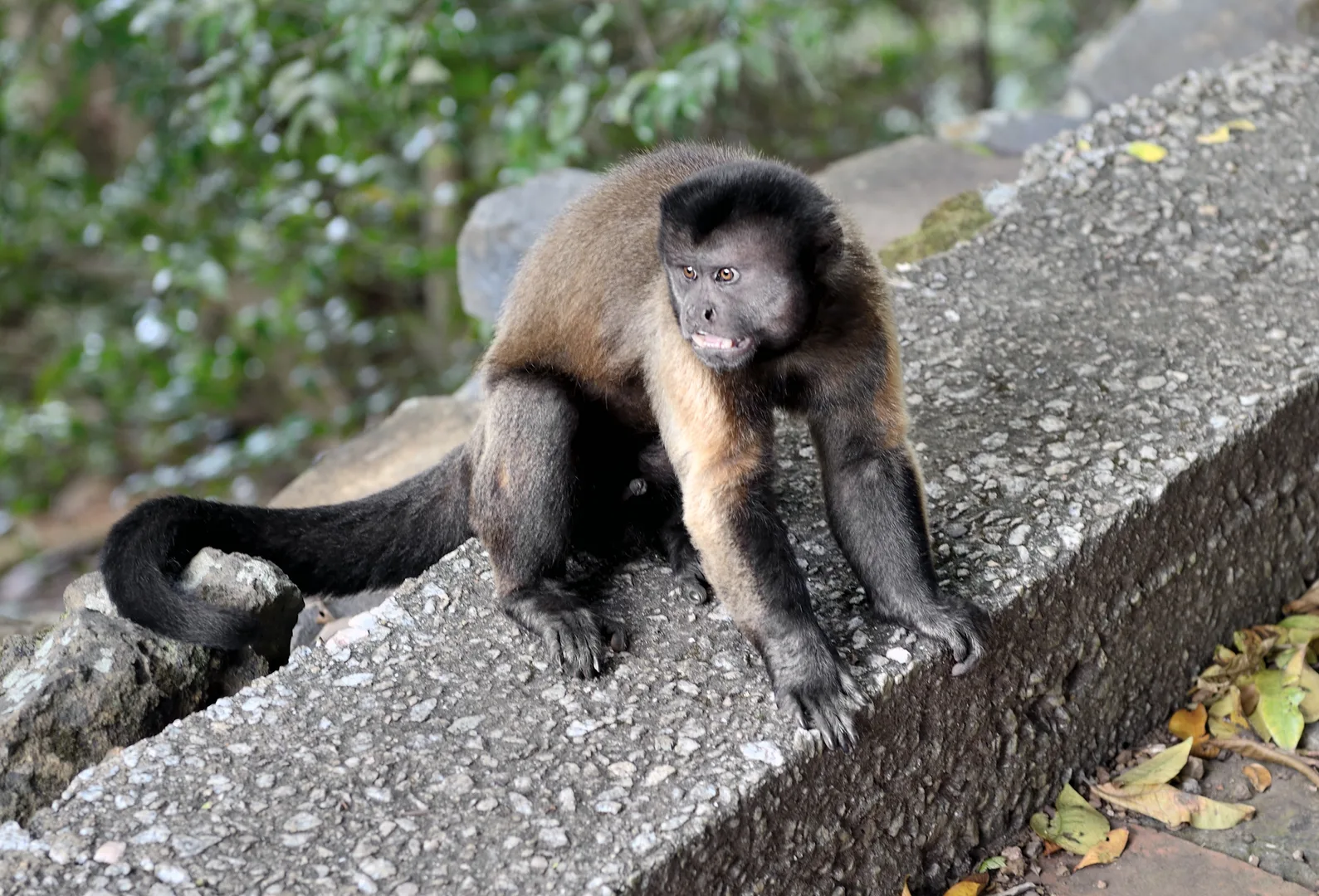
Some fruits have husks a tufted capuchin cannot open with its teeth or jaws. So it uses a tool, an object that gets a job done. Wild ones smash those fruits against tree surfaces or work them open with baton-like pieces of branch. Young capuchins have been seen copying adults, though they often fail.
Its jaws help too. A deep lower jaw and large jaw muscles suit a diet of large fruits and rough vegetation. In a study of three adult female captive tufted capuchins (Sapajus apella), X-ray video of a chewing muscle showed that on tougher foods, such as popcorn seeds and cashews, the muscle’s fibers rotated less as they shortened, a setup that favors more force.
Small monkey, long life
Wild males average 3.65 kg and females 2.52 kg. Body length (head and body) is 444 mm in males and 390 mm in females, with a tail about as long as the rest of the body.
The longevity database AnAge puts the species’ maximum at 46 years in captivity, from one animal that was about that age when it died.
A very wide menu
Tufted capuchins are omnivores: they eat both plants and animals. The diet includes fruit, nuts, leaves, nectar and insects, plus frogs, lizards and birds. In the dry season, when food is often scarce, it relies on palm nuts and pith, the soft core of a palm. At one Amazon site the diet was 82 percent plants and 18 percent animal matter, and a typical day splits into 12 percent rest, 21 percent travel and 66 percent feeding.
Urine washing Capuchins wash their hands and feet in urine and spread the scent over their fur, and by that odor they can tell members of other groups from their own.
Troops of the Amazon
The species lives in Colombia, Ecuador, Peru, Bolivia, Brazil, French Guiana, Suriname, Guyana and Venezuela, with the heart of its range in northwestern Brazil and the Amazon basin. It stays mostly in the understory and the lower and middle canopy. Troops often number in the teens or low twenties, led by an alpha male, and the harpy eagle is the main predator.
Genetic work points to an explosive expansion in the late Pleistocene, when the robust capuchins, the group called Sapajus, spread from the Atlantic Forest into the Amazon. The IUCN rates the species Least Concern.
Published
Traits
Intel
& FAQ
Guess
first
How big is a Tufted Capuchin, really? Slide, lock in, and see what the sources say. Every answer is a figure from this page, quoted from where it came from.
Sources
- 01Tufted capuchin. Primate Info Net, Wisconsin National Primate Research Center.
- 02Cebus apella (brown capuchin). Animal Diversity Web, University of Michigan.
- 03AnAge entry for Sapajus apella. Human Ageing Genomic Resources, AnAge.
- 04Cebus apella (Tufted Capuchin). The Online Guide to the Animals of Trinidad and Tobago, University of the West Indies.
- 05Laird et al. (2020). Muscle architecture dynamics modulate performance of the superficial anterior temporalis muscle during chewing in capuchins. Scientific Reports.
- 06Lynch Alfaro et al. (2011). Explosive Pleistocene range expansion leads to widespread Amazonian sympatry between robust and gracile capuchin monkeys. Journal of Biogeography.
- 07Boubli et al. (2021). Sapajus apella. The IUCN Red List of Threatened Species 2021: e.T172351505A192594550.
What the sources say: 45 claims checked word for word against these sources →