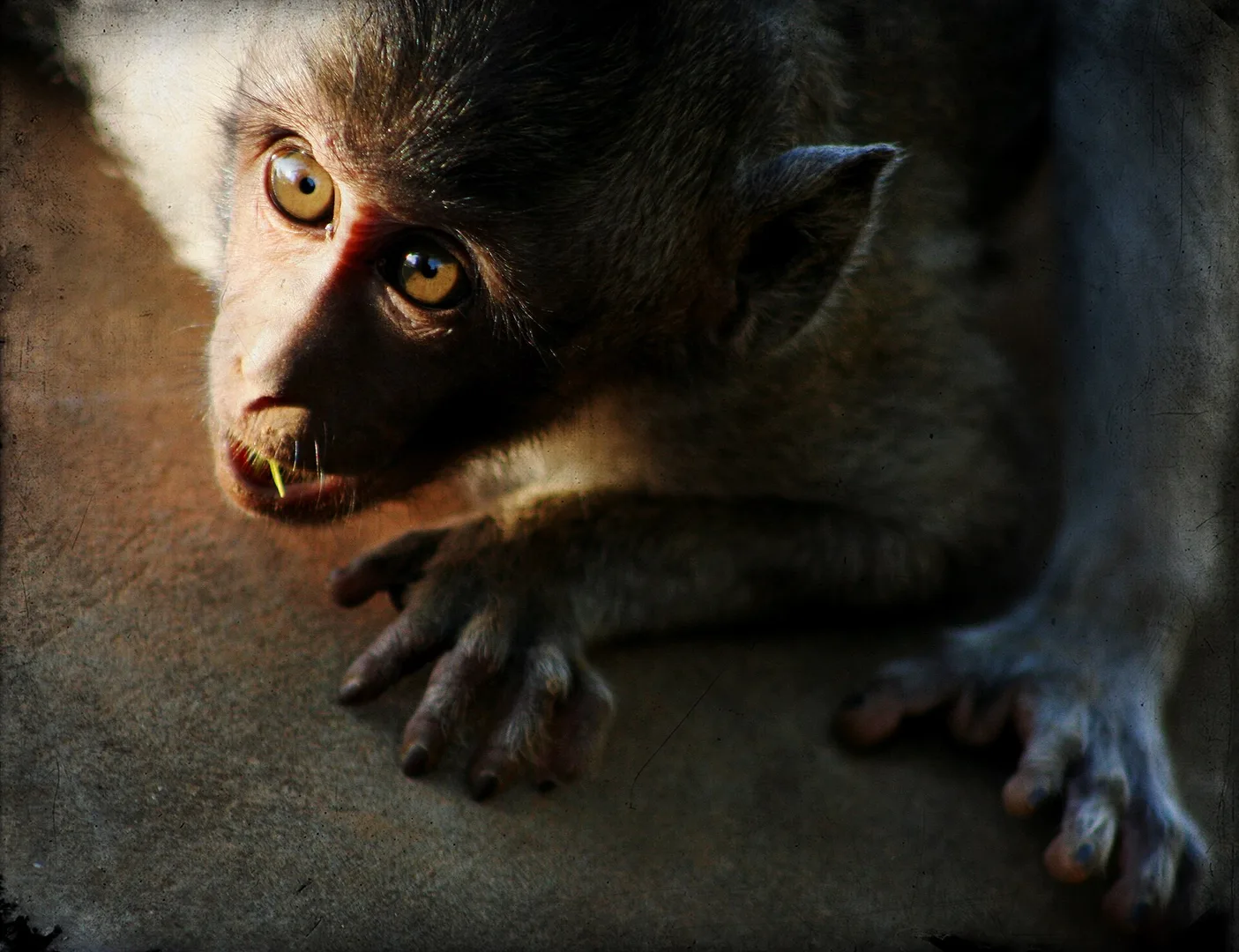
Hamadryas baboon (Papio hamadryas) adult male, Saudi Arabia
Field
notes
Four Levels of Society, Stacked on Top of Each Other
Hamadryas baboon society is stacked in layers. Researchers call this a multilevel society, and among primates the same pattern has been described in snub-nosed monkeys, proboscis monkeys, geladas and humans. The basic unit is the one-male unit, or OMU: a central male, the leader, who aggressively herds and controls one to nine females and their offspring. Several OMUs cluster into a clan, and the males in a clan are thought to be close genetic relatives. In one closely studied Ethiopian band, the clans held between seven and 13 of these family units. Clans combine into bands, and at night several bands may gather on the same sleeping cliff as a troop, which can run to several hundred baboons.
Adult males weigh 18 to 20 kilograms, roughly twice an adult female’s 9 to 11 kilograms, and grow a mantle of long silvery hair plus a bright pink face and backside. Females have no mantle, and their faces are black and brown. Sitting upright, an adult male measures 49 to 64 centimeters tall and an adult female 49 to 54. A hamadryas baboon lives about 20 years in the wild and 31 in expert care.
A Leader Male Rules by Force
A hamadryas leader keeps his females by herding them. He stops them straggling on the foraging march, prevents them from socializing with other males, and chases, bites or otherwise punishes any female who appears to be straying. A leader can lose his whole harem to another male in what researchers call a takeover. Infants caught up in one are at least four times more likely to be killed, or otherwise die, than at other times. Researchers watching one wild population at Filoha, in Ethiopia, recorded 162 takeovers over 20 years.
Cliffs, Cactus Fruit and Acacia Pods
Hamadryas baboons live across the Horn of Africa (Ethiopia, Somalia and Eritrea) and the Arabian Peninsula (Saudi Arabia and Yemen); no other kind of baboon lives as far north. Their turf is subdesert, steppe, plains and shortgrass savanna, and their range is limited by where they can find a water hole and rocks or cliffs to sleep on. Plant matter makes up the majority of the diet: grass seeds, roots, and acacia leaves, flowers and pods, plus, in Arabia, cactus fruit and palm nuts. Bird eggs, carrion, small mammals and occasional insects like locusts make up a small portion. Living in dry country, these baboons can survive on low-quality food for long stretches. They can fall prey to leopards, hyenas and Verreaux’s eagles, and one explanation for the cliff-sleeping habit is that it inhibits predators from reaching the animals.
Sacred to a God of Learning
Ancient Egyptians believed hamadryas baboons were sacred to Thoth, the god of learning, and the species is still referred to as the Sacred Baboon. Hamadryas baboons are now extinct in Egypt, though large populations remain in Ethiopia, Somalia, Saudi Arabia and Yemen.
Sacred Enough to Mummify Hamadryas baboons were so highly regarded in ancient times that some were mummified after death.
Published Updated
Traits
Intel
& FAQ
Guess
first
How big is a Hamadryas Baboon, really? Slide, lock in, and see what the sources say. Every answer is a figure from this page, quoted from where it came from.
Sources
- 01Papio hamadryas (hamadryas baboon). Animal Diversity Web, University of Michigan.
- 02Hamadryas Baboon. San Diego Zoo Wildlife Alliance.
- 03Gippoliti (2019). Papio hamadryas. The IUCN Red List of Threatened Species 2019: e.T16019A17953082.
- 04Schreier & Swedell (2009). The fourth level of social structure in a multi‐level society: ecological and social functions of clans in hamadryas baboons. American Journal of Primatology.
- 05Amann, Pines & Swedell (2017). Contexts and consequences of takeovers in hamadryas baboons: Female parity, reproductive state, and observational evidence of pregnancy loss. American Journal of Primatology.
- 06Grueter, Chapais & Zinner (2012). Evolution of Multilevel Social Systems in Nonhuman Primates and Humans. International Journal of Primatology.
What the sources say: 55 claims checked word for word against these sources →