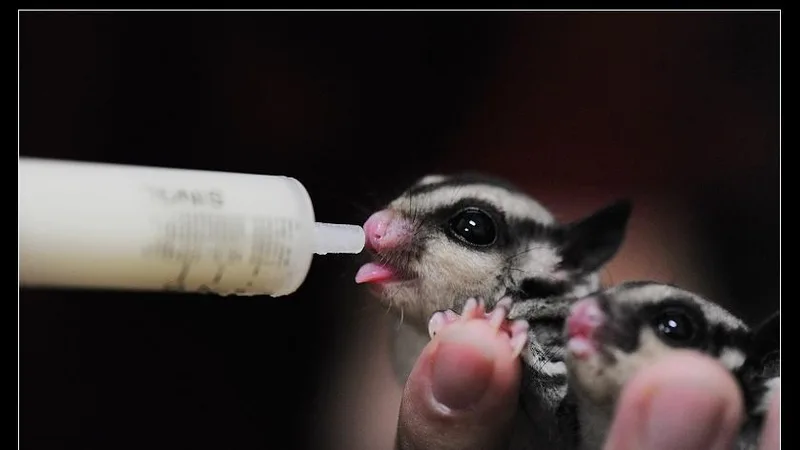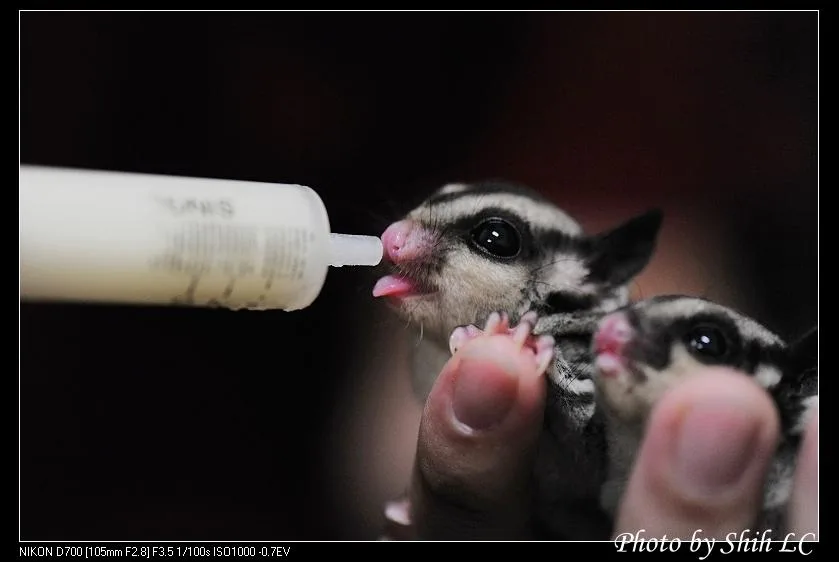
Wild sugar glider at night near Brisbane, Queensland
Field
notes
Built to Fall With Style
The sugar glider’s big trick is a soft membrane called a patagium, stretched between each wrist and ankle. The membrane works as an airfoil, and a glide can reach about 150 feet (over 45 meters) between trees. It steers mid-glide by tilting its hands, adjusting tension in the membrane, and using its long, flat tail as a rudder.
The membrane first shows as a ridge along a joey’s side, most visible at the armpit, about five days after birth. A 2023 study found that a gene called Wnt5a helps it form, and that bats’ wing membranes evolved using the same gene; in mice, it likely shapes the outer ear. Gliding has evolved as many as six separate times in living mammals, and sugar gliders and bats grow their membranes with some of the same limb-building genes.
About as Heavy as a Baseball
Its head and body run 4.7 to 12 inches (120 to 320 millimeters), plus a tail of 6 to 18 inches (150 to 480 millimeters). It weighs 3 to 5 ounces (85 to 141 grams), about as much as a baseball, and lives 4 to 5 years in the wild, up to 15 in expert care.
Its diet swings with the seasons. In spring and summer it eats mostly insects, mainly moths and beetles; in autumn and winter it switches to plant foods such as eucalyptus sap and pollen.
Torpor Through a Storm Tracked through a storm with category-1 cyclone wind speeds on the Australian coast, sugar gliders stayed inactive or cut back their foraging, and seven of the ten with data entered torpor. Body temperature fell as low as 13.8°C (57°F), and deep torpor cut energy use by up to 67 percent. Every glider in the study survived and resumed normal foraging over the following night or nights.
The Family Scent
A colony is a family: up to seven related adults plus their young, sharing around 2.5 acres of territory. The adult males mark the territory with saliva and scent from their anal, hand, and foot glands, and mark every other member with glands on the forehead and chest. One dominant male usually does most of the marking, and any glider without that shared scent gets attacked the moment it’s noticed.
Frightened, a glider can ooze a white, oily secretion that smells of soured fruit from its paracloacal glands, or stand on its hind legs, often with its mouth open. A really frightened one may lie on its back with its feet in the air, calling out.
One Species Became Three
Described in 1838, the sugar glider was treated as a single species ranging across New Guinea and northern and eastern Australia until a 2020 genetic and anatomical study split the Australian gliders into three: the sugar glider proper, Krefft’s glider, and the savanna glider. The IUCN’s Least Concern rating for Petaurus breviceps dates to 2016, before that split. The study’s authors note the old species was not listed as threatened because of its supposedly broad range, and warn that splitting it has important conservation implications for all three.
A DNA study of pet gliders from seven US states found that all those sampled probably came from a source population near Sorong, in Indonesia’s West Papua, with no sign of any harvested in Papua New Guinea or Australia. Sugar gliders were brought to the US for the exotic pet trade in the 1990s.
Published Updated
Traits
Intel
& FAQ
Guess
first
How big is a Sugar Glider, really? Slide, lock in, and see what the sources say. Every answer is a figure from this page, quoted from where it came from.
Sources
- 01Petaurus breviceps (sugar glider). Animal Diversity Web, University of Michigan.
- 02Sugar Glider. San Diego Zoo Wildlife Alliance.
- 03Salas et al. (2016). Petaurus breviceps. The IUCN Red List of Threatened Species 2016: e.T16731A21959798.
- 04Nowack et al. (2015). Snoozing through the storm: torpor use during a natural disaster. Scientific Reports.
- 05Feigin et al. (2023). Convergent deployment of ancestral functions during the evolution of mammalian flight membranes. Science Advances.
- 06Cremona et al. (2020). Integrative taxonomic investigation ofPetaurus breviceps(Marsupialia: Petauridae) reveals three distinct species. Zoological Journal of the Linnean Society.
- 07Campbell et al. (2019). The origin of exotic pet sugar gliders (Petaurus breviceps) kept in the United States of America. PeerJ.
What the sources say: 67 claims checked word for word against these sources →