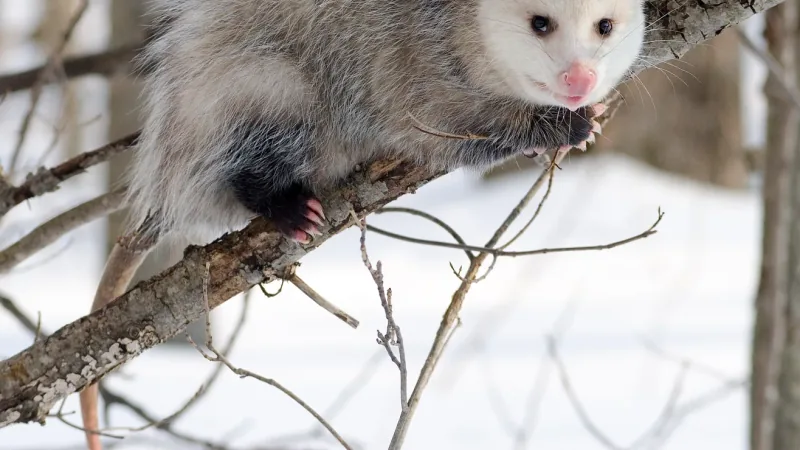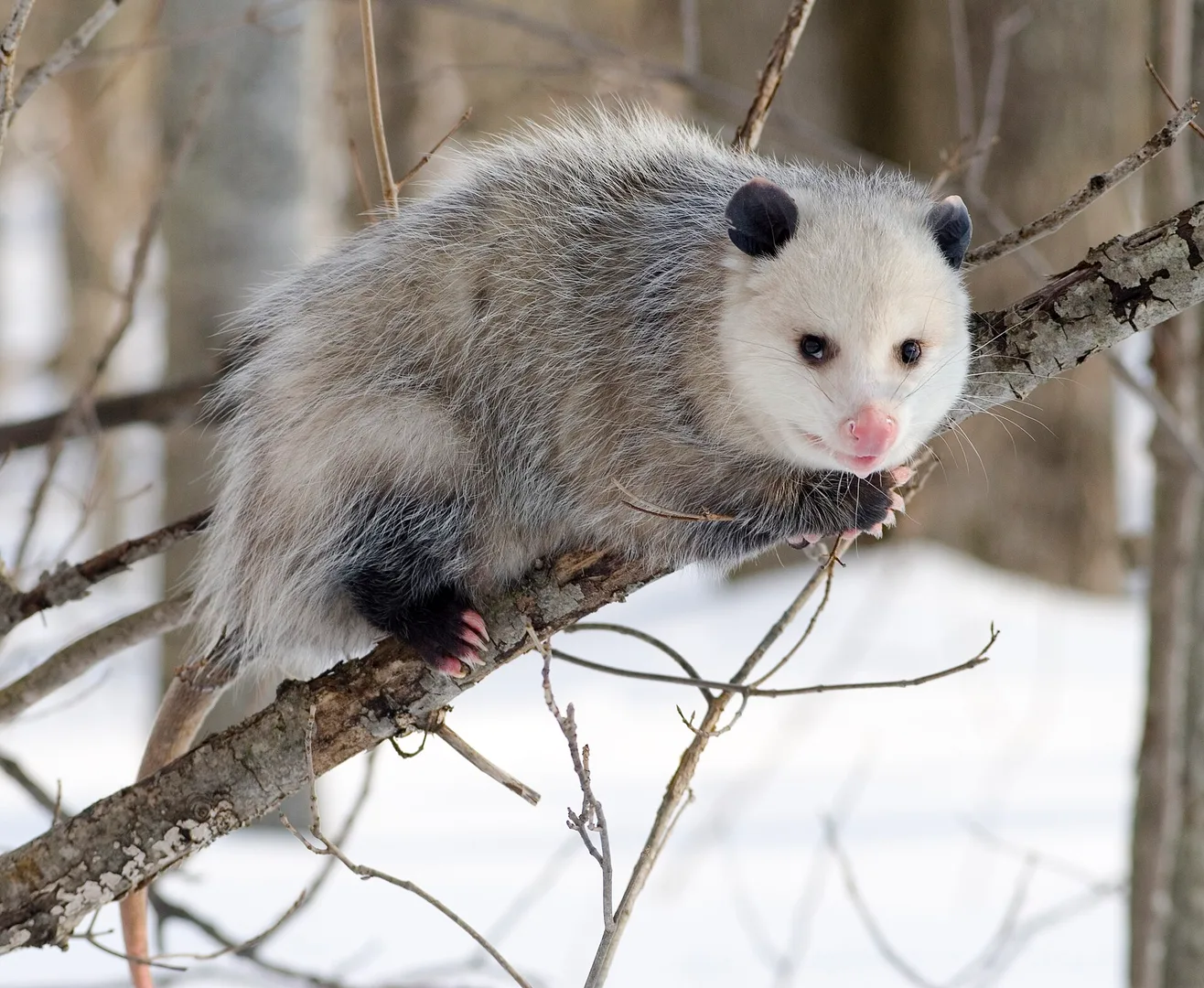
North American Opossum with winter coat.
Field
notes
The only marsupial found north of Mexico, the Virginia opossum (Didelphis virginiana) carries fifty teeth. Males run about 16 inches long plus an 11.6-inch tail and weigh 4.6 to 6.2 pounds; females are a little lighter, at 4.2 to 4.6 pounds. In the wild they may live to be 1.5 to 2 years old; in human care they typically reach 3 or 4.
A Collapse It Can’t Control
When threatened or harmed by a dog, fox, bobcat or other predator, an opossum may “play possum,” appearing to be sick or dead. It isn’t a conscious performance: the catatonic collapse is an automatic response to danger. Mostly young opossums do it; a threatened adult will bare its teeth, hiss, screech or flee, according to the Smithsonian’s National Zoo.
A corpse with a pulse Its lips curl back over bared teeth, saliva foams at its mouth, and its anal glands leak a foul-smelling fluid, a catatonic state that can last up to four hours.
Wired to Shrug Off a Snakebite
Opossums that prey on pit vipers, including several species in the Virginia opossum’s genus Didelphis, appear to take no precautions while subduing the snakes and are often bitten, according to a 2011 study in PLoS ONE. That study sequenced part of the blood-clotting gene von Willebrand factor (vWF) in Virginia opossums and their relatives, and found strong evidence of positive selection on it in venom-resistant opossums. Some changes are hypothesized to weaken its bond with botrocetin, a pit viper venom protein that contributes to systemic bleeding. A 2016 paper reports that an eleven-amino-acid opossum peptide completely neutralized a lethal dose of western diamondback rattlesnake venom in mice when the two were mixed before injection, and a bacteria-made version partially neutralized rattlesnake venom. San Diego Zoo Wildlife Alliance calls opossums “virtually immune to the venom of rattlesnakes, cottonmouths, and other pit vipers.”
Range, Diet, and the Tick Question
Virginia opossums range from Costa Rica north through the United States east of the Rocky Mountains into Ontario, Canada, and were introduced to the U.S. West Coast and British Columbia; the species is still expanding northward, per the Smithsonian’s National Zoo. A 2018 genetic study of opossums from Michigan, Ohio and Wisconsin suggested their spread may be helped by agricultural land development and, at the same time, limited by the animals’ inability to forage in snow. They’re opportunistic omnivores, eating small mammals, birds, insects, worms, plant material, fruits and seeds, and might also eat reptiles or amphibians depending on habitat.
One tick figure doesn’t hold up. A lab study on captive opossums estimated that they eat, on average, 5,500 tick larvae a week. But when a 2021 study searched the stomach contents of 32 Virginia opossums from central Illinois under a microscope, it did not locate any ticks or tick parts, and none of the 23 published diet studies it found had identified ticks either. The researchers concluded that ticks are not a preferred diet item for the species.
Published Updated
Traits
Intel
& FAQ
Sources
- 01Virginia opossum. Smithsonian's National Zoo and Conservation Biology Institute.
- 02Opossum. San Diego Zoo Wildlife Alliance.
- 03Didelphis virginiana (Virginia opossum). Animal Diversity Web, University of Michigan.
- 04Jansa & Voss (2011). Adaptive Evolution of the Venom-Targeted vWF Protein in Opossums that Eat Pitvipers. PLoS ONE.
- 05Komives et al. (2016). Opossum peptide that can neutralize rattlesnake venom is expressed in E scherichia coli. Biotechnology Progress.
- 06Hennessy & Hild (2021). Are Virginia opossums really ecological traps for ticks? Groundtruthing laboratory observations. Ticks and Tick-borne Diseases.
- 07Walsh & Tucker (2018). Contemporary range expansion of the Virginia opossum (Didelphis virginiana) impacted by humans and snow cover. Canadian Journal of Zoology.
- 08Pérez-Hernandez, Lew & Solari (2016). Didelphis virginiana. The IUCN Red List of Threatened Species 2016: e.T40502A22176259.