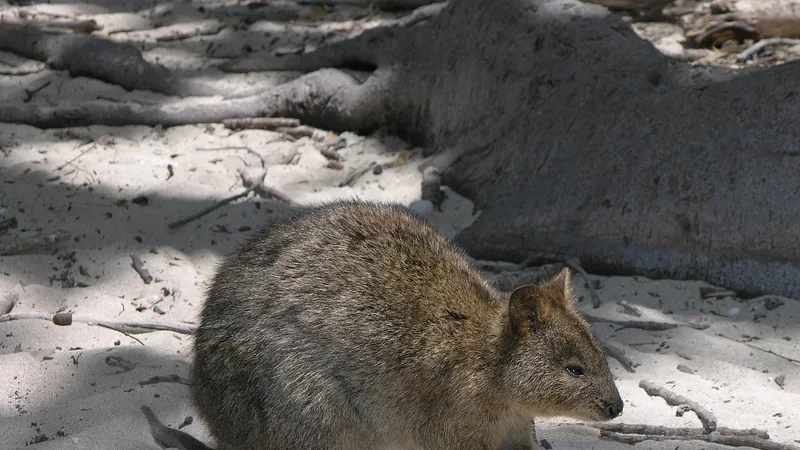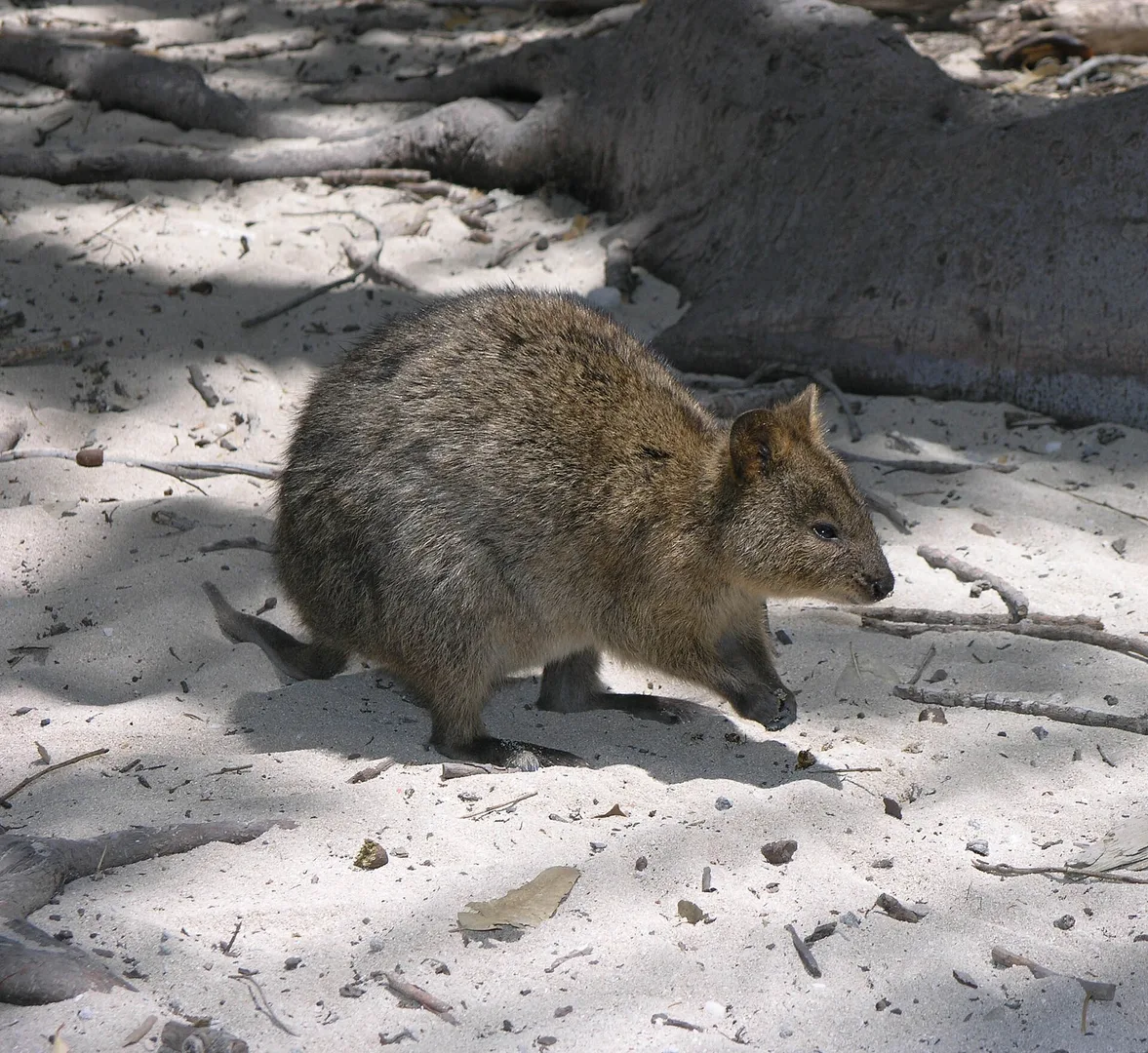
Quokka on Rottnest Island.
Field
notes
A Primate’s Cone Count
Among mammals, three types of cone cell (the eye’s colour-detecting receptors) were once thought to be unique to primates, humans included. In 2005, researchers found three cone types in the quokka retina too, two of them peaking at 502 and 538 nanometres. That’s the same number primates use for full-colour vision. Animal Diversity Web says colour vision likely helps quokkas spot predators.
Three Cone Types, Same as a Primate’s The quokka retina carries three spectrally distinct cone types, the same headcount primates use for full-colour vision. The study that found them suggests the trait spans the marsupials.
Bolt Down the Runways
Quokkas are among the smallest wallabies: males weigh 2.7 to 4.5 kg and females 1.6 to 3.5 kg, with a head and body 39 to 54 cm long, plus a 23 to 31 cm tail. A quokka has no weapon worth mentioning: no formidable bite, kick, or stench to put off a predator. Thick grass and shrubland are laced with the trodden paths a quokka uses to escape, and when a threat shows up, it bolts down one, hopping on its hind legs. Its natural predators are dingoes and birds of prey, but the red fox, which reached southwest Western Australia in the early 1930s, made short work of mainland quokkas in many areas. One modelling study found that quokkas would thrive alongside dingoes: the dingo suppresses the introduced fox through competition, direct killing or fear, dropping the total predation pressure on quokkas even with two predators present.
A Gut Like a Sheep’s
Quokkas eat grasses, sedges, succulents and wattle (Acacia) leaves, digesting rather like a sheep: most of the fifteen or so types of bacteria in their stomach resemble those in a sheep’s rumen, and a quokka brings its food back up to chew as cud. The leaves hold enough water that a quokka doesn’t need to drink much. They can survive extended stretches without food or water when supplies run low, and store fat in their tails for backup. A joey is born after a pregnancy of about a month and spends roughly six months in its mother’s pouch, then keeps nursing for about six months more. Its mother can already be carrying a second, dormant embryo in reserve, suspended for about five months: it starts developing if the first joey dies, and disintegrates if the joey survives. A quokka lives about 10 years.
Named After a Mistake
The quokka’s best-known home is named after a case of mistaken identity. In 1696, the Dutch explorer Willem de Vlamingh spotted quokkas on an island near Perth, mistook them for oversized rats, and named the place Rattennest, Dutch for “rat’s nest.” It later became Rottnest Island. Rottnest has no foxes or cats, so it holds the biggest quokka population, and its quokkas appear to shed their nocturnal habits and mix freely with visitors. The mainland tells a rougher story: by the early 1990s, the quokka’s mainland range had shrunk by more than half, and the global population today sits at roughly 7,500 to 15,000 mature quokkas. The IUCN lists Setonix brachyurus as Vulnerable.
Published Updated
Traits
Intel
& FAQ
Guess
first
How big is a Quokka, really? Slide, lock in, and see what the sources say. Every answer is a figure from this page, quoted from where it came from.
Sources
- 01Setonix brachyurus (quokka). Animal Diversity Web, University of Michigan.
- 02Quokka. San Diego Zoo Wildlife Alliance.
- 03Burbidge & Woinarski (2025). Setonix brachyurus. The IUCN Red List of Threatened Species 2025: e.T20165A258663635.
- 04Arrese et al. (2005). Cone topography and spectral sensitivity in two potentially trichromatic marsupials, the quokka (Setonix brachyurus) and quenda (Isoodon obesulus). Proceedings of the Royal Society B: Biological Sciences.
- 05Fauna Profile: Quokka Setonix brachyurus. Department of Biodiversity, Conservation and Attractions, Western Australia, 2017.
What the sources say: 59 claims checked word for word against these sources →