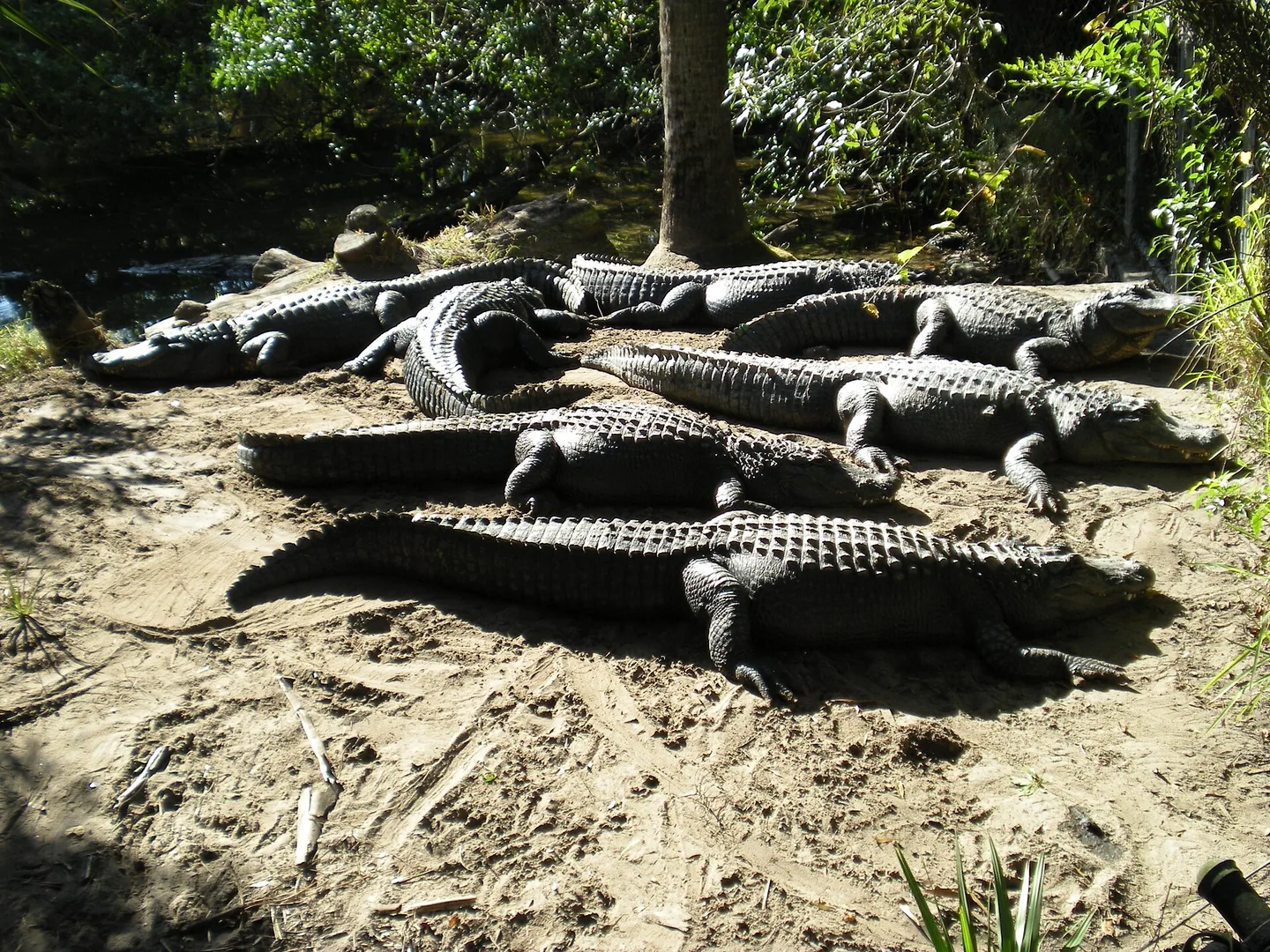
A group of American alligators basking on sand.
Field
notes
A Crushing Jaw
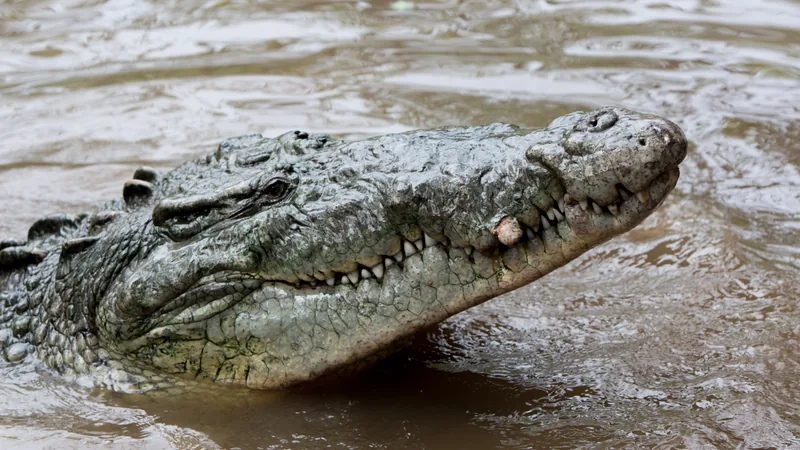
The American Alligator (Alligator mississippiensis) has 74 to 80 teeth in its mouth at a time. As they wear down they are replaced, and one alligator can go through 3,000 teeth in a lifetime. The large fourth tooth in its lower jaw fits into a socket in the upper jaw and is hidden when the mouth is closed. That does not happen in crocodiles, which makes the teeth an easy way to tell the two apart.
Adults typically eat fish, turtles, small mammals, birds, and reptiles, including small alligators, and a diet study in Texas found feral hogs among their prey. Their very strong jaws can crack a turtle shell. Small prey gets swallowed whole. Very large prey gets bitten, and then the alligator spins on the long axis of its body to tear off pieces small enough to swallow.
A 9,452-Newton Bite A 2012 study measured bite forces in adults of all 23 living crocodilian species and found these reptiles generate the highest bite forces and tooth pressures known for any living animals. The 15 American alligators tested bit with up to 9,452 newtons at a back tooth, about 2,125 pounds of force.
The Southeast’s Armored Heavyweight
American alligators live mostly in the freshwater rivers, swamps, marshes, and lakes of the southeastern United States, from the coast of North Carolina to central Texas. Adult females average 8.2 feet (2.6 meters) long and adult males average 11.2 feet (3.4 meters), while some adult males occasionally reach 13 to 15 feet. Exceptionally large males can near half a ton, about 1,000 pounds (454 kilograms). Wild alligators live about 50 years.
Alligators can tolerate a reasonable degree of salinity for short periods, even though, unlike crocodiles, they lack salt-secreting glands. The skin on an alligator’s back is armored with embedded bony plates called osteoderms, or scutes.
Hidden Sensors and Slow DNA
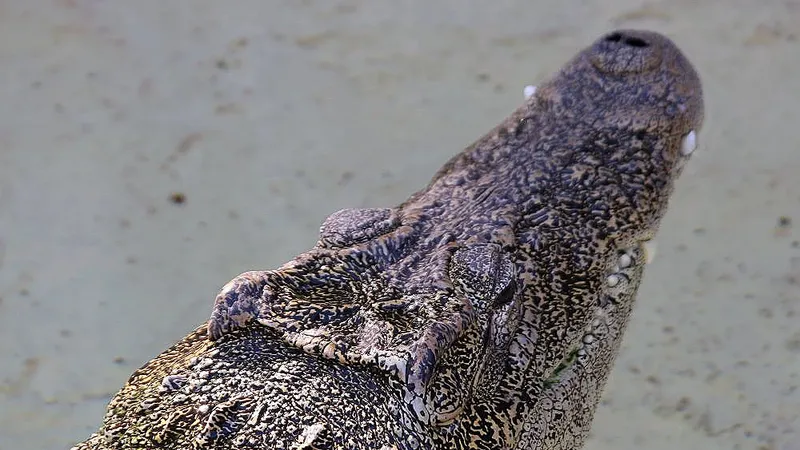
Sense organs in an alligator’s jaws and scales, called integumentary sense organs, help it sense movements in the water, tell it when prey is touching its teeth, and identify what it is holding in its jaws. Its long, rounded snout has upward-facing nostrils at the end, which allows it to breathe while the rest of its body is underwater.
The temperature of the nest sets a hatchling’s sex. Temperatures of 31°C (87.8°F) or below produce females.
Alligators do not hibernate, but they go through periods of dormancy when the weather becomes cold. They dig a depression called a “gator hole” along a waterway to use when the seasonal temperature falls, and burrow out dens for shelter when winter temperatures drop. Even outside their dens, they can tolerate limited periods of freezing conditions.
A 2014 study of three crocodilian genomes, the American alligator’s among them, found an exceptionally slow rate of genome evolution within crocodilians at every level it measured. Compared with birds and turtles, the results suggested that the shared ancestor of all these groups also had slow genome evolution, and that the faster change seen in birds came later, in the bird line.
Published Updated
Traits
Intel
& FAQ
Guess
first
How big is a American Alligator, really? Slide, lock in, and see what the sources say. Every answer is a figure from this page, quoted from where it came from.
Sources
- 01Erickson et al. (2012). Insights into the Ecology and Evolutionary Success of Crocodilians Revealed through Bite-Force and Tooth-Pressure Experimentation. PLoS ONE.
- 02Green et al. (2014). Three crocodilian genomes reveal ancestral patterns of evolution among archosaurs. Science.
- 03Elsey, Woodward & Balaguera-Reina (2019). Alligator mississippiensis. The IUCN Red List of Threatened Species 2019: e.T46583A3009637.
- 04American alligator. Smithsonian's National Zoo and Conservation Biology Institute.
- 05American Alligator: Species Profile. Everglades National Park, National Park Service.
- 06Alligator mississippiensis. Animal Diversity Web, University of Michigan.
What the sources say: 46 claims checked word for word against these sources →