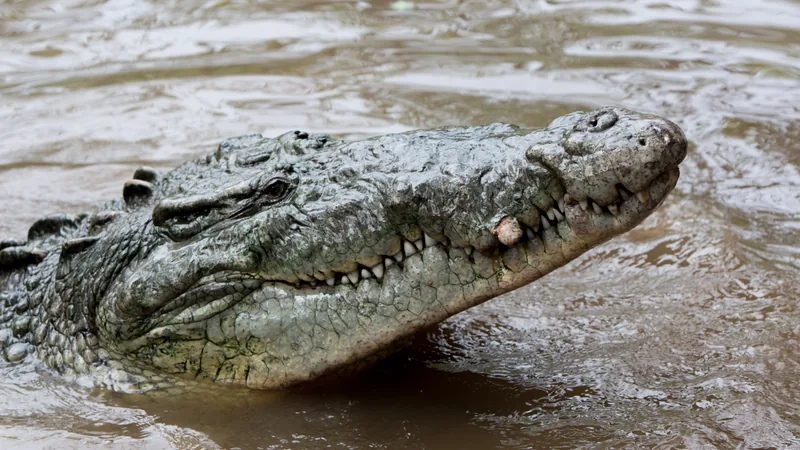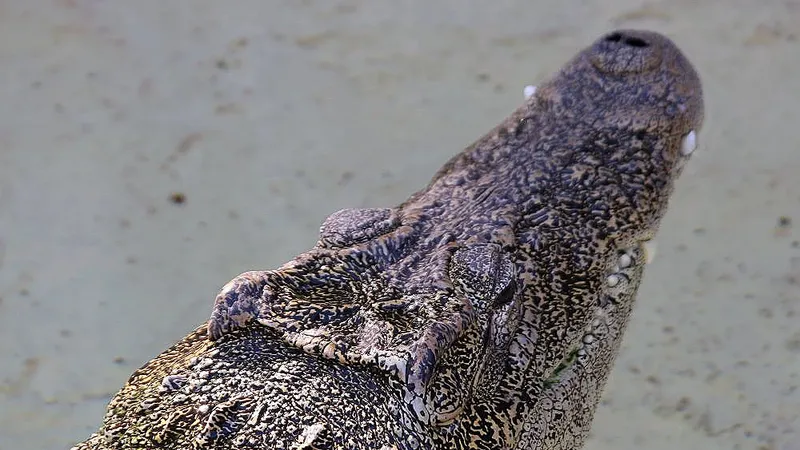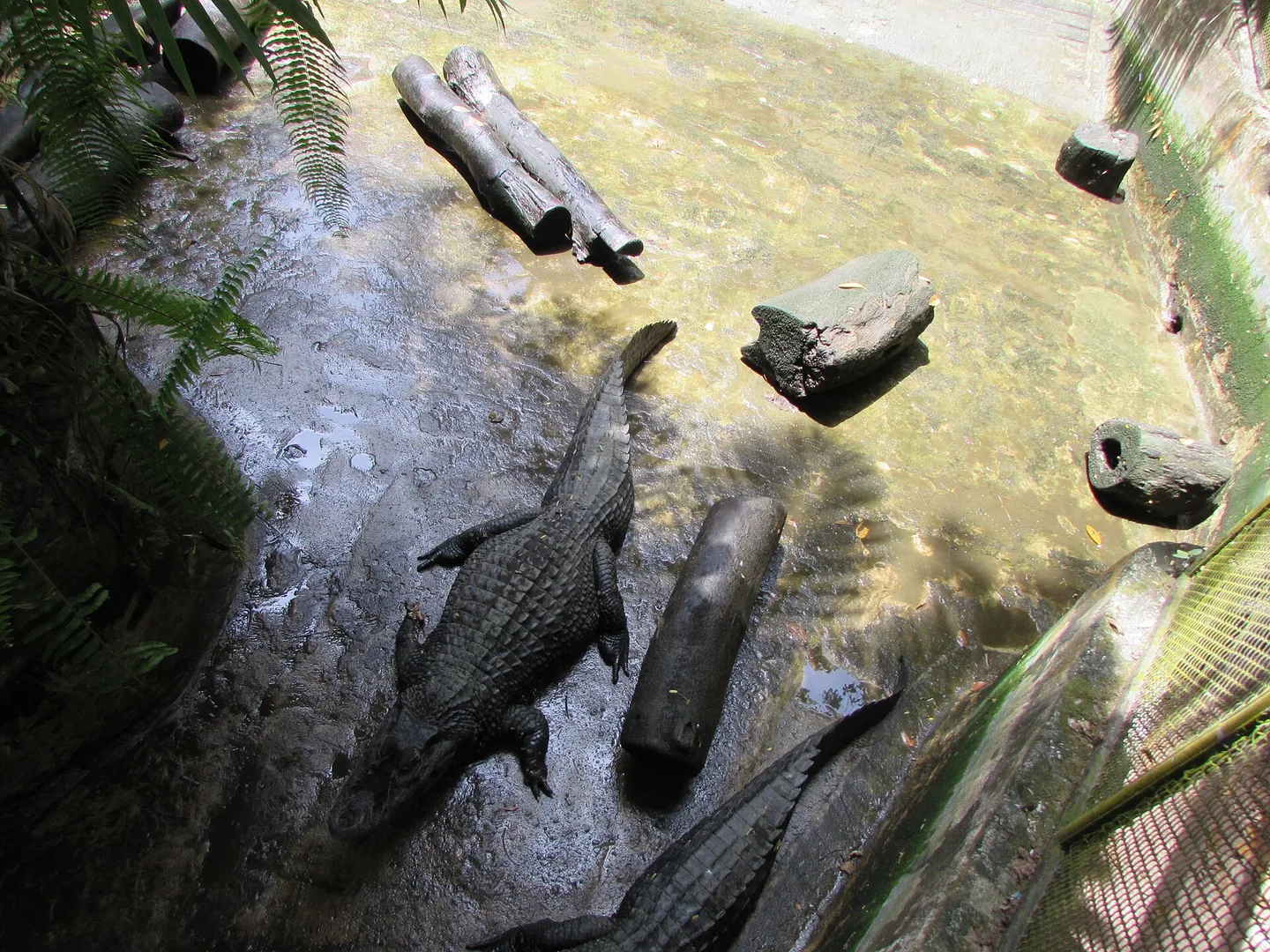
Hauled out on a sandbar of the Rio Guapore, Rondonia, Brazil.
Field
notes
Amazon’s Biggest Predator
The black caiman (Melanosuchus niger) is the largest member of the alligator family and the largest predator in the Amazon. Adult males grow past four to five meters (about 13 to 16 feet) long. Females reach sexual maturity at around two meters, and adult females average 2.8 meters. The AnAge ageing database gives an average adult weight of 82 kilograms (180 pounds), and its longest recorded life is 40 years, for a female in captivity.
It lives throughout the Amazon River basin, with a few populations outside it, in Bolivia, Brazil, Colombia, Ecuador, French Guiana, Guyana and Peru. Its homes include large rivers and streams, oxbow lakes and, in some areas, seasonally flooded savannas. The highest densities occur in the nutrient-rich varzea habitat along white-water rivers that rise in the Andes.
Bite Force and Diet
When researchers measured bite force in adults of all 23 living crocodilian species, they found these reptiles generate the highest bite forces and tooth pressures known for any living animals. The three black caimans tested weighed 31 to 103 kilograms, averaging 59, and their strongest bites at the back teeth ranged from 1,779 to 4,310 newtons, averaging 2,696 newtons.
2,696 newtons was the average strongest bite of three tested black caimans that averaged 59 kilograms, measured at the back teeth.
Young caimans tend to eat insects, crustaceans and other invertebrates. Fish such as piranhas and catfish make up a large part of an adult’s diet, along with molluscs and some mammals such as capybaras. A 2021 study of adults’ stomach contents in Guyana found that the largest individuals target mammals instead of fish, and that males eat other black caimans, a behavior never recorded for the species before. Much hunting is done in the water, but a black caiman may leave it to hunt on land, usually at night. Attacks on people have been recorded, including a fatal attack on an 11-year-old child described in a 2011 medical report.
Nests, Pods and Calling Young
In the dry season, a female builds a mound nest. Clutches average about 39 eggs, and the eggs average about 144 grams. Incubation lasts two to three months, and may vary with nest temperature. Hatchlings tend to gather in groups called pods, often protected by the presence of an adult female.
Researchers working in the wild recorded two kinds of calls from young caimans: one made while the group was left undisturbed, and one made while the researchers shook them to imitate a predator attack. Played back, the two call types drew different responses from both the mother and the other young.
From Endangered to Least Concern
Commercial hunting of black caimans began in earnest in the 1940s, when other South American crocodiles were becoming rare. It was the preferred Amazonian species because of its larger size and better-quality skin. Hunting peaked in the 1950s, and in some areas significant trade carried on into the 1970s. By 2010, the IUCN’s Crocodile Specialist Group reported that, overall, populations had recovered dramatically from their low levels in the 1970s, when the species was considered endangered. The IUCN Red List now rates it Least Concern.
Published Updated
Traits
Intel
& FAQ
Sources
- 01Thorbjarnarson, J.B. (2010). Black Caiman Melanosuchus niger. Crocodiles: Status Survey and Conservation Action Plan, 3rd ed. (IUCN/SSC Crocodile Specialist Group).
- 02Melanosuchus niger (black caiman). Animal Diversity Web, University of Michigan.
- 03Melanosuchus niger. AnAge: The Animal Ageing and Longevity Database, Human Ageing Genomic Resources.
- 04Botero-Arias et al. (2025). Melanosuchus niger. The IUCN Red List of Threatened Species 2025: e.T13053A512056.
- 05Erickson et al. (2012). Insights into the Ecology and Evolutionary Success of Crocodilians Revealed through Bite-Force and Tooth-Pressure Experimentation. PLoS ONE.
- 06Rosenblatt et al. (2021). What do adult black caiman (Melanosuchus niger) actually eat? Biotropica.
- 07Vergne et al. (2011). Acoustic signals of baby black caimans. Zoology.
- 08Haddad & Fonseca (2011). A Fatal Attack on a Child by a Black Caiman (Melanosuchus niger). Wilderness & Environmental Medicine.
What the sources say: 6 claims checked word for word against these sources →