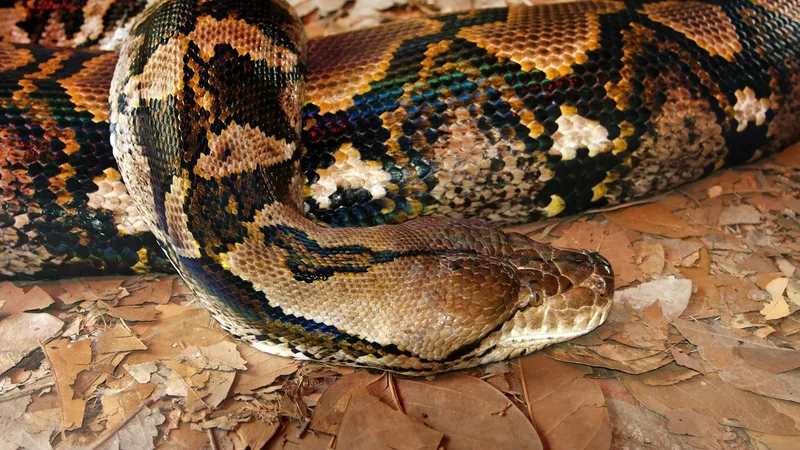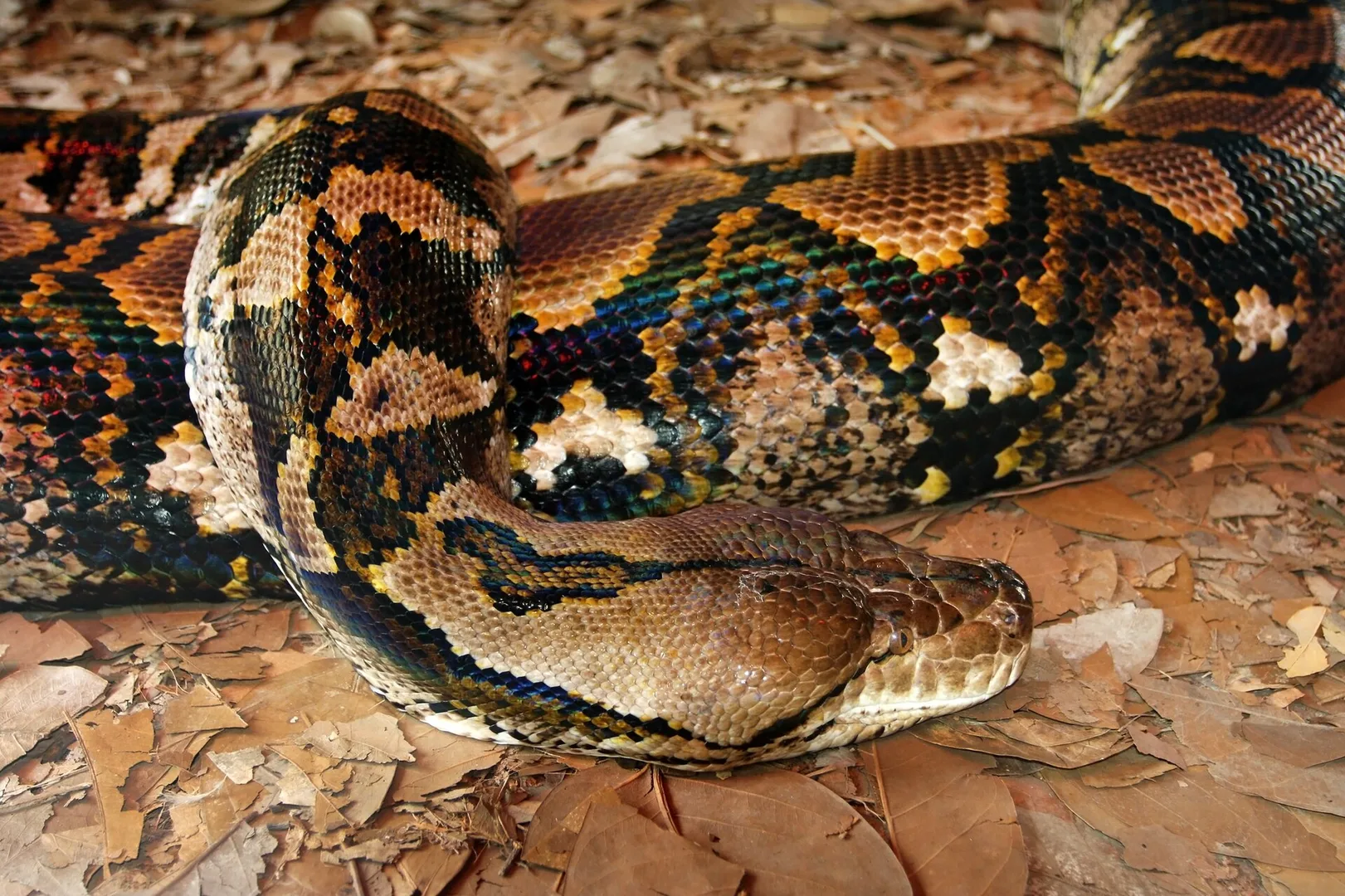
A reticulated python in Kaeng Krachan National Park, Thailand.
Field
notes
The Longest Python
The reticulated python (Malayopython reticulatus) is one of the biggest snakes in the world. San Diego Zoo Wildlife Alliance lists it as the longest python, at up to 33 feet (10 meters), and the heaviest, at up to 250 pounds (113 kilograms). According to Animal Diversity Web, females generally grow much larger than males. Black X’s run along its back in a diamond-like pattern. It is native to Southeast Asia, from western Bangladesh to southeastern Vietnam and on the islands west of New Guinea, where it lives in rainforests, wetlands and grassland forests near water. Animal Diversity Web gives the longest known lifespan as 32 years in captivity and 23 years in the wild. The IUCN assessed it as Least Concern in 2011.
Ambush, Then a Squeeze
A reticulated python uses water as cover, hiding in it before ambushing prey. Heat-sensing pit organs let it find prey without necessarily seeing it. Documented prey ranges from small bats and tree shrews up to deer and even sun bears. It uses its large size to constrict its prey, then swallows it whole. Predation on adults is very scarce and limited to crocodiles and other large predators, and against them its only defense besides size is constriction, which Animal Diversity Web says can squeeze the life out of an animal in around three to four minutes.
Too Big for a King Cobra
The Burmese python, a relative in the genus Python, has evolved resistance to cobra neurotoxins: it replaced a negatively charged amino acid in its receptor with a positively charged one, which repels the toxins. A 2024 study found Malayopython reticulatus much less resistant, with its receptors still strongly bound by those toxins.
Outgrowing the threat, a reticulated python is arboreal as a hatchling and juvenile, then rapidly grows into a terrestrial adult too big for a king cobra to consider as prey.
Skins, Farms and People
A 2017 study described reticulated pythons as primarily harvested from the wild for their skins, citing approximately 350,000 skins legally exported each year for the high-end fashion market alone. The species is listed on CITES Appendix II, which allows commercial trade regulated through permits. On python farms in Thailand, young reticulated pythons gained an average of 5.2 grams a day, with individuals ranging from 0.24 to 19.7 grams a day depending on food intake. People have been its prey too: among 120 Agta in the Philippines, observed while they were still hunter-gatherers, 26 percent of adult men had survived predation attempts by reticulated pythons, and six fatal attacks occurred between 1934 and 1973.
Published Updated
Traits
Intel
& FAQ
Sources
- 01Python reticulatus (Reticulated Python). Animal Diversity Web, University of Michigan.
- 02Python. San Diego Zoo Wildlife Alliance.
- 03Stuart et al. (2018). Python reticulatus. The IUCN Red List of Threatened Species 2018: e.T183151A1730027.
- 04Murray-Dickson et al. (2017). Phylogeography of the reticulated python (Malayopython reticulatus ssp.): Conservation implications for the worlds' most traded snake species. PLOS ONE.
- 05Natusch et al. (2024). Python farming as a flexible and efficient form of agricultural food security. Scientific Reports.
- 06Chandrasekara et al. (2024). High-Voltage Toxin'Roll: Electrostatic Charge Repulsion as a Dynamic Venom Resistance Trait in Pythonid Snakes. Toxins.
- 07Headland & Greene (2011). Hunter-gatherers and other primates as prey, predators, and competitors of snakes. Proceedings of the National Academy of Sciences.