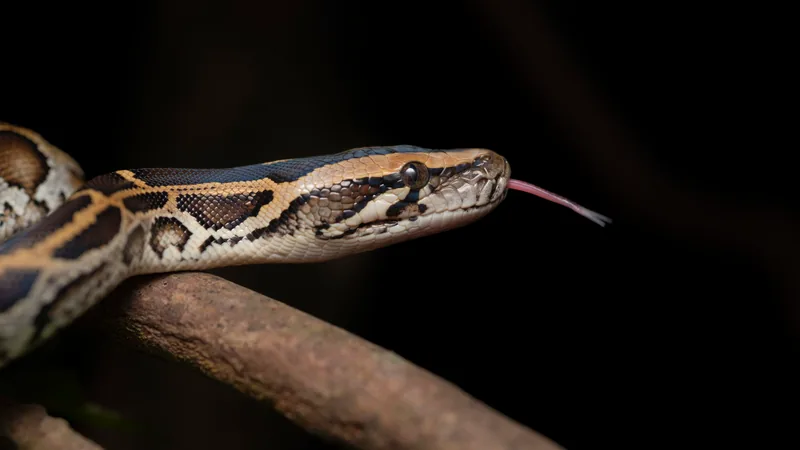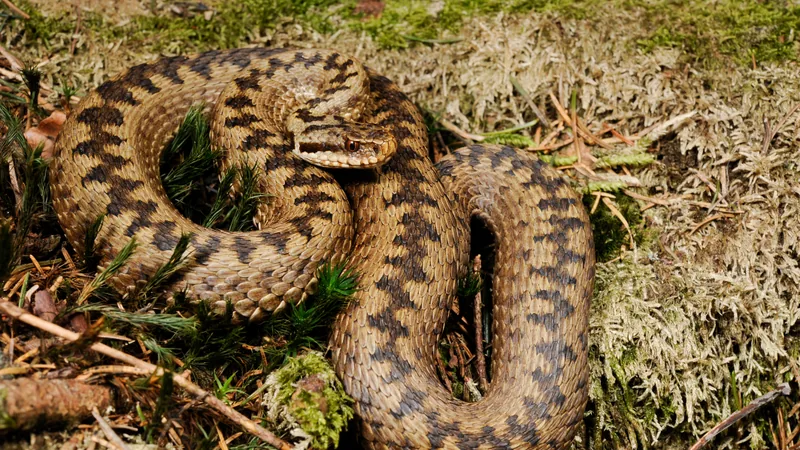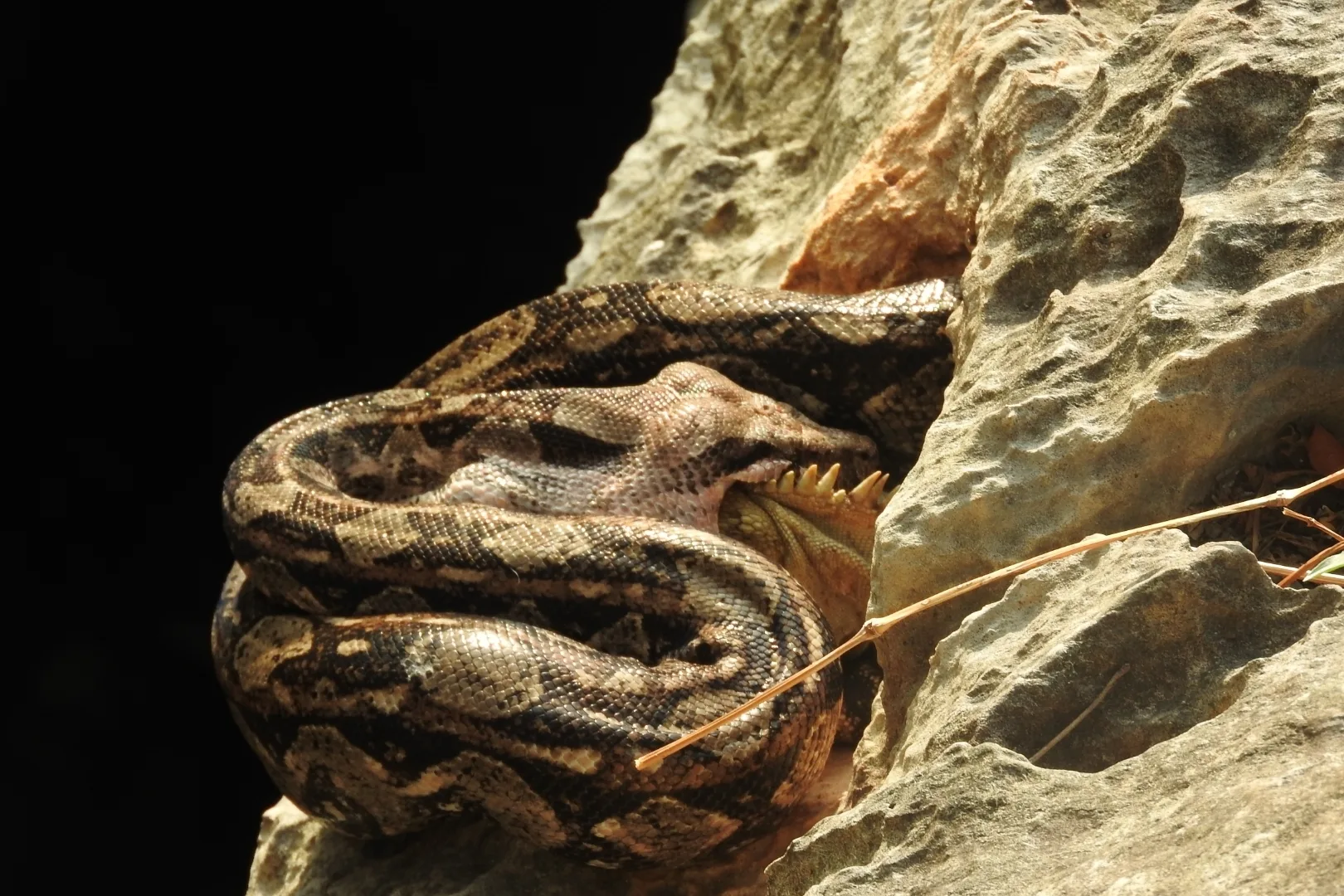
Boa Constrictor (Boa constrictor), Ticul, Yuc., México
Field
notes
Squeezing off the blood supply
Boa constrictors are named for how they kill: constriction. They are not venomous. Instead, a boa strikes, grabs and squeezes until the prey is subdued, then swallows it whole. Small hooked teeth give it a strong grip and keep the prey from wiggling free while the snake wraps its body around it.
Many people believe boas crush bones or squeeze the lungs shut. The Smithsonian’s National Zoo says recent research found something different. The snake squeezes just enough to cause “circulatory arrest”, by cutting off the heart’s ability to pump blood in and out. With no blood reaching the brain, the animal dies.
Fatherless boas Researchers found evidence of facultative parthenogenesis in a Boa constrictor. That is a long name for one mother producing viable female young with no father involved, and no experiment caused it. No males were produced.
An ambush hunter without heat pits
Larger members of the boa family have heat-sensitive pits on their heads, but boa constrictors do not. They rely on their tongue and their excellent vision instead. In most cases a boa is an ambush predator, which means it sits and waits for a meal to pass by. If food is scarce, it becomes more active and goes looking.
Boas hunt at night. They eat large lizards, small or moderate sized birds, opossums, bats, mongooses, rats and squirrels. Animal Diversity Web adds that a boa hanging from a branch can strike rapidly at an animal that passes by the branch.
Size and lifespan
A newborn boa is about 20 inches (50 cm) long. Adults reach up to 13 feet (3.9 m) and can weigh more than 100 pounds (45 kg) when full grown. Animal Diversity Web says boas are generally 2 to 3 meters long, and that the maximum length reported was slightly over 4 meters.
Boa constrictors live 20 to 30 years in the wild. In captivity, AnAge lists a maximum of 40.4 years.
One species or several?
The Smithsonian’s National Zoo says boa constrictors are found from northern Mexico to Argentina. Of all the boas, they can live in the greatest variety of habitats, from sea level to moderate elevation. That includes deserts, wet tropical forests, open savannas and cultivated fields. They are both terrestrial and arboreal, which means they live on the ground and in trees.
There may be more than one species here. A 2016 genetic study found three widely distributed clades, or branches of the family tree, roughly matching the three main land masses of the Western Hemisphere. The authors note that the snakes’ different looks and many habitats suggest the genus may represent multiple species.
Published
Traits
Intel
& FAQ
Guess
first
How big is a Boa Constrictor, really? Slide, lock in, and see what the sources say. Every answer is a figure from this page, quoted from where it came from.
Sources
- 01Boa constrictor. Smithsonian's National Zoo and Conservation Biology Institute.
- 02Boa constrictor. Animal Diversity Web, University of Michigan.
- 03AnAge entry for Boa constrictor. AnAge: The Animal Ageing and Longevity Database, Build 15, Human Ageing Genomic Resources.
- 04Card et al. (2016). Phylogeographic and population genetic analyses reveal multiple species of Boa and independent origins of insular dwarfism. Molecular Phylogenetics and Evolution.
- 05Booth et al. (2011). Evidence for viable, non-clonal but fatherless Boa constrictors. Biology Letters.
- 06Arzamendia et al. (2014). Boa constrictor. The IUCN Red List of Threatened Species 2021: e.T197462A2486405.
What the sources say: 49 claims checked word for word against these sources →