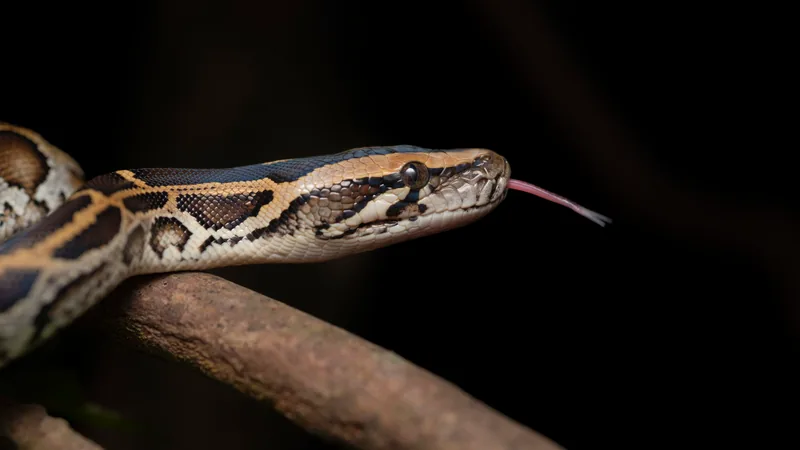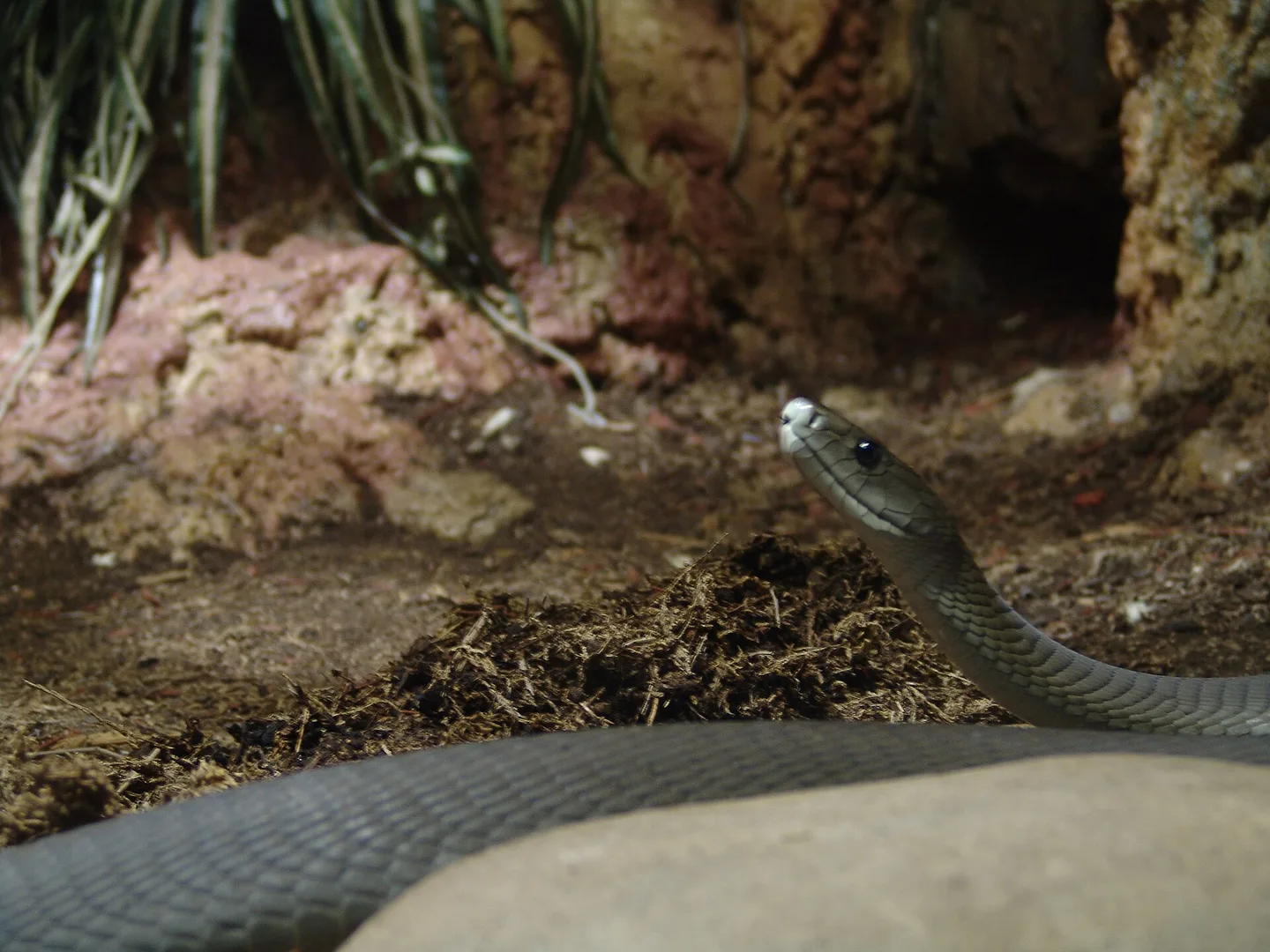
A wild black mamba in a tree at Tshukudu Game Reserve, South Africa
Field
notes
Black on the Inside
The black mamba (Dendroaspis polylepis) is not black. Its scales run olive, brown, grey or sometimes khaki, and the name comes instead from the inside of its mouth, which is dark blue to inky black and gets flashed as a threat display when the snake is cornered.
It backs that display up with size and speed. Adults typically run 2.2 to 2.7 metres (about 7 to 9 feet) long, and the biggest reach up to 14 feet (about 4.3 metres). Despite the length, it is light, weighing up to about 1.6 kilograms (3.5 pounds). It can reach speeds of up to 20 km/h (12.5 mph), carrying as much as a third of its body off the ground as it goes, though a black mamba is shy by nature and would usually rather retreat than fight. In captivity, black mambas have lived as long as 26.2 years.
A Venom With Two Ways to Kill
Black mamba venom is unusual even among its own relatives. While green mambas carry venom dominated by three-finger toxins, the black mamba’s is dominated by dendrotoxins, a family of proteins built on the same scaffold as some enzyme blockers, but with little or none of that blocking power. Instead, dendrotoxins jam potassium channels in nerve cells. One of them, toxin K, blocks a nerve-cell potassium channel at picomolar concentrations, an almost vanishingly small amount.
The venom’s other major weapon is a set of alpha-neurotoxins, three-finger toxins that block the acetylcholine receptors nerves use to signal muscles. The alpha-neurotoxins are the deadlier of the two, with dendrotoxins second, and together they make a two-pronged attack for bringing down prey. In people, a bite brings on severe nerve symptoms fast, and it can be fatal.
A Painkiller Hidden Inside a Killer’s Venom The same venom also carries peptides called mambalgins, which block ASICs, acid-sensing channels widely considered key players in the pain pathway. In mice they can dull pain as strongly as morphine, with much less tolerance buildup and no breathing trouble.
Built to Hunt, and on Its Own From Birth
A black mamba hunts mostly rodents, hyraxes, squirrels and the occasional bird, striking and then waiting for the venom to work before swallowing its prey. It ranges across savanna, rocky hills and riverine forest from Eritrea south to South Africa and west to Namibia, and where it is left undisturbed, it keeps a permanent lair to return to.
Females lay their eggs in a burrow or similar spot and abandon them, and the young hatch two to three months later to fend for themselves from the start. The IUCN rates the species Least Concern, though encroachment on its territory is putting pressure on it and bringing it into more potentially dangerous contact with people.
Published Updated
Traits
Intel
& FAQ
Guess
first
How big is a Black Mamba, really? Slide, lock in, and see what the sources say. Every answer is a figure from this page, quoted from where it came from.
Sources
- 01Dendroaspis polylepis (black mamba). Animal Diversity Web, University of Michigan.
- 02Black mamba. National Geographic.
- 03AnAge entry for Dendroaspis polylepis. AnAge: The Animal Ageing and Longevity Database.
- 04Branch et al. (2021). Dendroaspis polylepis. The IUCN Red List of Threatened Species 2021: e.T177584A15627370.
- 05Laustsen et al. (2015). Unveiling the nature of black mamba (Dendroaspis polylepis) venom through venomics and antivenom immunoprofiling: Identification of key toxin targets for antivenom development. Journal of Proteomics.
- 06Ainsworth et al. (2018). The medical threat of mamba envenoming in sub-Saharan Africa revealed by genus-wide analysis of venom composition, toxicity and antivenomics profiling of available antivenoms. Journal of Proteomics.
- 07Harvey & Robertson (2004). Dendrotoxins: Structure-Activity Relationships and Effects on Potassium Ion Channels. Current Medicinal Chemistry.
- 08Tsetlin (1999). Snake venom alpha-neurotoxins and other 'three-finger' proteins. European Journal of Biochemistry.
- 09Diochot et al. (2012). Black mamba venom peptides target acid-sensing ion channels to abolish pain. Nature.
What the sources say: 49 claims checked word for word against these sources →