Boomslang
Field
notes
A Slender Hunter of the Canopy
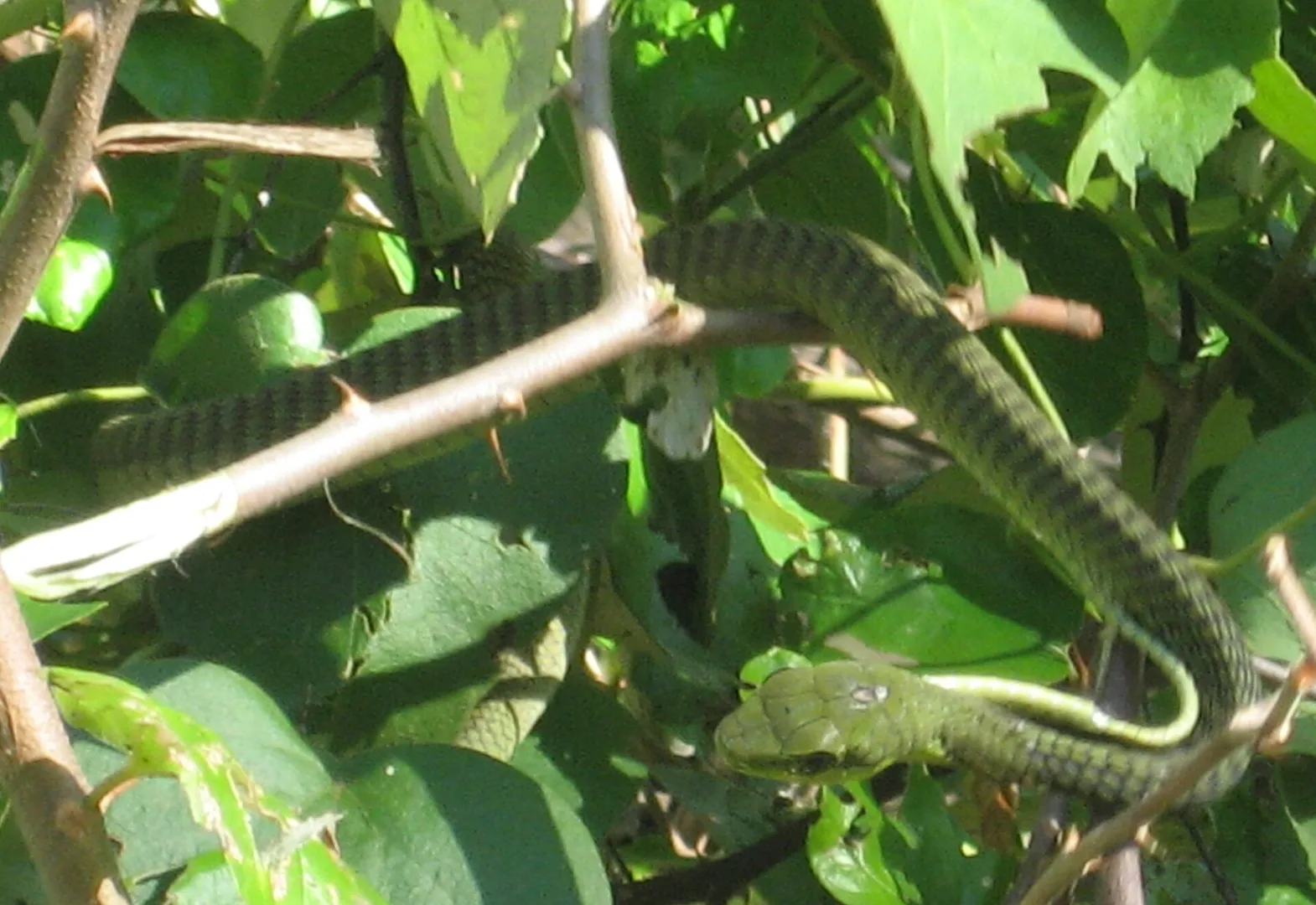
The boomslang (Dispholidus typus) hunts the canopy across sub-Saharan Africa with venom that turns its victim’s blood against itself. It’s a slender, big-eyed snake that spends almost all its time off the ground. It’s most common in Eswatini, Botswana, Namibia, Mozambique and Zimbabwe, and has been recorded as far north as Nigeria and southern Chad. It favors karoo scrub, arid savanna and east African lowland forest, keeping mostly to low trees and shrubs.
An adult usually runs 1.2 to 1.5 meters long, occasionally reaching 2 meters. The record lifespan is 8.7 years, set in captivity.
Eyes Built to Chase
Most snakes have poor eyesight. The boomslang is the exception, with unusually large eyes, round pupils and sharp vision. It’s also an agile, fast-moving snake that chases prey through the branches rather than waiting in ambush. It hunts birds in the canopy, whose fast circulation leaves them quick to subdue, along with chameleons and other tree lizards, frogs and the occasional egg. Chameleons are slow and harmless, and it takes them by day, when their own circulation is running fastest.
A 180-Degree Gape The boomslang is not a front-fanged snake: its fangs sit toward the back of its upper jaw. It can open its mouth a full 180 degrees and work those long fangs into its target, a motion more like chewing than a strike.
Blood Turned Against Itself
Roughly three-quarters of the toxins in boomslang venom are metalloproteinases, enzymes that switch on the blood’s clotting system. The clotting factors get used up making many small, useless clots, and once they run out, the blood can’t clot. Doctors call the result disseminated intravascular coagulation, or DIC: uncontrolled bleeding once the body’s own clotting supply is exhausted. Symptoms can take several hours to appear. There’s time to feel fine before anything goes wrong.
The Snake That Killed a Snake Expert
Karl Patterson Schmidt, an eminent American herpetologist, was bitten on the thumb in 1957 by a juvenile boomslang sent to him for identification, and only one fang went in, to its full length of about 3 mm. Like many herpetologists of his day, he wrongly believed a rear-fanged snake could not deliver a fatal dose to a human, so he kept meticulous notes on his own symptoms and refused medical care when it was offered. He died of internal bleeding from his eyes, lungs, kidneys, heart and brain about 24 hours after the bite. The boomslang is now considered one of the most dangerous snakes in Africa, probably causing more serious human bites than any other rear-fanged species.
Even so, it would rather flee than fight. Bites generally happen only when someone tries to handle, catch or kill one. Dogs may be bitten more often than people; because they go after snakes mouth-first, snakebites on dogs usually land on the face or neck. There’s only one treatment: a monovalent antivenom made specifically for boomslang venom. It’s often hard to source, and at around $6,000 a vial, it’s out of reach for many snakebite patients, which is why researchers are now testing whether cheaper drugs that block the same clotting enzymes could work as a backup.
Published Updated
Traits
Intel
& FAQ
Guess
first
How big is a Boomslang, really? Slide, lock in, and see what the sources say. Every answer is a figure from this page, quoted from where it came from.
Sources
- 01Luiselli et al. (2021). Dispholidus typus. The IUCN Red List of Threatened Species 2021: e.T190603A15357215.
- 02Dispholidus typus (boomslang). Animal Diversity Web, University of Michigan.
- 03Dispholidus typus (Boomslang). AnAge: The Animal Ageing and Longevity Database, Human Ageing Genomic Resources.
- 04Pla et al. (2017). What killed Karl Patterson Schmidt? Combined venom gland transcriptomic, venomic and antivenomic analysis of the South African green tree snake (the boomslang), Dispholidus typus. Biochimica et Biophysica Acta (BBA) - General Subjects.
- 05Debono et al. (2017). Coagulating Colubrids: Evolutionary, Pathophysiological and Biodiscovery Implications of Venom Variations between Boomslang (Dispholidus typus) and Twig Snake (Thelotornis mossambicanus). Toxins.
- 06Menzies et al. (2022). In vitro and in vivo preclinical venom inhibition assays identify metalloproteinase inhibiting drugs as potential future treatments for snakebite envenoming by Dispholidus typus. Toxicon: X.
- 07Leisewitz et al. (2004). The diagnosis and management of snakebite in dogs - a southern African perspective. Journal of the South African Veterinary Association.
What the sources say: 60 claims checked word for word against these sources →