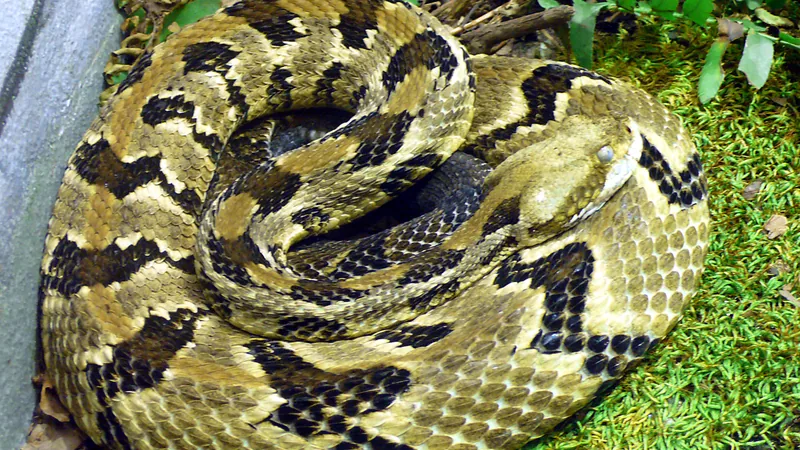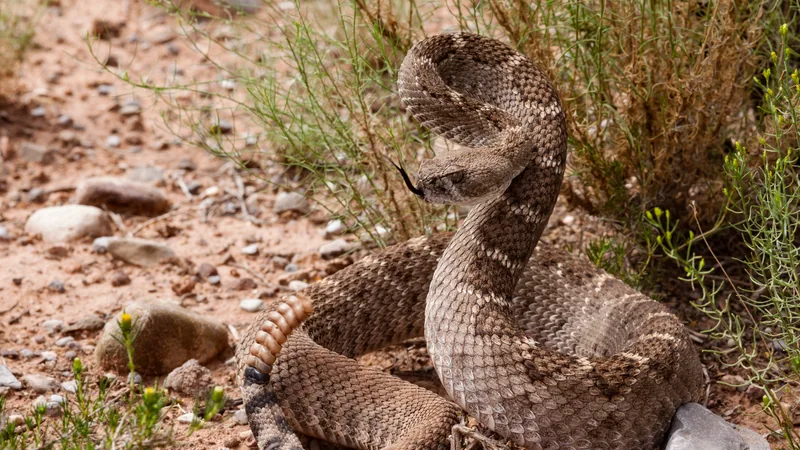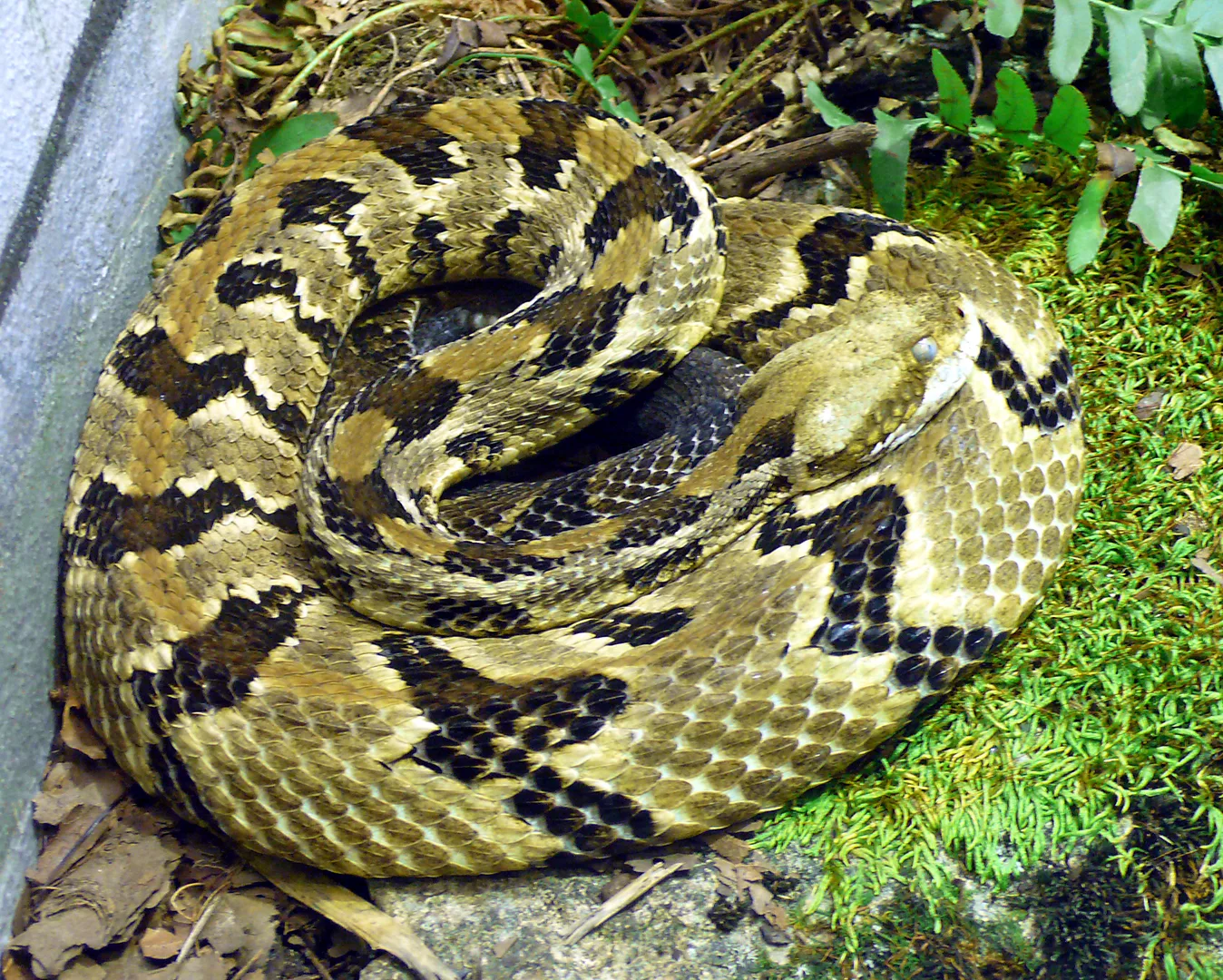
Timber rattlesnake coiled on moss.
Field
notes
A snake that senses heat
The timber rattlesnake is a large, heavy-bodied pit viper that hunts by waiting. It sits in the brush, waits for prey to pass, then strikes, bites and injects venom. Its meals are mainly small to medium rodents like mice, shrews, chipmunks and squirrels, with birds, lizards and amphibians as extras. It swallows its prey whole once the venom has killed it.
Heat sensor Timber rattlers are pit vipers, with heat-sensitive pit organs between the nostrils and the eyes that can tell very slight changes in temperature apart.
How big, how heavy, how old
Adults typically reach 2.5 to 5 feet (0.76 to 1.5 meters), and there are reports of snakes up to 7 feet (2 meters). In New York, where the record is 60 inches, it is the largest venomous snake. AnAge lists an average adult weight of 1,000 grams, about a kilogram. Juvenile deaths run very high, but New York’s DEC says an adult’s average lifespan may be 15 to 20 years, and some wild snakes have been recorded past 50. AnAge’s maximum longevity figure is 30.2 years, for a snake in captivity.
A warning first, then venom
The rattle is made of loosely attached keratin segments, the same substance as human hair and fingernails. A young snake has just one button, and a new segment is added each time the snake sheds its skin. Segments also break off, and a full rattle is rarely seen. When threatened, the snake props itself up and shakes the rattle, and the segments press together with a rapid, crisp sound. That sound is a warning before a strike. The National Zoo calls it more docile than other members of its family, and likelier to stay motionless when found.
The venom itself varies. Some rattlesnake venoms have shifted exceptionally fast. Timber rattlesnake venom generally causes bleeding (it is hemorrhagic), but populations along the southern edge of the range carry highly lethal, neurotoxic venom instead. A 2013 study of one snake from northern Florida found its venom glands made almost none of the two major classes of bleeding toxins.
From Kansas to Florida, and gone from Canada
Timber rattlesnakes range across the eastern half of the United States, from eastern Kansas and Texas to Georgia, the Carolinas and New England, and from New York to northern Florida. They hibernate in crevices on or just under the ground, and in some places they gather in dens under rocks. The IUCN rated the species Least Concern in 2007, but the National Zoo reports that New Jersey saw a 50 to 66 percent population decline, and that the species is regionally extinct in Canada.
Published
Traits
Intel
& FAQ
Guess
first
How big is a Timber Rattlesnake, really? Slide, lock in, and see what the sources say. Every answer is a figure from this page, quoted from where it came from.
Sources
- 01Timber rattlesnake. Smithsonian's National Zoo.
- 02Crotalus horridus. Animal Diversity Web.
- 03AnAge entry for Crotalus horridus. Human Ageing Genomic Resources, AnAge.
- 04Timber Rattlesnake. New York State Department of Environmental Conservation.
- 05Rokyta, Wray & Margres (2013). The genesis of an exceptionally lethal venom in the timber rattlesnake (Crotalus horridus) revealed through comparative venom-gland transcriptomics. BMC Genomics.
- 06Hammerson (2007). Crotalus horridus. The IUCN Red List of Threatened Species 2007: e.T64318A12765920.
What the sources say: 47 claims checked word for word against these sources →