Common European adder, Vipera berus
Field
notes
The zigzag test
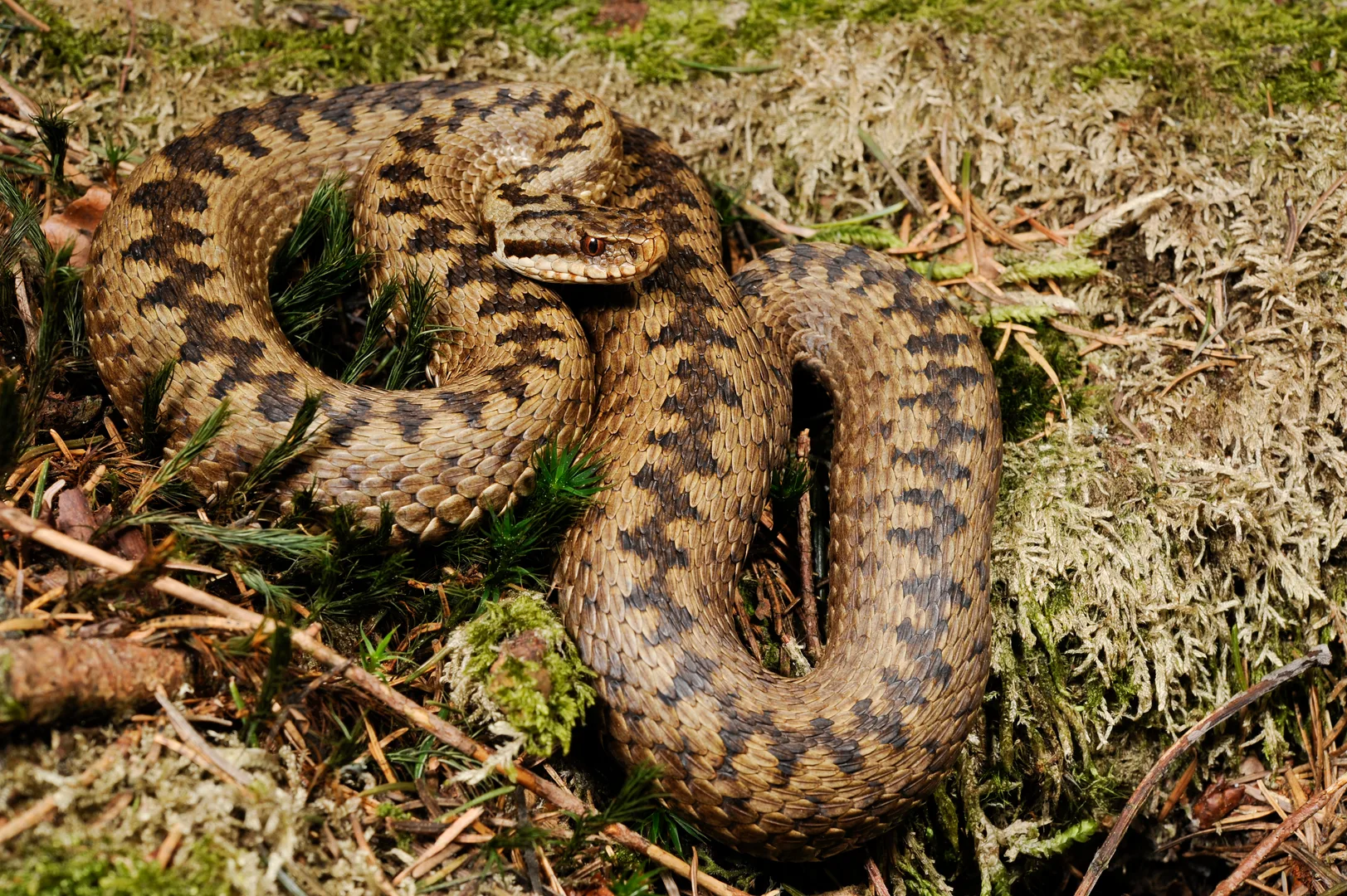
The common European adder, Vipera berus, is a rather stocky viper. A dark, continuous zig-zag stripe runs along its back, with a row of dark spots down each side. The background color varies from grey-white in males to shades of brown or copper in females.
Zigzag test In a field test, birds made 813 attacks on 12,636 Plasticine snake models. Models with the adder’s zigzag band were attacked significantly less often than plain ones.
Size and lifespan
A newborn adder is about 16 to 18 centimeters long. Adults typically reach about 50 to 60 centimeters, and some can grow as long as 80. Males generally weigh 50 to 70 grams, and females 80 to 100 grams. Adders typically live 5 to 10 years. The AnAge database lists a captive record of 19 years.
From Britain to the Pacific
Adders live across Eurasia, from the United Kingdom to the Pacific Ocean. In Scandinavia, the adder is the only snake found north of the Arctic Circle. In Britain, adders like open habitats such as heathland, moorland, open woodland and sea cliffs. They are not found in Ireland.
Adders hunt voles, shrews, mice, small lizards, birds and frogs. They have hinged fangs, which fold against the roof of the mouth and inject venom. In Britain, adders hibernate from around October to February, depending on local conditions. When two adders fight, both raise their bodies into the air, intertwine and try to wrestle each other to the ground. This is known as the “dance of the adders”.
Bites and the future
The adder is the only venomous snake in the United Kingdom, but its bites are very rarely fatal. Amphibian and Reptile Conservation counts only around ten recorded deaths from adder bite in the last 100 years, and says most bites happen when the snake has been disturbed or deliberately antagonised. A bite is potentially serious, though. In Sweden in 1995, 231 people were treated in hospital for adder bites, and 13 percent of them had severe envenomation.
The IUCN Red List rates the species Least Concern. Even so, data from 260 sites in Make the Adder Count, a UK survey begun in 2005, confirmed a significant decline, on average, across sites with small populations. Adders are protected by law in Great Britain, where it is illegal to intentionally kill or injure one.
Published
Traits
Intel
& FAQ
Guess
first
How big is a Common European Adder, really? Slide, lock in, and see what the sources say. Every answer is a figure from this page, quoted from where it came from.
Sources
- 01Vipera berus. Animal Diversity Web, University of Michigan.
- 02Adder (Vipera berus). Amphibian and Reptile Conservation.
- 03AnAge entry for Vipera berus. AnAge: The Animal Ageing and Longevity Database, Build 15, Human Ageing Genomic Resources.
- 04Owens et al. (2025). The genome sequence of the common adder, Vipera berus (Linnaeus, 1758). Wellcome Open Research.
- 05Wüster et al. (2004). Do aposematism and Batesian mimicry require bright colours? A test, using European viper markings. Proceedings of the Royal Society of London. Series B: Biological Sciences.
- 06Karlson-Stiber, Salmonson & Persson (2006). A nationwide study of Vipera berus bites during one year: epidemiology and morbidity of 231 cases. Clinical Toxicology.
- 07Gardner et al. (2019). Make the Adder Count: population trends from a citizen science survey of UK adders. Herpetological Journal.
- 08Bowles et al. (2024). Vipera berus. The IUCN Red List of Threatened Species 2024: e.T47756146A215261275.
What the sources say: 50 claims checked word for word against these sources →