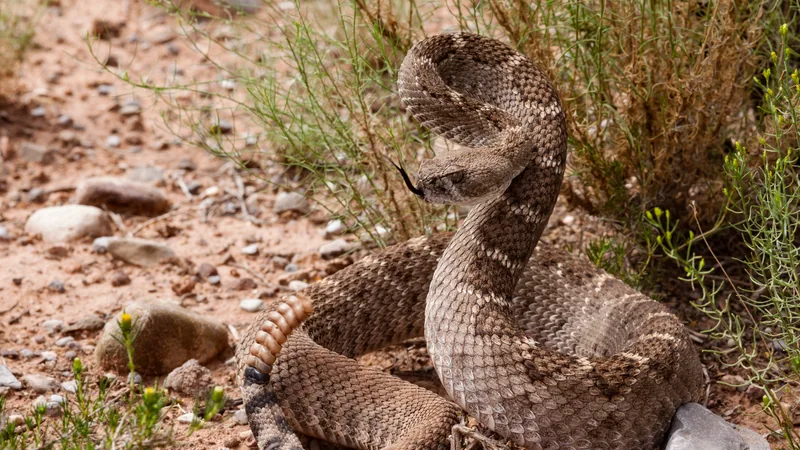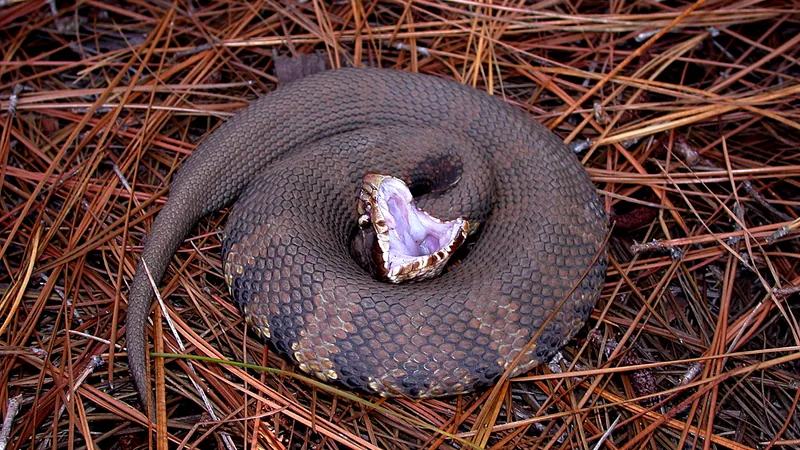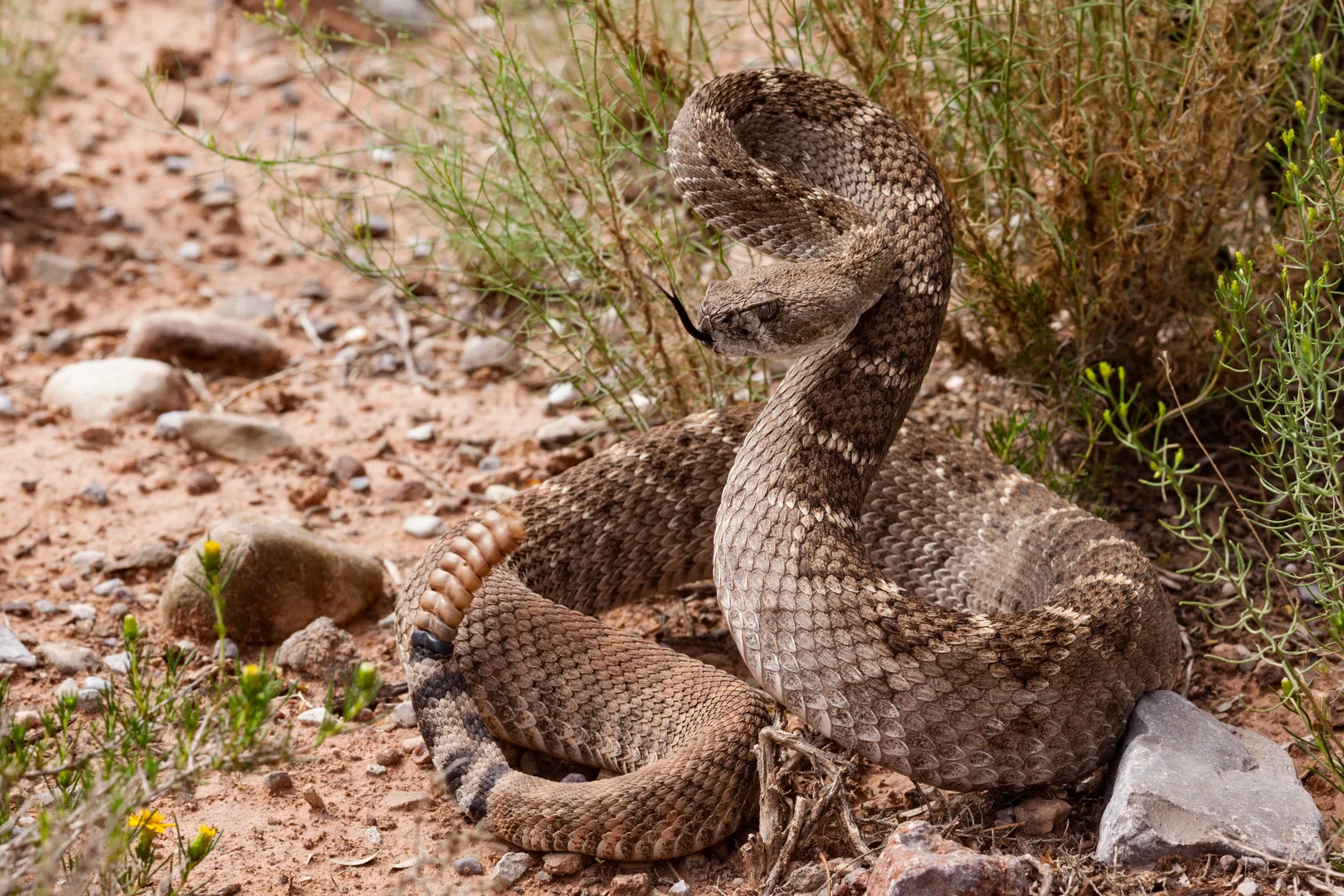
Crotalus atrox , western foothills of the Sacramento Mountains, north of Fresnal Canyon on the south side of Cottonwood Canyon, 32.994...
Field
notes
Two pits that sense heat
The western diamondback has a plump body and a broad triangular head. Like all pit vipers, it has a pit organ in an indentation of the upper jaw, between the nostril and the eye. Each pit is about 5 mm deep. A thin membrane inside it senses very slight temperature differences between the snake’s body and its surroundings.
Young venom, tested on mice In a lab test on mice, venom from young snakes in north Texas was much more lethal when injected under the skin than venom from adults taken from any part of the range. Fifteen months later, the young snakes’ venom had become almost five times less lethal.
Size, weight and lifespan
An adult is about 1.5 m long, and the species can exceed 180 cm in total length. Body weight is up to 6.7 kg. AnAge lists a maximum longevity of 27 years in captivity.
A rattle that warns
The tail ends in a rattle. Each link is the remnant of a molted skin: as the snake molts, the last scale loosens but does not fall off. Rattlesnake rattles are made of interlocking segments of keratin, the same material as our fingernails. This species can shake its rattle 40 to 60 times a second.
The rattle is a warning sign. The snake is not apt to attack offensively, but is defensive. When threatened it slightly flattens its body, coils, lifts its front end into an S-shape and keeps the tail raised.
Males have been seen in ritualized fights. Each lifts its forebody 80 cm in the air, and the two wrap around each other, head to head, until one backs off.
Where it lives and what it eats
Its range covers much of the southwestern United States, from California to central and northern Texas, with a presence in Arkansas, Kansas and Oklahoma. In Mexico it covers 12 states, with isolated populations in Hidalgo, Jalisco, Veracruz and Oaxaca. The snake lives in dry, rocky, shrub-covered terrain, hiding in rock crevices or mouse holes.
It preys on small mammals and birds, sometimes reptiles and amphibians, and even fish and invertebrates. It will also take a meal that is already dead. In lab tests, adults and newborns readily accepted mice that had been aged up to 48 hours.
It can go hungry, too. In one study, snakes fasted for 168 days lost 30% of their body mass, and their whole-body resting metabolic rate dropped by 75%.
Published
Traits
Intel
& FAQ
Guess
first
How big is a Western Diamondback Rattlesnake, really? Slide, lock in, and see what the sources say. Every answer is a figure from this page, quoted from where it came from.
Sources
- 01Ingmarsson (2002). Crotalus atrox (Western Diamond-backed Rattlesnake). Animal Diversity Web, University of Michigan.
- 02AnAge entry for Crotalus atrox. AnAge: The Animal Ageing and Longevity Database, Build 15, Human Ageing Genomic Resources.
- 03Rattlesnake. San Diego Zoo Wildlife Alliance.
- 04Villalobos Juárez et al. (2023). BEYOND MYTHS: REDISCOVERY OF THE WESTERN DIAMONDBACK RATTLESNAKE Crotalus atrox (BAIRD & GIRARD, 1853) IN THE MEXICAN STATE OF OAXACA AFTER A SPAN OF 79 YEARS. Revista Latinoamericana de Herpetología.
- 05Minton & Weinstein (1986). Geographic and ontogenic variation in venom of the western diamondback rattlesnake (Crotalus atrox). Toxicon.
- 06Gillingham & Baker (1981). Evidence for Scavenging Behavior in the Western Diamondback Rattlesnake (Crotalus atrox). Zeitschrift für Tierpsychologie.
- 07McCue (2006). Characterizing the starvation syndrome in the western diamond-back rattlesnake, a species well-suited to tolerate long-term fasting. The FASEB Journal.
- 08Frost, Hammerson & Santos-Barrera (2007). Crotalus atrox. The IUCN Red List of Threatened Species 2007: e.T64311A12763519.
What the sources say: 45 claims checked word for word against these sources →