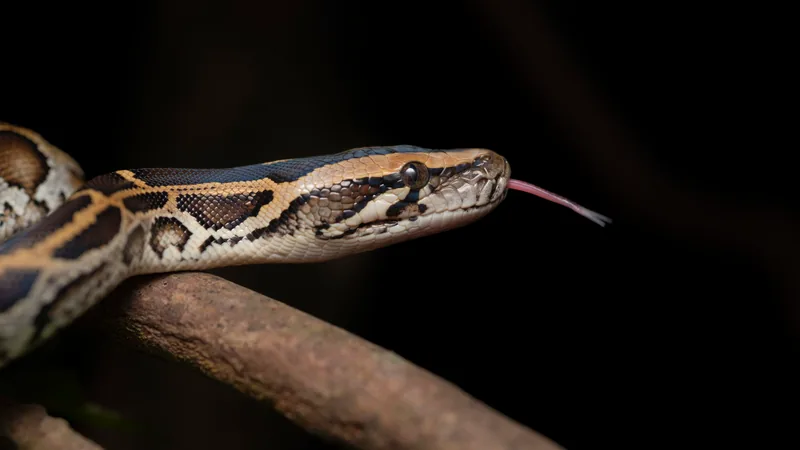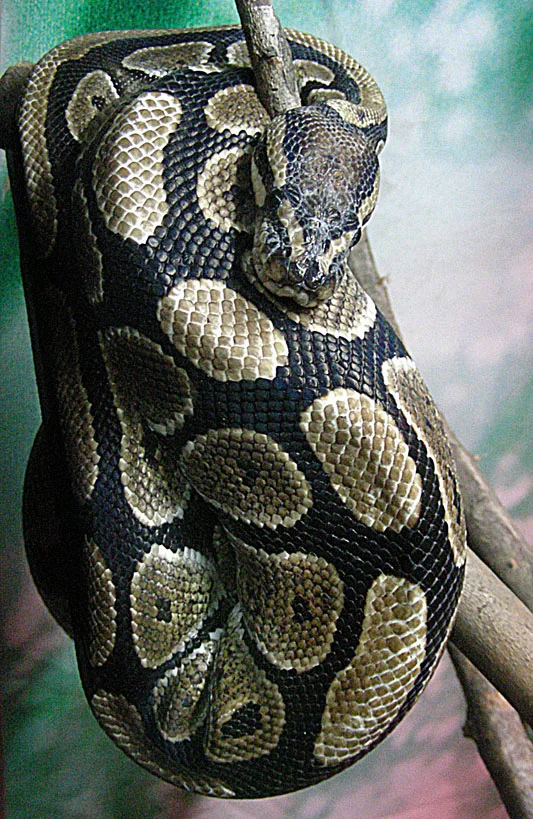
Ball python (Python regius) at the Reptilienzoo Neu-Ulm, Germany
Field
notes
Rolling Into a Ball
The ball python (Python regius) is a small, heavy-bodied python from West and Central Africa, found from Senegal to South Sudan and Uganda. It lives in savanna grasslands and open forests, and also in areas cleared for farming. Adults reach 3 to 5 feet long and weigh 3 to 5 pounds, and females tend to be larger than males. A hatchling is only about a foot long and weighs about a fifth of a pound. In the wild a ball python lives an estimated 10 years; in protected care, 20 to 30. Oakland Zoo in California reports one that has lived 35 years and counting.
Ball pythons live alone and are usually found in or near burrows. They are most active at dawn and dusk.
Their best-known defense gives them their name: when threatened, a ball python wraps itself into a tight ball with its head protected in the center. It has other defenses too, including camouflage, escape attempts, bluffing displays and biting.
Waiting in Ambush
Ball pythons are ambush predators that spend most of their time sitting in wait. They hunt using smell and sight, and they can also detect heat given off by other animals. Research suggests they may follow the scent trails of their prey, because those trails reflect ultraviolet light.
A ball python pulls back its head and neck and strikes fast. It then swallows its prey alive or first holds it still by constriction. It feeds almost only on small mammals, usually rats, and eats large, infrequent meals, often going weeks to months without feeding.
Built for the Long Fast In a lab study, ball pythons, ratsnakes and western diamondback rattlesnakes all got through 168 days without food. The snakes cut their resting energy needs by up to 72 percent, and they saved their body protein while burning fat.
Two Months on Guard
Breeding runs mostly from mid-September through mid-November. A female lays a clutch of 1 to 11 eggs, then coils around them until they hatch, about two months later, staying close to protect them from predators.
A female can sometimes manage without a male. A 10-year-old pet ball python with no prior contact with a male laid four eggs, and genetic tests showed that the three embryos inside came from her alone, a process called parthenogenesis. The researchers counted it as the fourth such report in a captive female ball python.
Reshaped by the Pet Trade
Selective breeding in captivity has produced a wide variety of color morphs. One of them, the spider morph, comes at a cost. In one study, all four spider morph pythons showed “wobble syndrome”: twisting movements of the head, impaired movement, and trouble striking or constricting prey. The researchers concluded that the wobble in those four snakes is caused by a malformed inner ear, and that the malformations suggest their sense of balance does not work properly.
A 2020 study called the ball python the single most exported live species from Africa among those listed under CITES, the international treaty that controls wildlife trade. Oakland Zoo reports that more than 3.5 million ball pythons have been taken from the wild since 1997. The IUCN lists the species as Near Threatened, which Oakland Zoo puts down to habitat loss for urban development and to capture for the pet trade.
Published Updated
Traits
Intel
& FAQ
Guess
first
How big is a Ball Python, really? Slide, lock in, and see what the sources say. Every answer is a figure from this page, quoted from where it came from.
Sources
- 01Python regius. Animal Diversity Web, University of Michigan.
- 02Royal (Ball) Python. Oakland Zoo.
- 03D'Cruze et al. (2022). Python regius. The IUCN Red List of Threatened Species 2022: e.T177562A220378972.
- 04D'Cruze et al. (2020). Searching for snakes: ball python hunting in southern Togo, West Africa. Nature Conservation.
- 05McCue (2007). Snakes survive starvation by employing supply- and demand-side economic strategies. Zoology.
- 06Starck et al. (2022). Malformations of the sacculus and the semicircular canals in spider morph pythons. PLOS ONE.
- 07Di Ianni et al. (2023). Demonstration of Parthenogenetic Reproduction in a Pet Ball Python (Python regius) through Analysis of Early-Stage Embryos. Genes.
What the sources say: 63 claims checked word for word against these sources →