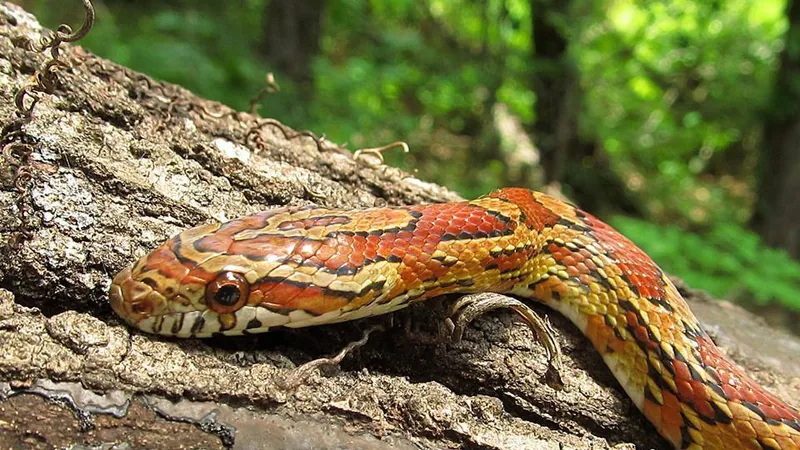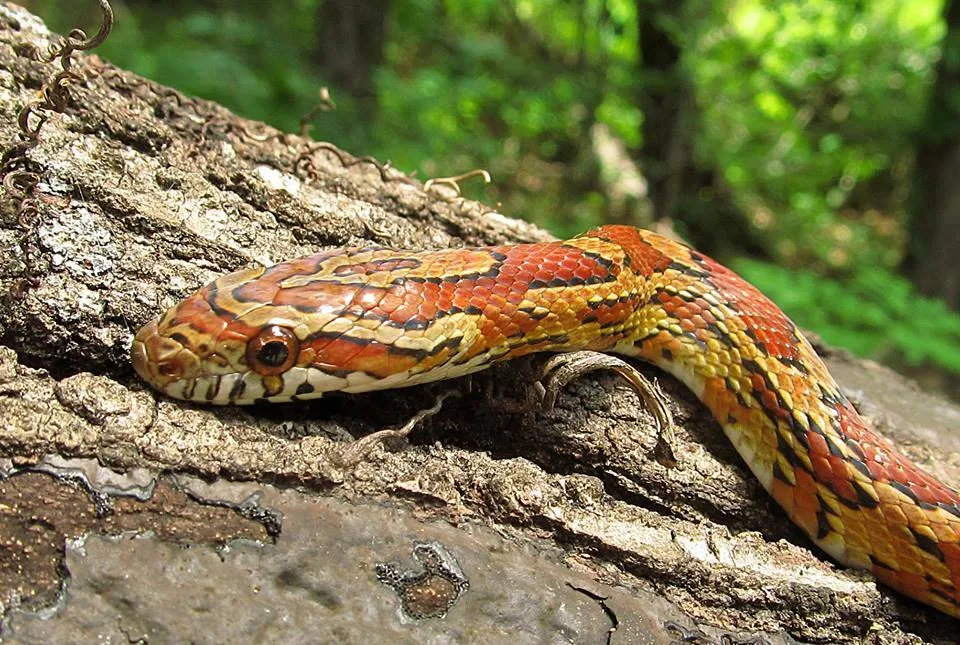
Corn snake on a log.
Field
notes
A Snake That Squeezes, Then Swallows
The corn snake is a constrictor, a snake that wraps around its prey and squeezes. It bites its prey to get a firm grip, then quickly coils around its meal and squeezes tightly until the prey is subdued. Then it swallows the food whole, usually headfirst. Corn snakes have also been seen swallowing small prey alive.
Hatchlings eat lizards and tree frogs. Adults go for larger prey such as mice, rats, birds and bats.
Tooth factory Corn snakes are polyphyodonts, animals that can regenerate their teeth constantly.
Nose First, Eyes Second
Corn snakes have rather poor eyesight and depend mainly on smell. Their tongue works with the Jacobson’s organ in the roof of the mouth to pick up scent molecules, and they can tell which direction the scent came from. They can also feel ground vibrations through their bodies, which helps them find small or hidden prey.
How Big, How Old
Corn snakes are about 61 to 182 centimeters (24 to 72 inches) long. Hatchlings measure 25 to 38 centimeters. An average adult weighs about 900 grams. In captivity, corn snakes have been reported to live up to 32.3 years, and their lifespan is shorter in the wild.
Where It Lives
Corn snakes live in the eastern United States, from southern New Jersey to Florida, into Louisiana and parts of Kentucky, and are most abundant in Florida and the southeast. They inhabit wooded groves, rocky hillsides, meadowlands, barns and abandoned buildings. They are secretive and spend most of their time underground in rodent burrows, though they also climb trees. Corn snakes are sometimes mistaken for the venomous copperhead and killed. The Red List rates the species Least Concern.
A Colour Lab with Scales
Corn snakes are the most commonly bred snake species in the pet industry. One team calls the corn snake a new model species for investigating how reptiles get their colours, because numerous colour and pattern mutants have been isolated in the last five decades.
The lavender morph has gray blotches on a pink background, instead of red blotches on orange. Researchers traced it to a single change in the LYST gene that cuts the protein short, and used it as evidence that the colour-making compartments in red and yellow skin cells and in light-reflecting skin cells are lysosome-related organelles. The amelanistic morph, which lacks the dark pigment melanin, shows white borders instead of black ones around an otherwise normal pattern of orange saddles.
Published
Traits
Intel
& FAQ
Guess
first
How big is a Corn Snake, really? Slide, lock in, and see what the sources say. Every answer is a figure from this page, quoted from where it came from.
Sources
- 01Echternacht & Hammerson (2016). Pantherophis guttatus. The IUCN Red List of Threatened Species 2016: e.T63863A71740603.
- 02Eastern corn snake. Smithsonian's National Zoo and Conservation Biology Institute.
- 03Pantherophis guttatus (red corn snake). Animal Diversity Web, University of Michigan.
- 04AnAge entry for Elaphe guttata. AnAge: The Animal Ageing and Longevity Database, Build 15, Human Ageing Genomic Resources.
- 05Gaete & Tucker (2013). Organized Emergence of Multiple-Generations of Teeth in Snakes Is Dysregulated by Activation of Wnt/Beta-Catenin Signalling. PLoS ONE.
- 06Ullate-Agote et al. (2020). Genome mapping of a LYST mutation in corn snakes indicates that vertebrate chromatophore vesicles are lysosome-related organelles. Proceedings of the National Academy of Sciences.
- 07Saenko et al. (2015). Amelanism in the corn snake is associated with the insertion of an LTR-retrotransposon in the OCA2 gene. Scientific Reports.
What the sources say: 39 claims checked word for word against these sources →