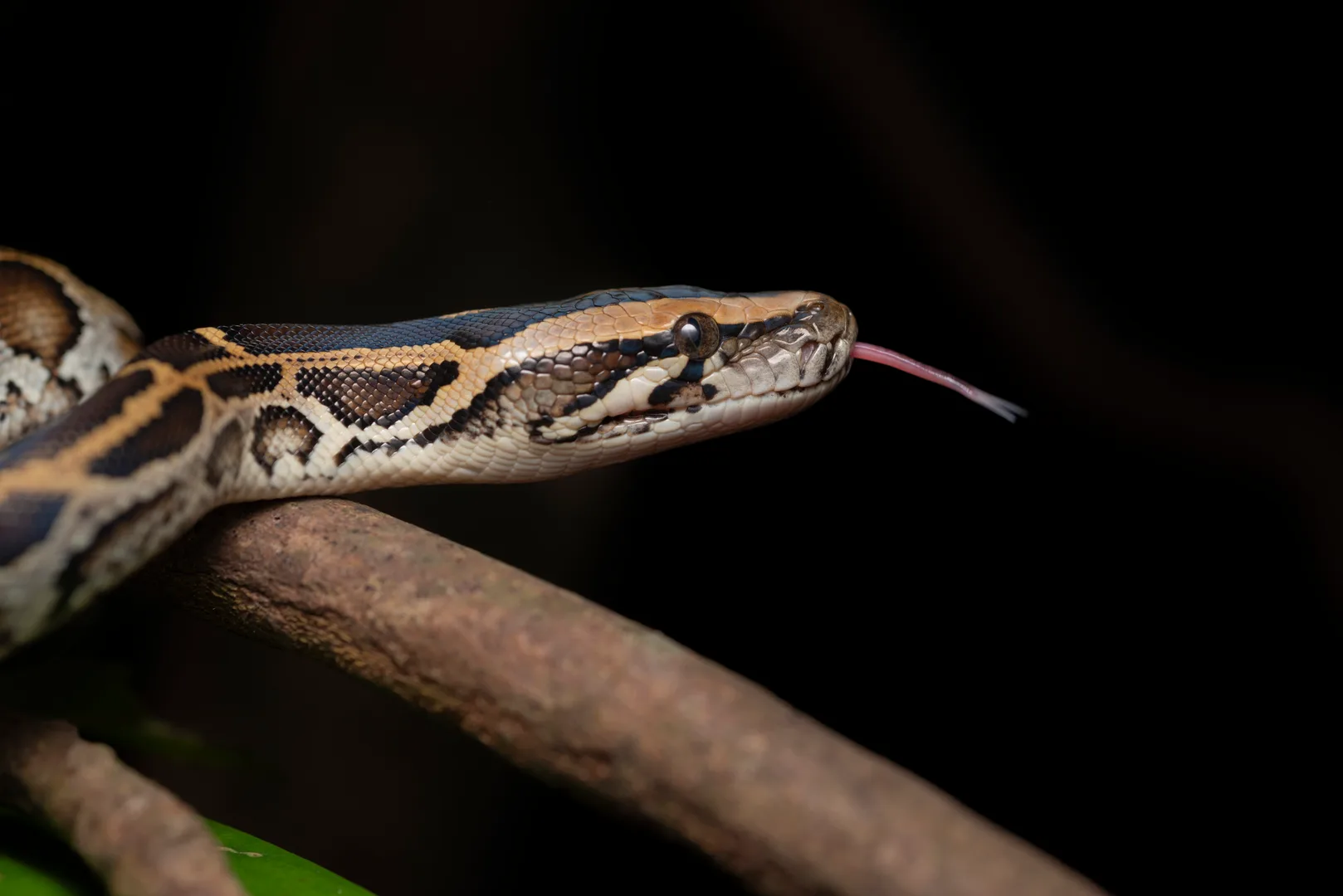
Burmese Python (Python bivittatus)
Field
notes
Jaws built for a big meal
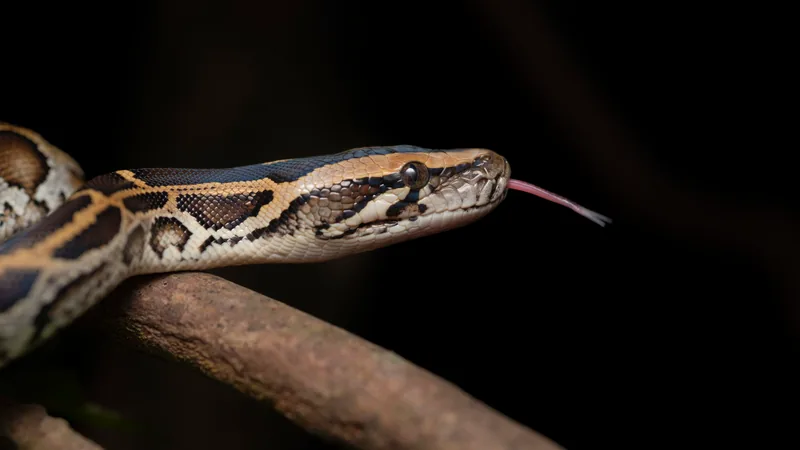
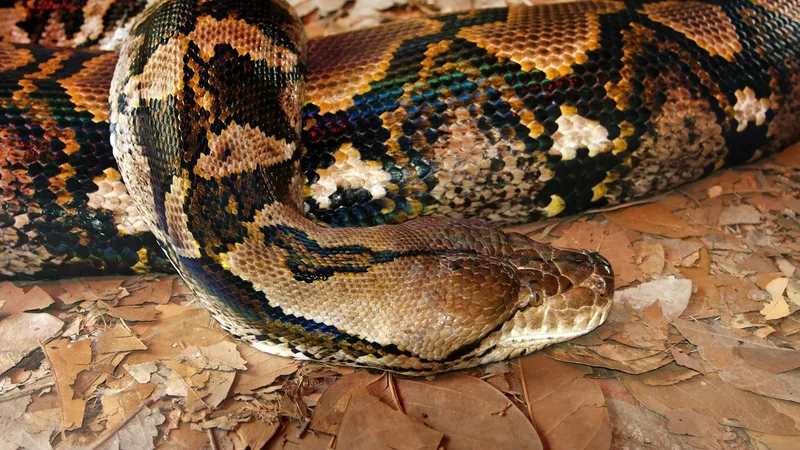
The Burmese python, Python bivittatus, is a constrictor, a snake that grabs prey and squeezes. Pythons have no fangs. They have many back-curving teeth that grab and hold prey and do not allow escape. It eats mammals, birds and reptiles, and it swallows them whole.
Stretchy jaws Its jaw bones are connected by tissue that can separate and expand the jaws, allowing it to eat an animal several times as wide as its head.
Its body has other quirks. Snakes usually have only one lung, but the Burmese python has two. The second is vestigial: it is considerably smaller and not fully functional. It has no eyelids either. A thin, clear scale covers each eye and is shed along with the rest of the skin.
Size, age and range
This is one of the six largest snakes in the world. Lengths over 15 feet (4.6 meters) are common, and the average is 10 to 16 feet (3 to 4.9 meters). The U.S. Geological Survey says the species can grow to 20 feet and weigh more than 250 pounds, with females larger than males. In human care these pythons live about 20 to 25 years.
The home range covers parts of southern China, Myanmar, Laos, Vietnam, Cambodia, Malaysia, Thailand and parts of Indonesia. They live in rainforests and are often found near water or wetlands, though they also survive in grasslands, swamps, marshes and rocky foothills. They were once counted as a subspecies of the Indian python. Most authorities now call them a separate species.
A snake that incubates
A mother python does something unusual for a snake. She coils around her eggs and stays with them until they hatch, and she does not feed while she waits, which may take two or more months. The average clutch is 30 to 60 eggs. She twitches her muscles to raise the temperature inside her coils by several degrees above the air.
The Everglades problem
In Florida, the Burmese python is an invasive species, an animal living where it does not belong. The National Park Service says the snakes are established in Everglades National Park due to accidental or intentional release of captive pets.
Scientists tracked what happened to the mammals. Pythons have increased dramatically since 2000. Road surveys in the park totaling 56,971 kilometers from 2003 to 2011 found a 99.3 percent drop in raccoon sightings, plus drops of 98.9 percent for opossums and 87.5 percent for bobcats. The surveys failed to detect rabbits.
A later experiment moved marsh rabbits into the park. Pythons accounted for 77 percent of the rabbit deaths within 11 months.
Back home in Asia, the snake is in trouble too. The IUCN Red List rates it Vulnerable. The National Zoo says its numbers are diminishing and that it is often killed for its skin or meat.
Published
Traits
Intel
& FAQ
Guess
first
How big is a Burmese Python, really? Slide, lock in, and see what the sources say. Every answer is a figure from this page, quoted from where it came from.
Sources
- 01Burmese python. Smithsonian's National Zoo and Conservation Biology Institute.
- 02Python bivittatus Kuhl, 1820: Burmese Python. USGS Nonindigenous Aquatic Species database.
- 03Burmese Python. Everglades National Park, National Park Service.
- 04Python Information. Florida Fish and Wildlife Conservation Commission.
- 05Dorcas et al. (2012). Severe mammal declines coincide with proliferation of invasive Burmese pythons in Everglades National Park. Proceedings of the National Academy of Sciences.
- 06McCleery et al. (2015). Marsh rabbit mortalities tie pythons to the precipitous decline of mammals in the Everglades. Proceedings of the Royal Society B: Biological Sciences.
- 07Reed & Rodda (2009). Giant Constrictors: Biological and Management Profiles and an Establishment Risk Assessment for Nine Large Species of Pythons, Anacondas, and the Boa Constrictor. Open-File Report.
- 08Smith et al. (2021). Native Burmese pythons exhibit site fidelity and preference for aquatic habitats in an agricultural mosaic. Scientific Reports.
- 09Stuart et al. (2012). Python bivittatus. The IUCN Red List of Threatened Species 2012: e.T193451A151341916.
What the sources say: 40 claims checked word for word against these sources →