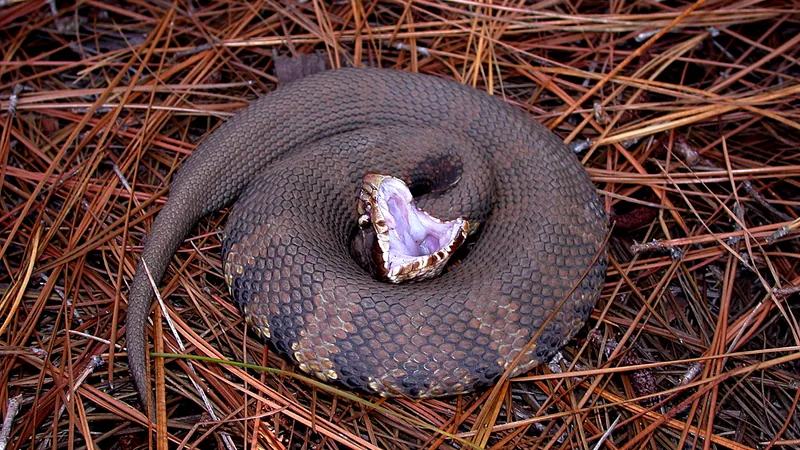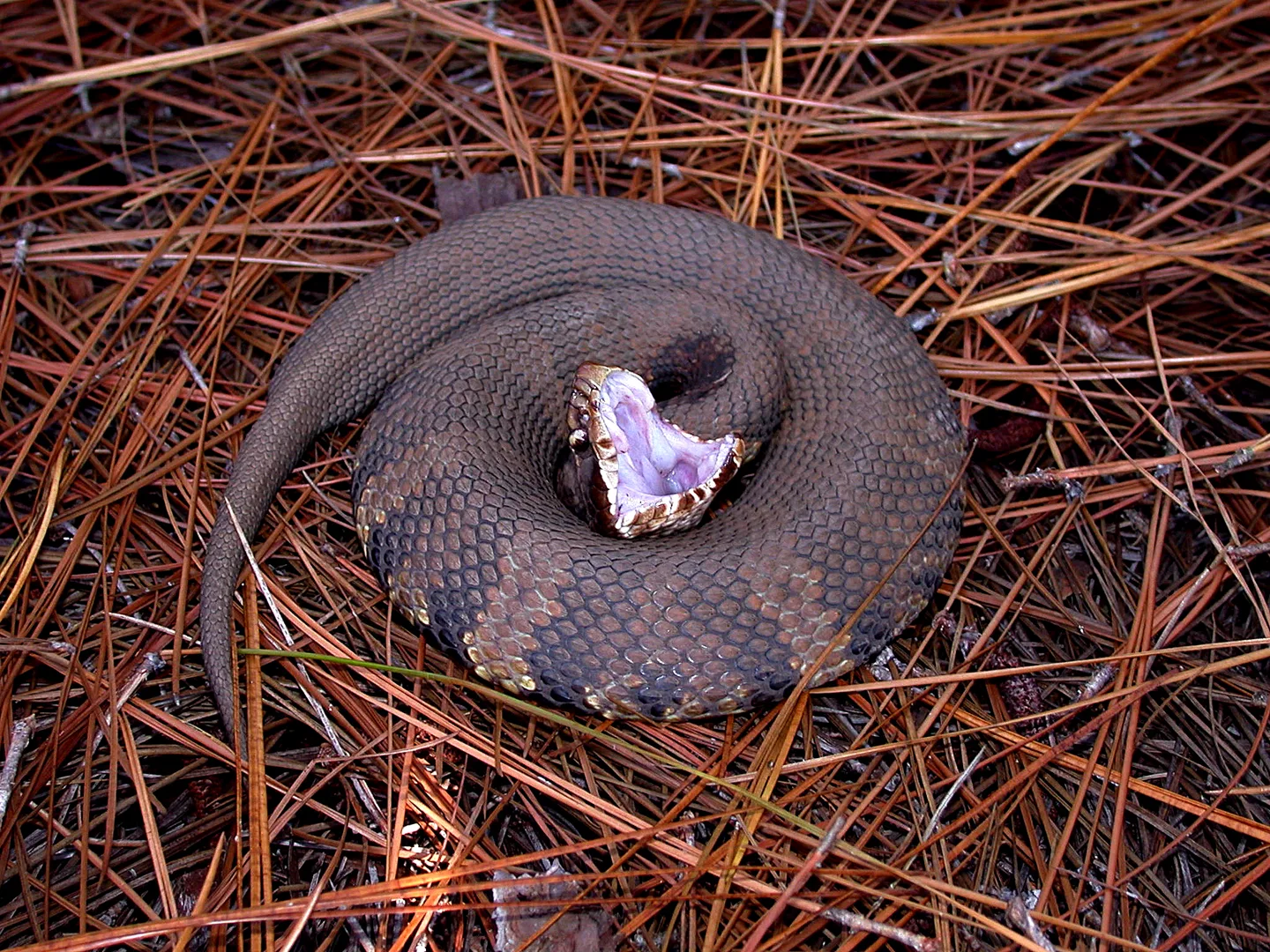
This 2005 photograph depicted an “eastern cottonmouth” snake, Agkistrodon p.
Field
notes
A mouth like a cotton ball
The cottonmouth, Agkistrodon piscivorus, is a venomous pit viper that lives in and around water. Its name comes from the inside of its mouth, which is bright white. When threatened, it may coil its body and open its mouth as though ready to bite, flashing that white lining. It may also shake its tail in the plants to make a rattlesnake-like sound, and it can spray a foul-smelling musk from a gland. Given the chance, though, it usually retreats.
On its face, between each nostril and eye, sits a heat-sensing pit that is larger than the nostril.
Warning displays are not the whole story. In a field study, cottonmouths with higher baseline levels of a stress hormone were more likely to strike than to put on a threat display when approached.
Virgin birth in the wild In 2012, scientists reported the first cases of facultative parthenogenesis in wild-collected pregnant females, from two species: the copperhead and the cottonmouth. Facultative parthenogenesis is asexual reproduction by a species that normally has two sexes.
Size and lifespan
Cottonmouths measure 76 to 189 centimeters in total length and weigh 435 to 1,700 grams. Males are typically longer and heavier than females. The oldest cottonmouth on record lived 24.5 years in captivity. Not much is documented about how long wild ones live, and young cottonmouths suffer high predation. On average, just 2 to 3 young per clutch make it to adulthood.
Hunting in two worlds
The cottonmouth eats fish, amphibians, snakes, turtles, baby alligators, mammals and birds. It often waits in ambush. Young cottonmouths lure frogs within striking range by wiggling their yellow tails.
In a lab test with mice and fish, strikes on land were considerably more successful than strikes in water. The researchers said the slower mouth closing underwater likely explained it.
Where it lives, and what a bite means
The Eastern cottonmouth lives from southeastern Virginia through the Carolinas and Georgia, and the Western cottonmouth from eastern Texas and Louisiana north to extreme southern Illinois and Indiana. Cottonmouths turn up in lakes, creeks and ditches, and even on river bottoms. Recent genetic studies show that the Florida cottonmouth is a separate species.
A cottonmouth can bite, poison and potentially kill a human. Still, cottonmouths are generally secretive and not aggressive, so bites are rare. Cottonmouths and other pit vipers that bite in defense typically inject less venom than they would to kill prey.
Published
Traits
Intel
& FAQ
Guess
first
How big is a Cottonmouth, really? Slide, lock in, and see what the sources say. Every answer is a figure from this page, quoted from where it came from.
Sources
- 01Agkistrodon piscivorus. Animal Diversity Web, University of Michigan.
- 02AnAge entry for Agkistrodon piscivorus. AnAge: The Animal Ageing and Longevity Database, Build 15, Human Ageing Genomic Resources.
- 03Agkistrodon piscivorus (Lacepede, 1789). USGS Nonindigenous Aquatic Species database.
- 04Booth et al. (2012). Facultative parthenogenesis discovered in wild vertebrates. Biology Letters.
- 05Vincent, Herrel & Irschick (2005). Comparisons of aquatic versus terrestrial predatory strikes in the pitviper,Agkistrodon piscivorus. Journal of Experimental Zoology Part A: Comparative Experimental Biology.
- 06Herr, Graham & Langkilde (2017). Stressed snakes strike first: Hormone levels and defensive behavior in free ranging cottonmouths (Agkistrodon piscivorus). General and Comparative Endocrinology.
- 07Hammerson (2007). Agkistrodon piscivorus. The IUCN Red List of Threatened Species 2007: e.T64298A12756313.
What the sources say: 55 claims checked word for word against these sources →