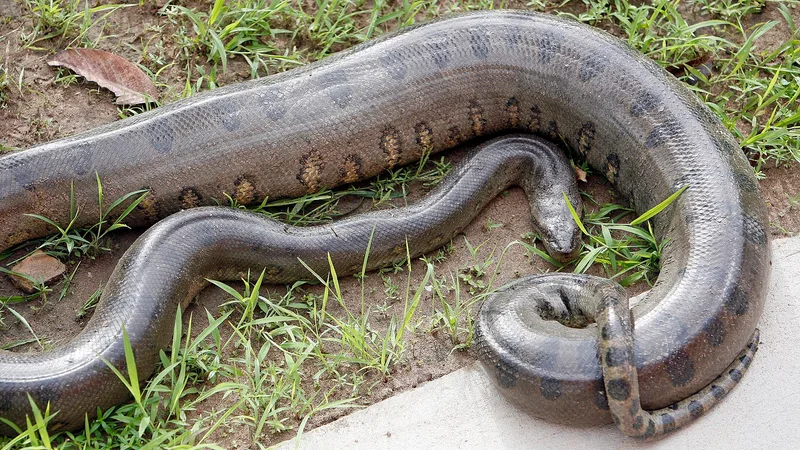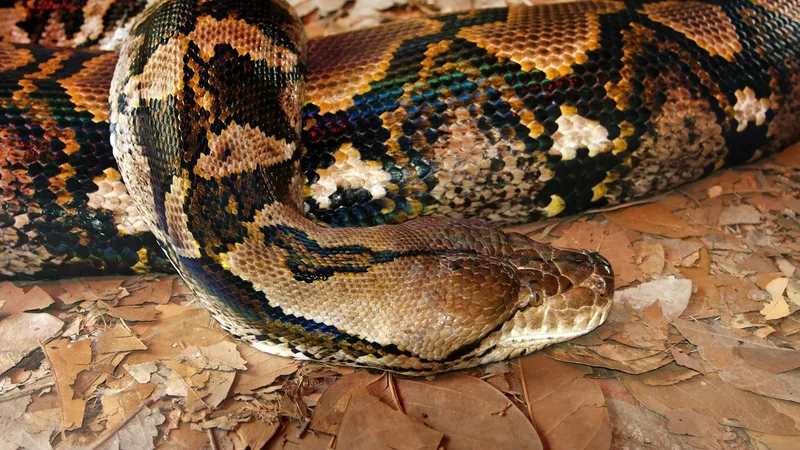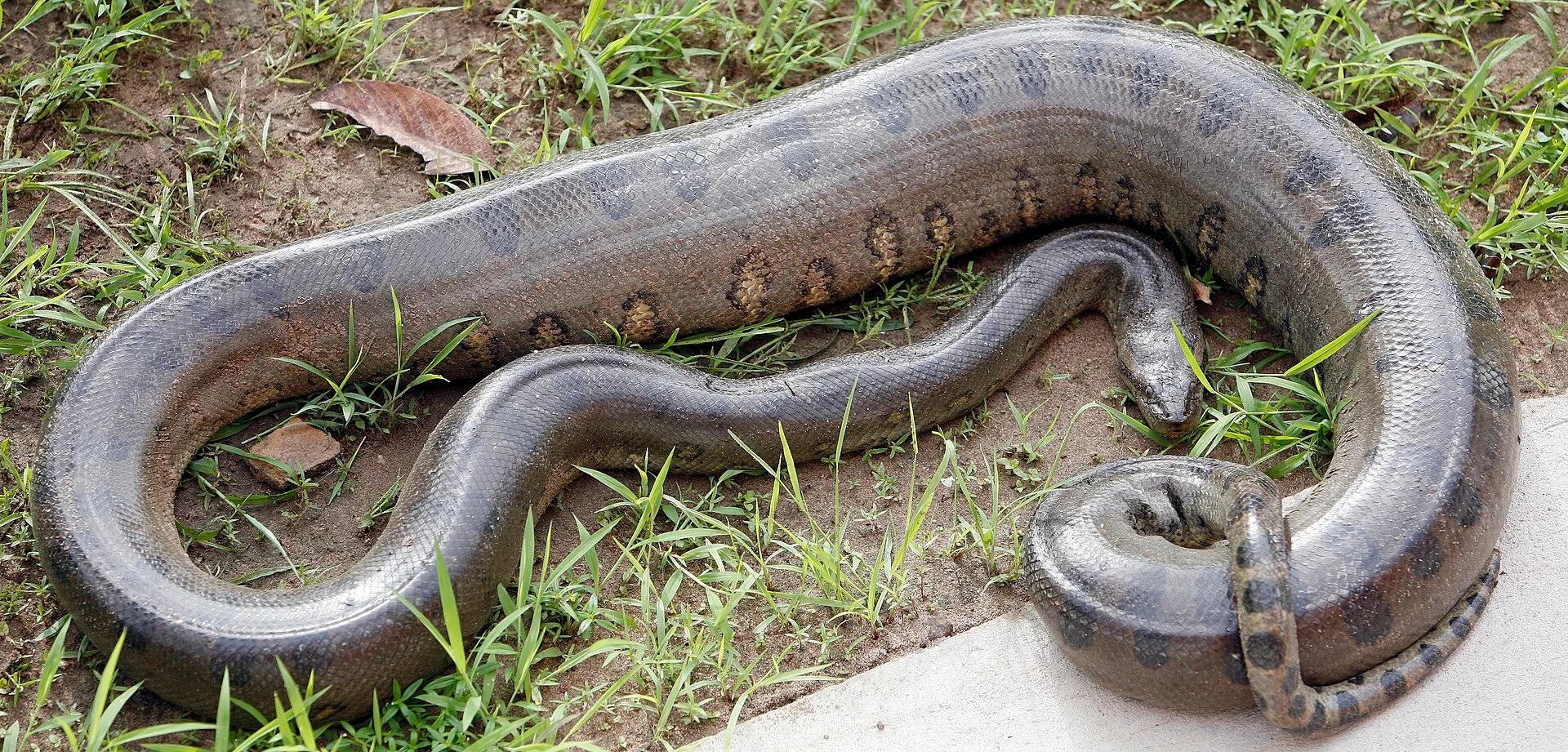
A 3-meter green anaconda found on the campus of the Federal University of Pará.
Field
notes
An Ambush Built Around a Periscope
Its eyes and nostrils sit on top of its head, letting a green anaconda “see and breathe while swimming in the water,” and its camouflage leaves a submerged anaconda virtually invisible from a short distance away. Females are considerably larger than males, and can reach 30 feet (9 meters) long, 12 inches (30.5 centimeters) across and 550 pounds (250 kilograms). San Diego Zoo calls South America’s green anaconda “the heaviest snake in the world.” The US Geological Survey, citing a 2000 study, reports that breeding females are at least five times the size of breeding males. The average life span in the wild is about 10 years; anacondas live much longer in human care, with some reports of them reaching their late 20s.
Teeth, Coils and a Stretchy Jaw
It grabs hold of prey with needle-sharp, curved teeth, throws coils of muscle around the body, and death follows from respiratory arrest and circulatory failure. Feeding usually happens near water, where prey are as likely to drown as to die from constriction. Its jaws are attached by stretchy ligaments, which let it swallow prey whole and headfirst, though large prey carries a risk of injury. Juveniles tend to eat fish, birds and small mammals; adults can take much larger animals, including deer, capybaras, caimans, tapirs and large birds. Green anacondas have slow metabolisms, and apart from breeding females, they only need to eat once every few weeks.
A Female With Options
Mating generally runs from March to May, during the dry season. Males form groups of up to 13 around one female, a “breeding ball” in which they compete for access to her, and the mating can last up to a month. Afterward she may eat one or more of the smaller males, as she will not eat again during the seven-month gestation. She gives birth to live young in the water, 20 to 40 at a time, and the largest litter on record was 82.
A mother without a mate at Ueno Zoo in Tokyo had been kept alone for eight years and two months when she died of pneumonia in 2015. Her autopsy found two almost fully developed but dead female offspring, and at all 16 informative DNA markers they carried only her alleles and no paternal ones. The researchers call it the first case of parthenogenesis in Eunectes validated by DNA analysis.
Range, Status, and a Contested Name
Green anacondas are native to the northern regions of South America: most abundant in Colombia’s Orinoco basin, Brazil’s Amazon basin and Venezuela’s flooded Llanos grasslands, and also found in Ecuador, Peru, Bolivia, Guyana, Paraguay, French Guiana and Trinidad. The IUCN lists Eunectes murinus as Least Concern, though habitat loss, hunting and the international pet trade work against it. In 2024 Rivas and colleagues named the northern green anaconda, Eunectes akayima, as a separate species, saying the two separated about 10 million years ago and differ notably in how much bigger females grow than males. Other researchers argued that the original description broke the International Code of Zoological Nomenclature and sank the new name as a synonym; the describers’ later paper says it rectifies earlier oversights in that description. The zoo and government pages behind the size, range and lifespan figures here do not mention the split.
Published Updated
Traits
Intel
& FAQ
Guess
first
How big is a Green Anaconda, really? Slide, lock in, and see what the sources say. Every answer is a figure from this page, quoted from where it came from.
Sources
- 01Green anaconda. Smithsonian's National Zoo and Conservation Biology Institute.
- 02Anaconda. San Diego Zoo Wildlife Alliance.
- 03Eunectes murinus (Anaconda, Green Anaconda). Animal Diversity Web, University of Michigan.
- 04Eunectes murinus (Linnaeus, 1758). USGS Nonindigenous Aquatic Species Database.
- 05Shibata et al. (2017). Facultative parthenogenesis validated by DNA analyses in the green anaconda (Eunectes murinus). PLOS ONE.
- 06Rivas et al. (2024). Description of the Northern Green Anaconda (Eunectes akayima sp. nov. Serpentes; Boidae): What Is in a Name? Diversity.
- 07Vásquez-Restrepo, Alfonso-Rojas & Palacios-Aguilar (2024). On the validity of the recently described northern green anaconda Eunectes akayima (Squamata, Serpentes). Bionomina.
- 08Calderón et al. (2021). Eunectes murinus. The IUCN Red List of Threatened Species 2021: e.T44580041A44580052.
- 09Rivas (2023). What can studying anacondas tell us about Titanoboa cerrejonensis? Exploring the life of an extinct giant snake using an extant pretty big snake. The Herpetological Journal.
What the sources say: 51 claims checked word for word against these sources →