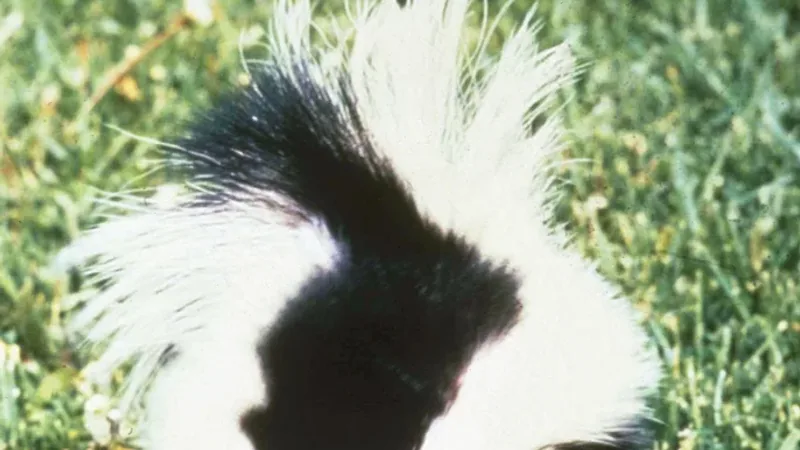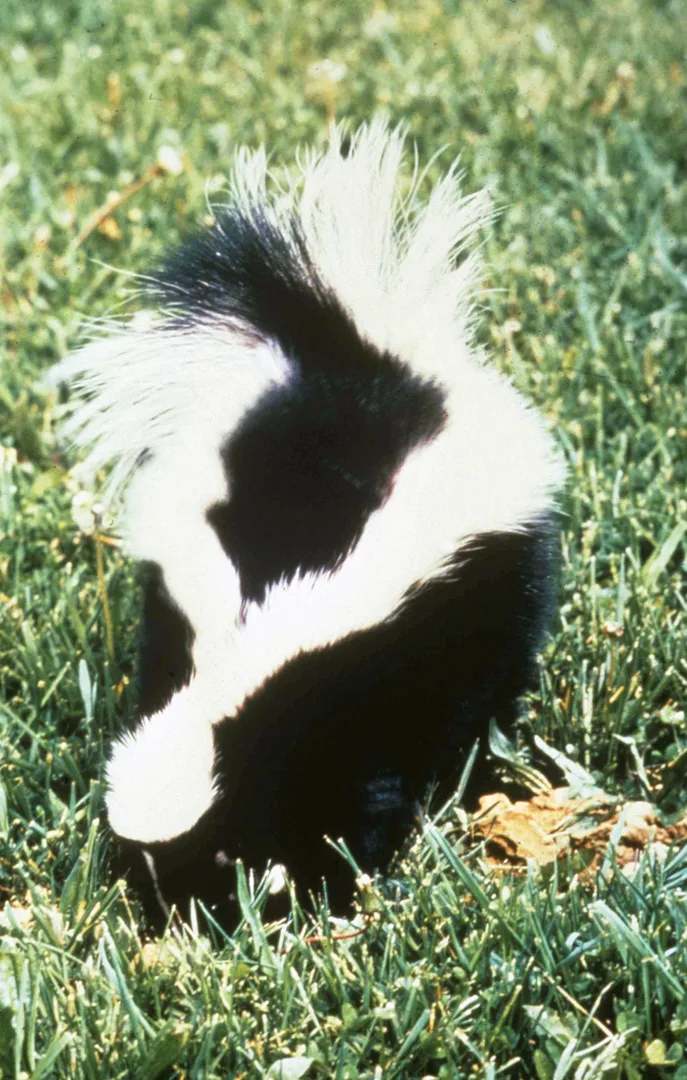
A striped skunk with its tail raised.
Field
notes
A Coat That Works as a Warning
The Striped Skunk (Mephitis mephitis) is known for two things: its coloration and the strong, pungent odor it gives off when upset. Two thick white stripes run along the back and tail against an otherwise black coat, and Animal Diversity Web lists the species as aposematic, meaning its coloration warns predators off.
A striped skunk measures 46.5 to 81.5 centimeters (18 to 32 inches) long and weigh 0.7 to 6.3 kilograms (1.5 to 13 pounds), with males usually a little larger than females. Weight swings hard with the seasons: a skunk can lose up to half its body weight over a cold winter, holed up in a single den and living off stored fat. A striped skunk usually does not survive its first year, because of severe weather and infectious disease. Past it, one can live up to seven years in the wild and up to ten in human care. The striped skunk ranges across North America, from southern Canada through the United States and into northern Mexico, at home in woodland, farmland and suburban neighborhoods alike.
A Diet That Switches With the Season
In spring and summer, a skunk eats mostly insects: grasshoppers, beetles, crickets and bees, dug out of soil and rotting logs with long foreclaws. In colder months, the menu shifts toward small mammals and the eggs and young of ground-nesting birds. Corn and nightshade fruit round things out, but plant matter makes up only ten to twenty percent of the diet.
The Show Before the Spray
Faced with a threat, a skunk first tries to escape. If it can’t, it puts on a warning display: it arches its back, raises its tail, hisses and stamps the ground with its forelegs, and it may even do a brief handstand while stamping and backing away. A radio-tracking study from 1993 to 1995 logged 207 defensive displays, 95.7 percent of them aimed at the trackers themselves. Tail-up made up 69.1 percent and stomping 17.4 percent, and 42.5 percent of encounters ended with the skunk running away.
Armed Before It Can See Young skunks are capable of spraying at 8 days old, around two weeks before their eyes open.
If the opponent does not back off, the skunk bends its hindquarters around while still facing the intruder and sprays. Its paired anal glands release an oily musk as a fine mist or a stream of droplets, striking objects up to about 5 to 6 meters (18 to 20 feet) away, and both sexes can discharge it 5 or 6 times in rapid succession. The musk can cause temporary blindness and pain if it gets into an attacker’s eyes, but causes no permanent damage.
The Predators the Musk Does Not Stop
Most mammals avoid the striped skunk because of its defenses. Mountain lions, bobcats, coyotes, foxes and badgers are still known to prey on it, and research has shown that skunks do not avoid areas of coyote activity. Large birds of prey are unaffected by the musk, and the most prominent of these are great horned owls and eagles. Striped skunks are the most common skunks in North America, and the IUCN assessed the species as Least Concern in 2015.
Published Updated
Traits
Intel
& FAQ
Sources
- 01Mephitis mephitis (striped skunk). Animal Diversity Web, University of Michigan.
- 02Striped Skunk. San Diego Zoo Wildlife Alliance.
- 03Striped skunk. Smithsonian's National Zoo and Conservation Biology Institute.
- 04Striped Skunk. SUNY College of Environmental Science and Forestry, Adirondack Ecosystem.
- 05Wood (1990). New components in defensive secretion of the striped skunk,Mephitis mephitis. Journal of Chemical Ecology.
- 06Aposematic Behaviour in the Striped Skunk,Mephitis mephitis. Ethology, 1996.
- 07Helgen & Reid (2016). Mephitis mephitis. The IUCN Red List of Threatened Species 2016: e.T41635A45211301.