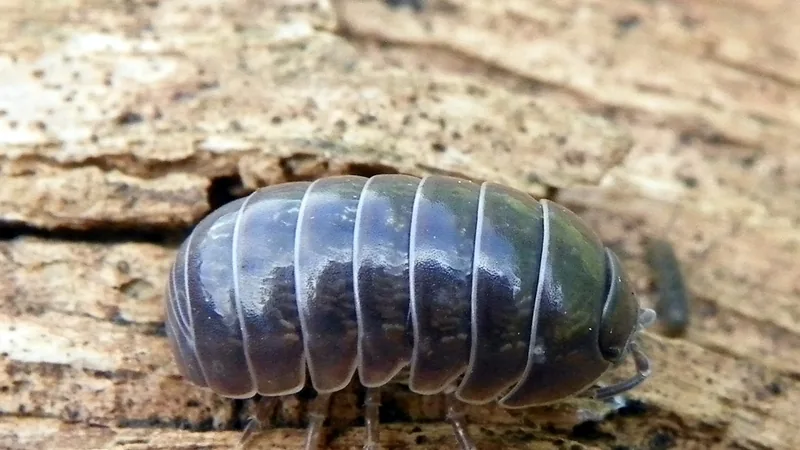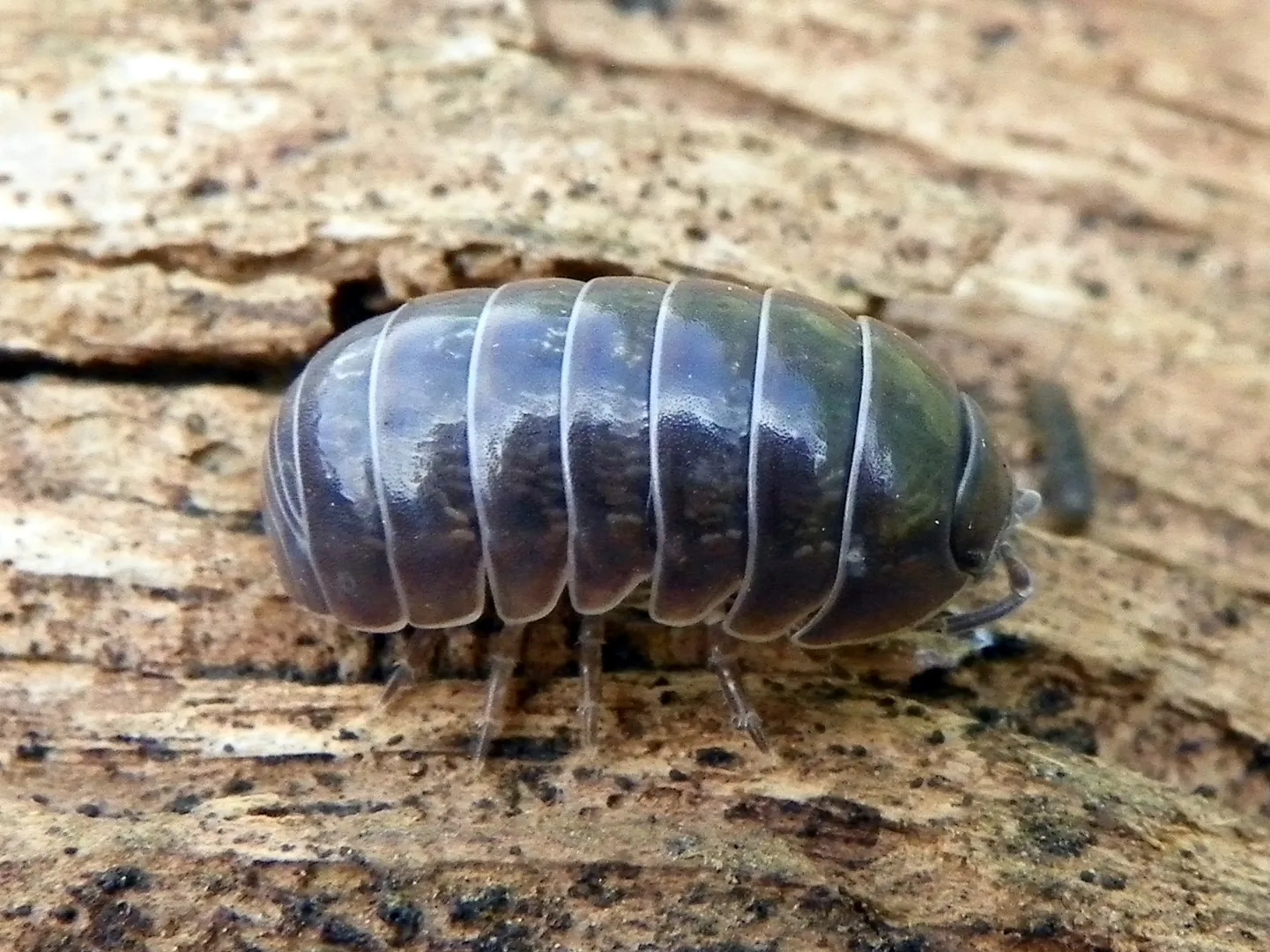
Pill woodlouse, Hertfordshire, England
Field
notes
Armour that curls into a ball
Press hard on a common pill bug (Armadillidium vulgare) or shake the ground near it, and it curls its rear body joints in toward its front ones into a sphere-like shape. The trick is called conglobation. Animal Diversity Web says it may be a shield for the softer belly and legs, or a way to cut water loss. The genus was once named Armadillo, after the armored mammal that does something similar. The defence has limits: birds such as the common starling can beat it, and tropical ants of the genus Leptogenys have mandibles long enough to pry rolled-up pill bugs apart.
Not an insect
The nickname says “bug”, but a pill bug is an isopod, a crustacean that lives on land. A typical young adult is 10 millimetres long and 5 wide, and Animal Diversity Web lists a mass range of 0.060 to 0.116 grams. Its shell is mineralized: a study of the cuticles (outer shells) of two woodlice species, this one included, found crystalline magnesium calcite plus two non-crystalline forms, calcium carbonate and calcium phosphate.
Armour has a price. A pill bug must shed its cuticle to grow, and in the usual molt cycle, for about two days after a molt the new shell is soft, and the animal cannot move or eat and is open to predators and drying out. Females carry their eggs in a fluid-filled pouch called a marsupium for two to three months. Animal Diversity Web gives a range of 6 to 300 young, averaging 100.
A life ruled by water
Much of a pill bug’s behaviour is a fight against drying out. It moves slowly when the air is humid and faster when it is dry, and it is usually more active at night. Roughly 13 metres a day in summer is its pace, falling to 6.6 in winter. It cannot swim. At 20 to 30 degrees Celsius, pheromones (scent signals) draw pill bugs into clumps, which cuts the surface each one exposes to the heat.
The species comes from the Mediterranean’s edge and has been carried to nearly all landmasses. It lives under stones and logs and in the soil of fields, gardens and hedgerows. Mostly it eats decaying leaf litter, and some data suggest almost ten percent of its diet is its own droppings, which recycles microbes and nutrients it missed the first time.
Bacteria that rewired its sex
Borrowed chromosome Researchers found a 3-megabase insert of a feminizing Wolbachia genome inside the pill bug’s own nuclear genome, and their results support it now acting as a female sex-determining region.
Wolbachia are bacteria that live inside cells and pass from mother to young. In this pill bug, at least two strains turn genetic males into females. The researchers concluded that the chromosome carrying the insert is a new W sex chromosome, which would make a bacterium’s DNA part of what decides whether a pill bug is female.
Published
Traits
Intel
& FAQ
Guess
first
How big is a Common Pill Bug, really? Slide, lock in, and see what the sources say. Every answer is a figure from this page, quoted from where it came from.
Sources
- 01Armadillidium vulgare. Animal Diversity Web.
- 02Becker, Ziegler & Epple (2005). The mineral phase in the cuticles of two species of Crustacea consists of magnesium calcite, amorphous calcium carbonate, and amorphous calcium phosphate. Dalton Transactions.
- 03Leclercq et al. (2016). Birth of a W sex chromosome by horizontal transfer of Wolbachia bacterial symbiont genome. Proceedings of the National Academy of Sciences.
- 04Cordaux et al. (2004). Evidence for a new feminizing Wolbachia strain in the isopod Armadillidium vulgare: evolutionary implications. Heredity.
What the sources say: 52 claims checked word for word against these sources →