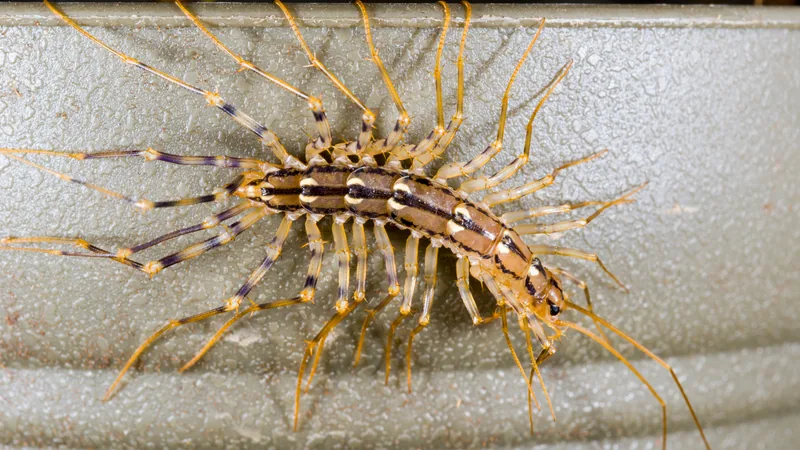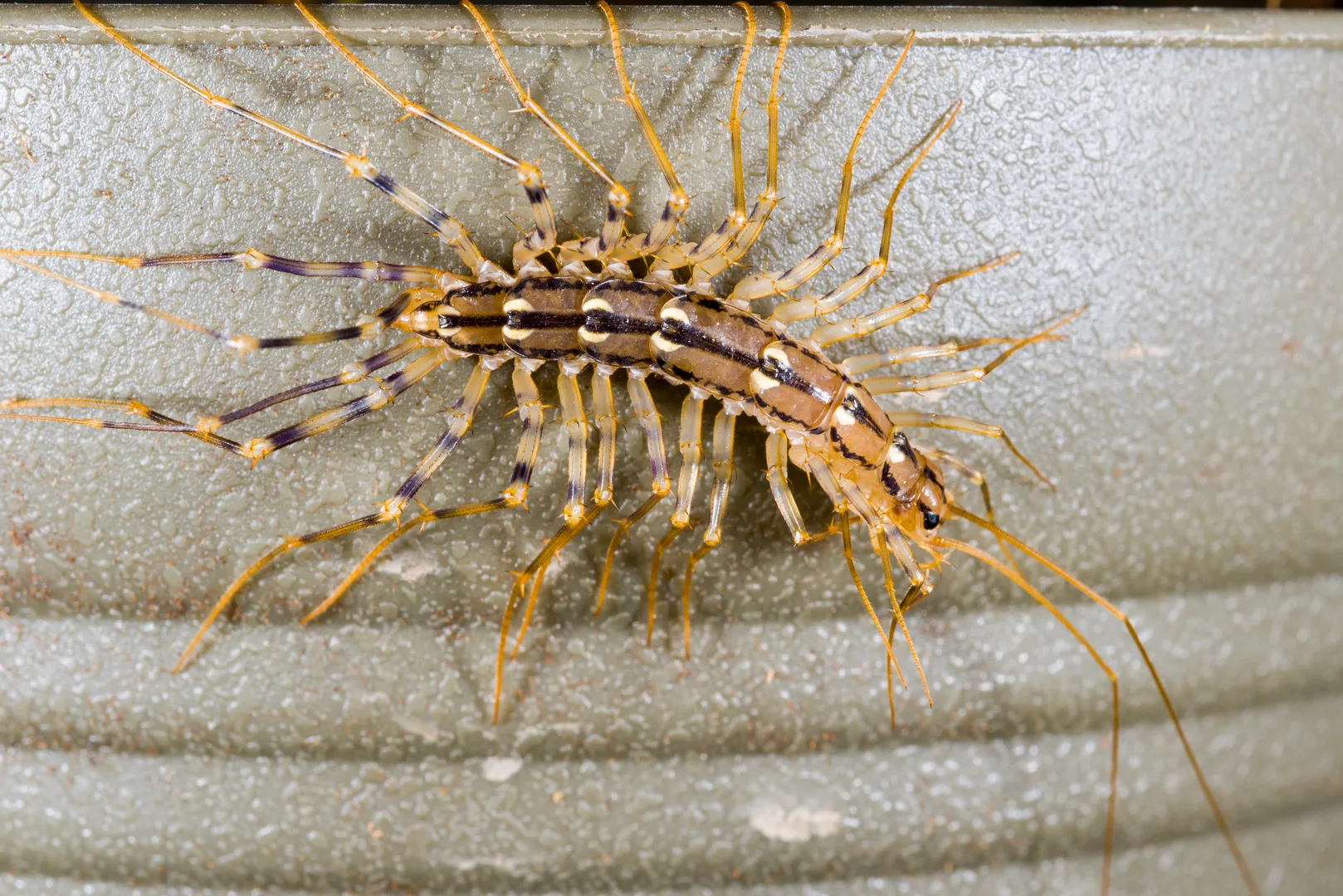
House centipede in Portland, Oregon.
Field
notes
Fifteen Pairs of Racing Legs
An adult house centipede has 15 pairs of legs. On adult females, the last pair is nearly twice the length of the body. The legs get progressively longer toward the rear. That allows the back legs to cross the legs in front of them, passing above and to the outside, which prevents entanglement. The house centipede is a very quick runner in comparison with other centipedes.
Small Body, Long Legs
The body is one to one and a half inches long. Add the legs and antennae and the whole animal looks three to four inches long. The body is a dirty yellow with three dark stripes running along it, and the legs are banded light and dark.
A newly hatched larva has four pairs of legs. Over the next five molts, when it sheds its hard outer layer, it has 5, 7, 9, 11 and 13 pairs. After one more molt it counts as an adolescent with 15 pairs, and four more molts later it is an adult. Females have been known to survive for several years and produce up to 150 young.
A Night Hunter With Odd Eyes
By day it hides in dark, damp places. At night it comes out to forage. Silverfish, cockroaches and spiders are on its menu. It senses prey with its antennae, which carry scent and touch receptors. Behavioral experiments indicate it can perceive airborne stimuli from live prey. It then holds the prey in fangs, which are its modified first pair of legs, while injecting poison. It makes better use of its eyes than most other centipedes.
Eyes that respond to ultraviolet Electrical recordings from the eye of Scutigera coleoptrata found two sensitivity peaks, one near 448 nm and a second, lower one in the ultraviolet around 350 nm. The authors called the ultraviolet sensitivity surprisingly well developed.
Each eye contains about 150 ommatidia, which are tiny lens units. Among centipedes, millipedes and their relatives, only its group, the Scutigeromorpha, has eyes of closely packed hexagonal facets like those of insects.
From the Mediterranean to Your Basement
House centipedes are native to the Mediterranean region. They were accidentally introduced into the southern United States and are now widespread throughout the country and the world. Animal Diversity Web lists them across Europe, Asia and North America.
Penn State Extension calls them harmless and says they feed on small arthropods, including pest insects. They are not aggressive, but Animal Diversity Web says they can bite in self-defense. In homes they are more common in basements and bathrooms, probably because those rooms are more humid.
Published
Traits
Intel
& FAQ
Sources
- 01House Centipedes. Penn State Extension.
- 02Scutigera coleoptrata. Animal Diversity Web, University of Michigan.
- 03Meyer-Rochow, Müller & Lindström (2006). Spectral sensitivity of the eye of Scutigera coleoptrata (Linnaeus, 1758) (Chilopoda: Scutigeromorpha: Scutigeridae). Applied Entomology and Zoology.
- 04Sombke, Harzsch & Hansson (2011). Organization of deutocerebral neuropils and olfactory behavior in the centipede Scutigera coleoptrata (Linnaeus, 1758) (Myriapoda: Chilopoda). Chemical Senses.
What the sources say: 44 claims checked word for word against these sources →