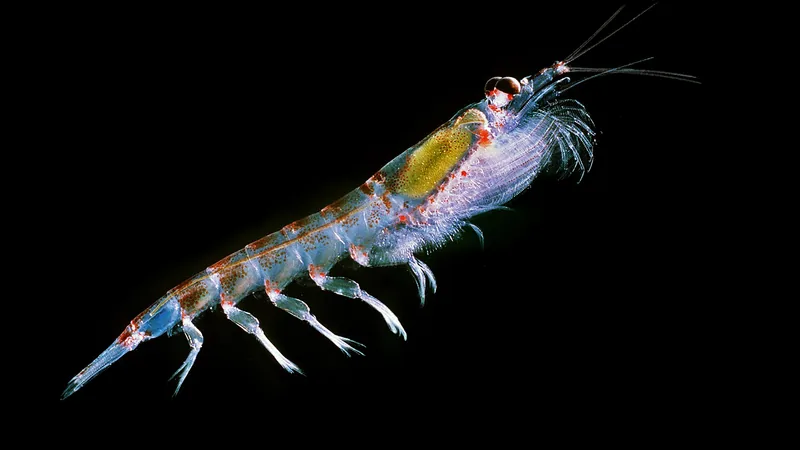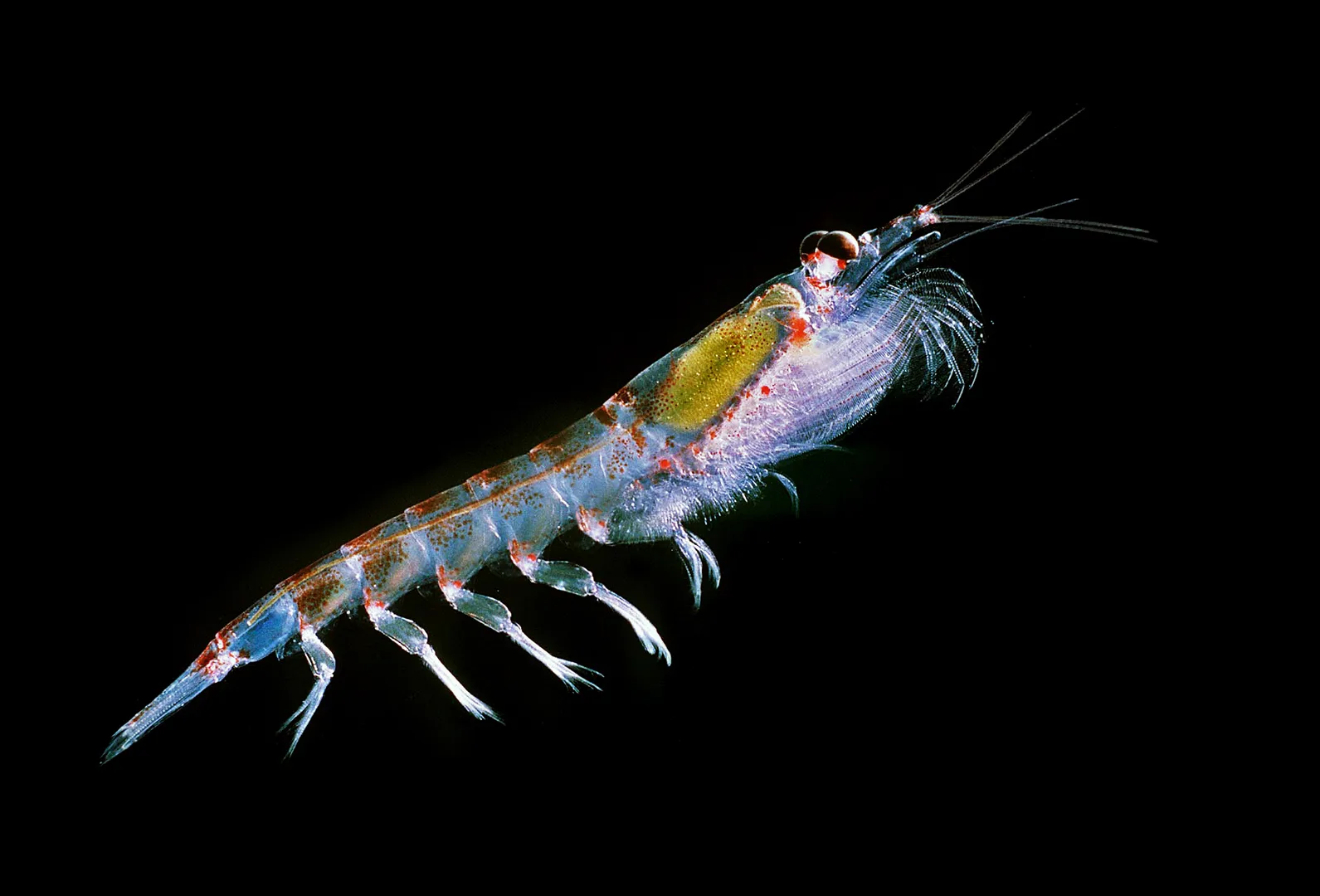
An Antarctic krill, the green of a phytoplankton meal visible through its shell.
Field
notes
Swarms That Turn the Sea Reddish-Brown
The Antarctic krill (Euphausia superba) is one of the most abundant animal species on the planet. It lives in the Antarctic waters of the Southern Ocean. An adult is about 6 centimeters long and weighs more than a gram. Scientists estimate it lives for 5 to 10 years.
Krill gather in schools or swarms, which can hold as many as 30,000 animals in one cubic meter of water. They are often so abundant that they color the sea reddish-brown. Scientists estimate there are 400 million tonnes of Antarctic krill in the Southern Ocean. A 2018 study of all the living matter on Earth, measured by the carbon in it, found Antarctic krill on a par with humans or cows.
A Filter Built From Its Own Legs
Krill usually feed by using their chest legs to form a watertight basket around a pocket of water and food. Water is squeezed out sideways through fine bristles. The phytoplankton (microscopic ocean plants) left in the basket is brushed forward into the mouth.
In winter, krill turn to other food: algae growing on the underside of the pack ice, detritus (bits of dead matter) on the seafloor, or other animals in the water. Food is scarce then, and lab studies show Antarctic krill can survive more than 200 days of starvation. They shrink as they starve. Krill can molt (shed their hard outer shell) all their lives, and they use it to shrink as well as grow. This “downsizing” lets them burn their own body proteins as fuel. At the end of summer, adults start to lose their sexual features. After a series of molts they look like two-year-old juveniles again, and in spring they mature once more.
Antarctic keystone Most of the larger Antarctic animals (seals, whales, seabirds, fish and squid) depend on Antarctic krill, directly or indirectly.
A Light That Points Away From the Light
A krill has ten photophores, organs that make light. They sit near its mouthparts, at its reproductive organs and at the base of its swimming legs, and they give off blue light. Eight of the ten sit at the tips of muscular stalks. In experiments, when white light shone on a krill, the stalks turned, pointing their light away from it, and the eyes turned at the same time. Removing the eyes, or covering the head with a hood, stopped the photophores moving together. The researchers concluded that krill need vision to aim their lights.
Krill That Grind Up Plastic
Filter feeders may be the animals most likely to swallow microplastics (tiny pieces of plastic), because filter feeding is fairly unselective. A krill chews its food with its mandibles (jaws), then passes it into its stomach and gastric mill, where it is mixed with digestive enzymes and chewed again. In a lab study, researchers fed Antarctic krill plastic beads averaging 31.5 micrometers wide (a micrometer is a millionth of a meter). Every krill ended up holding a mix of whole beads and fragments. Some pieces were less than 1 micrometer across. The authors think most of the grinding happened in the stomach and gastric mill.
Earlier feeding studies had shown microplastics either passing through an animal unchanged or being small enough already to cross into its body. The authors called krill’s grinding a new pathway, which gives krill, and potentially other species, a new role in what happens to plastic in the ocean.
Published Updated
Traits
Intel
& FAQ
Guess
first
How big is a Antarctic Krill, really? Slide, lock in, and see what the sources say. Every answer is a figure from this page, quoted from where it came from.
Sources
- 01Antarctic krill. Australian Antarctic Program, Australian Antarctic Division.
- 02Euphausia superba (Antarctic krill). Animal Diversity Web, University of Michigan.
- 03Kawaguchi & Nicol (2015). Euphausia superba. The IUCN Red List of Threatened Species 2015: e.T64239743A64239951.
- 04Hill (2012). Prospects for a Sustainable Increase in the Availability of Long Chain Omega 3s: Lessons from the Antarctic Krill Fishery. Omega-6/3 Fatty Acids.
- 05Grinnell et al. (1988). Eye/Photophore Coordination and Light-Following in Krill, Euphausia Superba. Journal of Experimental Biology.
- 06Dawson et al. (2018). Turning microplastics into nanoplastics through digestive fragmentation by Antarctic krill. Nature Communications.
- 07Bar-On, Phillips & Milo (2018). The biomass distribution on Earth. Proceedings of the National Academy of Sciences.
What the sources say: 51 claims checked word for word against these sources →