American lobster, Homarus americanus
Field
notes
Two claws, two jobs
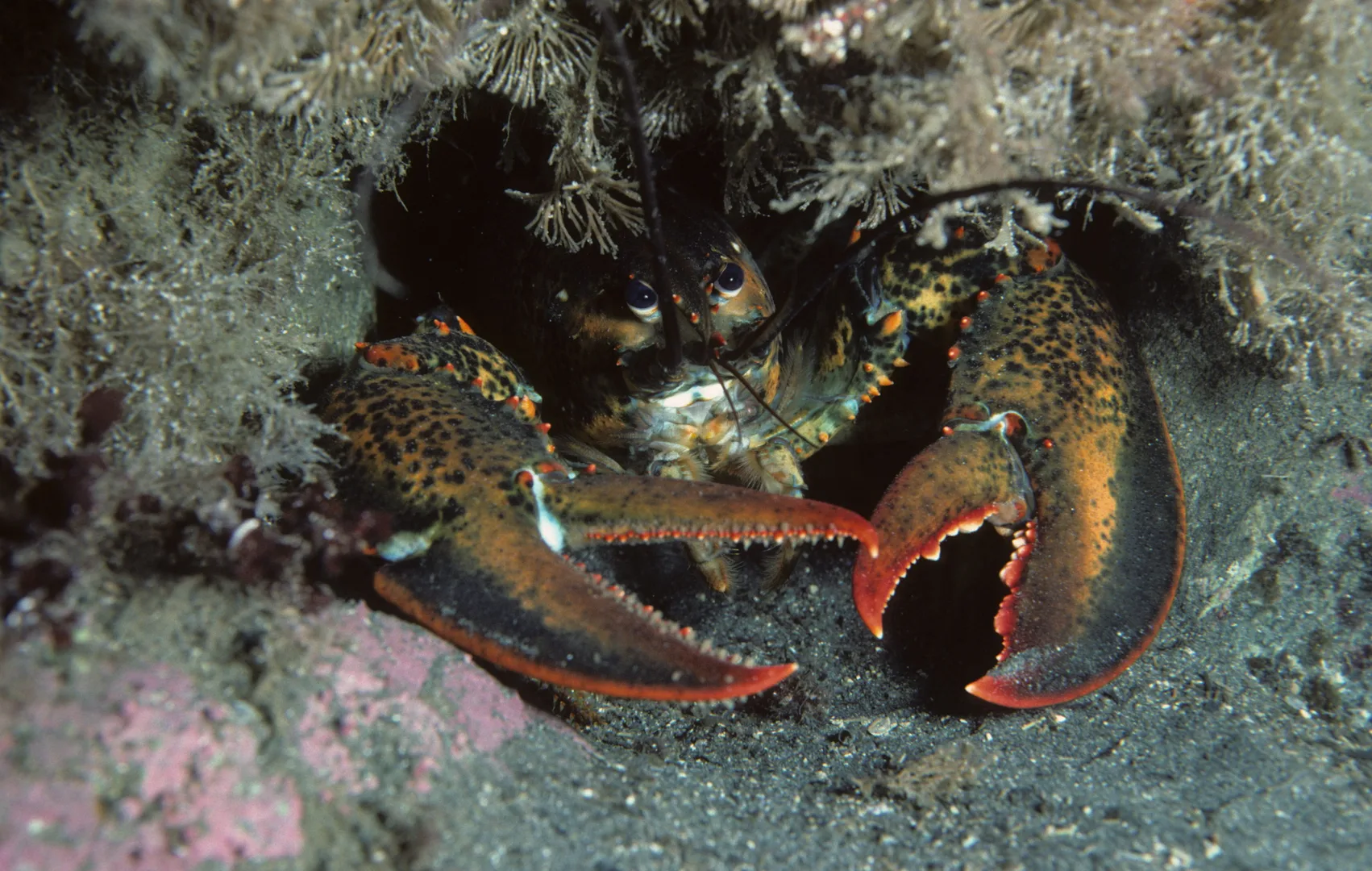
The American lobster is a crustacean with a large shrimp-like body and 10 legs, and two of those legs end in big claws. The claws are not twins. One is a big-toothed crusher for pulverizing shells. The other is a finer-edged ripper, resembling a steak knife, for tearing soft flesh.
A lobster of the size commonly caught is about 25 cm long and weighs about 0.5 kg. The giants are another story: they can weigh up to 44 pounds, roughly 20 kg. And forget the red shell from restaurants. Live lobsters are mostly olive-green or greenish-brown, and the red comes after cooking, when pigments in the shell break down.
Growing means escaping your own armor
A lobster’s skeleton is on the outside, and it must shed it in order to grow. Each time it outgrows its shell, it slides out and forms a new one. Then comes the odd part: it often devours its own vacated shell, which replenishes lost calcium and helps harden the new one. While the new shell hardens, the lobster stays in seclusion to avoid predators.
Molting marathon A lobster molts about 20 to 25 times over 5 to 8 years between hatching and being able to reproduce.
Shedding the shell also leaves no evidence of age, so an exact age is difficult to determine. NOAA says lobsters have a long life span and scientists believe some may live to be 100 years old.
A loner on the ocean floor
American lobsters live in the northwest Atlantic, from Labrador down to Cape Hatteras. They are most abundant in coastal waters from Maine through New Jersey, and they are also common offshore, to depths of 2,300 feet, from Maine through North Carolina. They live on the seafloor, alone, and they are very territorial. They can live in a variety of habitats as long as there is a burrow or crevice for cover.
They stay among the rocks by day and venture out at night to look for food. Adults are omnivores and eat whatever is most available, including crabs, mollusks, worms, sea urchins, sea stars, fish and macroalgae (seaweeds). Animal Diversity Web adds that a lobster is usually a scavenger, though it can capture its own prey. Its antennules, feelers on the head, carry more than 400 types of chemoreceptors, the sensors that detect chemicals. Lobsters use them to sense other species, potential mates, prey and predators.
Fight or flee
Young lobsters are especially vulnerable to predators, and fish, sharks, rays, skates, octopuses and crabs feed on lobsters. A 1977 study found that in larval and early juvenile stages, physiological and morphological factors favor the escape response over defense. In large animals, defensive behavior is preferred almost exclusively, unless the claws are lost. Large, hard-shelled lobsters may be immune to predators, except humans.
The IUCN Red List rates the species Least Concern.
Published
Traits
Intel
& FAQ
Guess
first
How big is a American Lobster, really? Slide, lock in, and see what the sources say. Every answer is a figure from this page, quoted from where it came from.
Sources
- 01American Lobster. NOAA Fisheries.
- 02Homarus americanus (American lobster). Animal Diversity Web, University of Michigan.
- 03Wahle et al. (2009). Homarus americanus. The IUCN Red List of Threatened Species 2011: e.T170009A6705155.
- 04Lang et al. (1977). Developmental Neuroethology: Changes in Escape and Defensive Behavior During Growth of the Lobster. Science.
What the sources say: 35 claims checked word for word against these sources →