Birgus latro
Field
notes
The Biggest Arthropod on Land
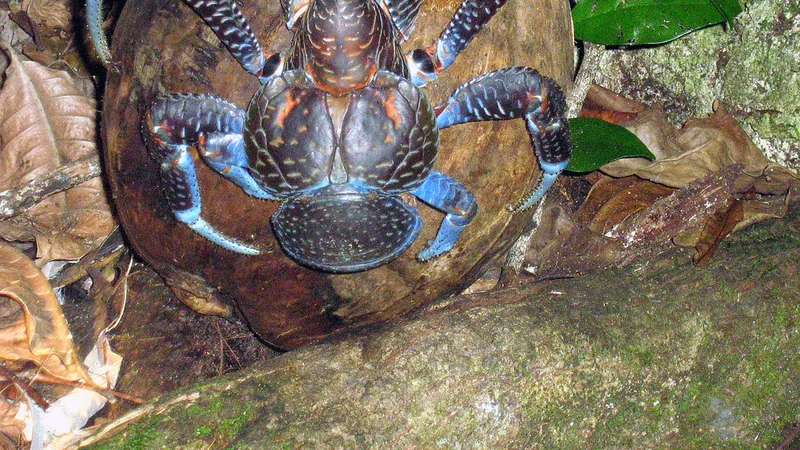
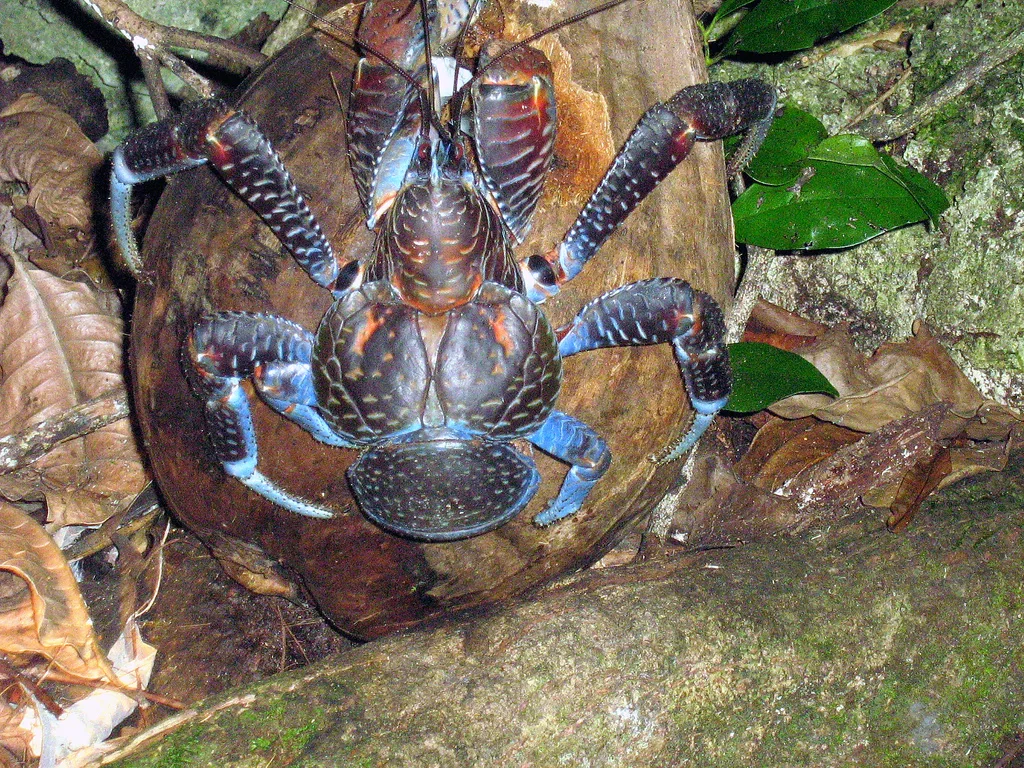
The coconut crab (Birgus latro) is a hermit crab that outgrows the borrowed shells of its youth. Animal Diversity Web records a maximum carapace length of 200 millimeters, a leg span of up to a meter from tip to tip, and a top weight of 4 kilograms, and a GPS-tracking study on Christmas Island calls it “the world’s largest land-living arthropod.” Growing that big takes decades: a review of the species says it “reach[es] their maximum size only after 40-60 years,” and the tracking study notes it “can reach an age of up to 60 years.”
The Mighty Claw
A crab has several ways into a coconut: it may haul one up a tree and drop it, or poke a claw through one of the coconut’s soft “eyes” to split it open. That claw is a serious tool. Researchers had 29 wild crabs, weighing up to 2.1 kilograms, pinch a steel sensor, and the strongest pinch measured 1,765 newtons. Using their equation linking weight to pinch strength, the team estimated what a crab at the species’ reported 4-kilogram maximum could manage: 3,300 newtons.
How it compares That estimated 3,300-newton pinch would far exceed the pinch of every other crustacean species reported, and beat the bite force of most living land predators, alligators excepted.
Lungs on Land, Larvae at Sea
A coconut crab’s gill area, for its body weight, is the smallest measured in any land crab, and its gills do little to take up oxygen; it breathes through branchiostegal lungs instead. One study on the species puts the risk plainly: apart from its marine larval stage, the crab “is fully terrestrial, and will actually drown if submerged in water.” Breeding still needs the sea: a female releases up to 138,000 eggs into shallow water in one spawn, and the hatchlings drift through several larval stages at sea before migrating onto land.
A Loner With a Nose Like an Insect’s
Spread across small tropical islands in the Indian and Pacific Oceans, coconut crabs live in burrows and are mostly solitary. Adults scavenge fruit, nuts, seeds and carrion, other crabs included. On Christmas Island, GPS-tagged males made short trips from a home site, mostly at night, and some roamed several kilometers between the coast and inland forest; crabs moved away from home could find their way back over large distances. Their sense of smell is unusual too. One study found the crab’s nose has evolved to resemble an insect’s, with similarities in physiology, behavior, and anatomy: convergent evolution, where similar pressures produce similar solutions.
Published Updated
Traits
Intel
& FAQ
Guess
first
How big is a Coconut Crab, really? Slide, lock in, and see what the sources say. Every answer is a figure from this page, quoted from where it came from.
Sources
- 01Birgus latro (coconut crab). Animal Diversity Web, University of Michigan.
- 02Oka, Tomita & Miyamoto (2016). A Mighty Claw: Pinching Force of the Coconut Crab, the Largest Terrestrial Crustacean. PLOS ONE.
- 03Kumaralingam (2020). The Robber Crab Birgus latro (Linnaeus, 1767). Crustacea.
- 04Stensmyr et al. (2005). Insect-Like Olfactory Adaptations in the Terrestrial Giant Robber Crab. Current Biology.
- 05Krieger et al. (2012). Giant Robber Crabs Monitored from Space: GPS-Based Telemetric Studies on Christmas Island (Indian Ocean). PLoS ONE.
- 06Greenaway (2003). Terrestrial adaptations in the Anomura (Crustacea: Decapoda). Memoirs of Museum Victoria.
- 07Cumberlidge (2020). Birgus latro. The IUCN Red List of Threatened Species 2020: e.T2811A126813586.
What the sources say: 56 claims checked word for word against these sources →