Tasmanian devils (Sarcophilus harrisii)
Field
notes
A Bite That Outclasses Its Size
The Tasmanian devil (Sarcophilus harrisii) is the world’s largest living carnivorous marsupial, though “largest” is relative: it is about the size of a small dog. Its body measures 57 to 65 centimeters, plus a 24-to-26-centimeter tail, and it weighs 5 to 14 kilograms, with males heavier than females. A devil can live five to eight years. A 2005 study estimated the bite force of a wide sample of living and fossil mammal predators and scaled it to body size, and no living species in the study came out ahead of the devil.
Nature’s Cleanup Crew
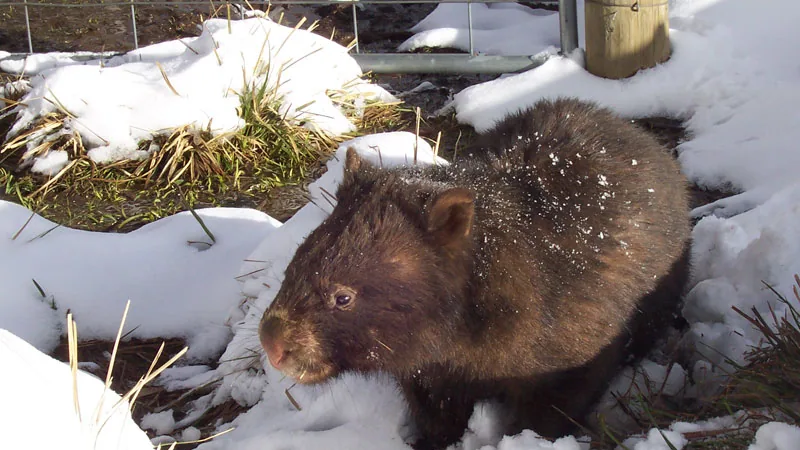
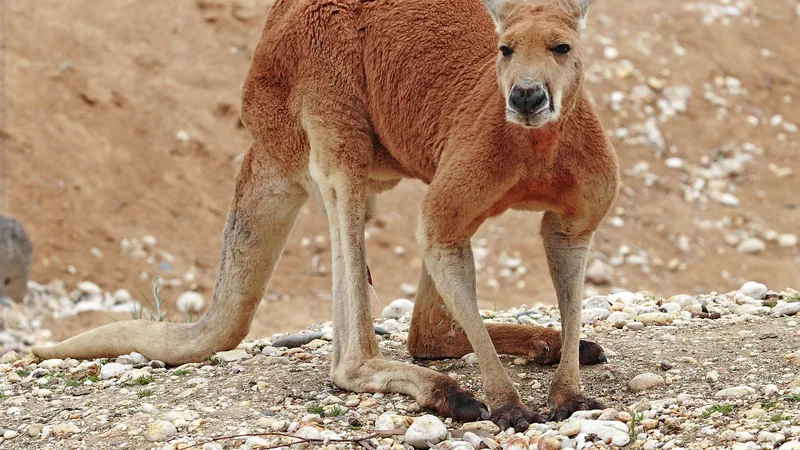
Devils are scavengers first and hunters second. At night they follow their nose to carrion, mostly the carcasses of possums and macropods, the kangaroo and wallaby family. They also hunt live prey: slow animals such as wombats, sick wallabies and lambs, and small mammals and birds. Insects, snakes and small amounts of plant matter get eaten when a devil comes across them. Powerful jaws and shearing teeth let a devil eat most of a carcass, bones included, and fur goes down too. Devils live alone, but they often gather at carcasses, and the feeding turns rowdy, with aggression and loud calls.
A Forty Percent Feast In a 1993 field study of devils feeding together at carcasses, they gorged on roughly 40 percent of their own body mass.
Mostly Bluff
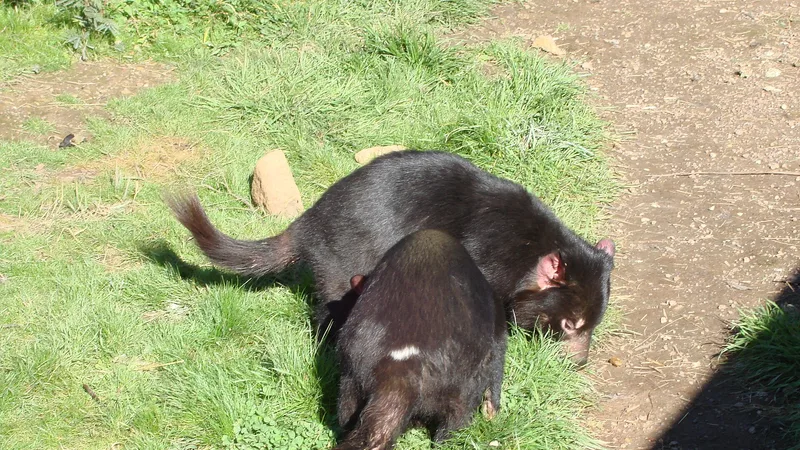
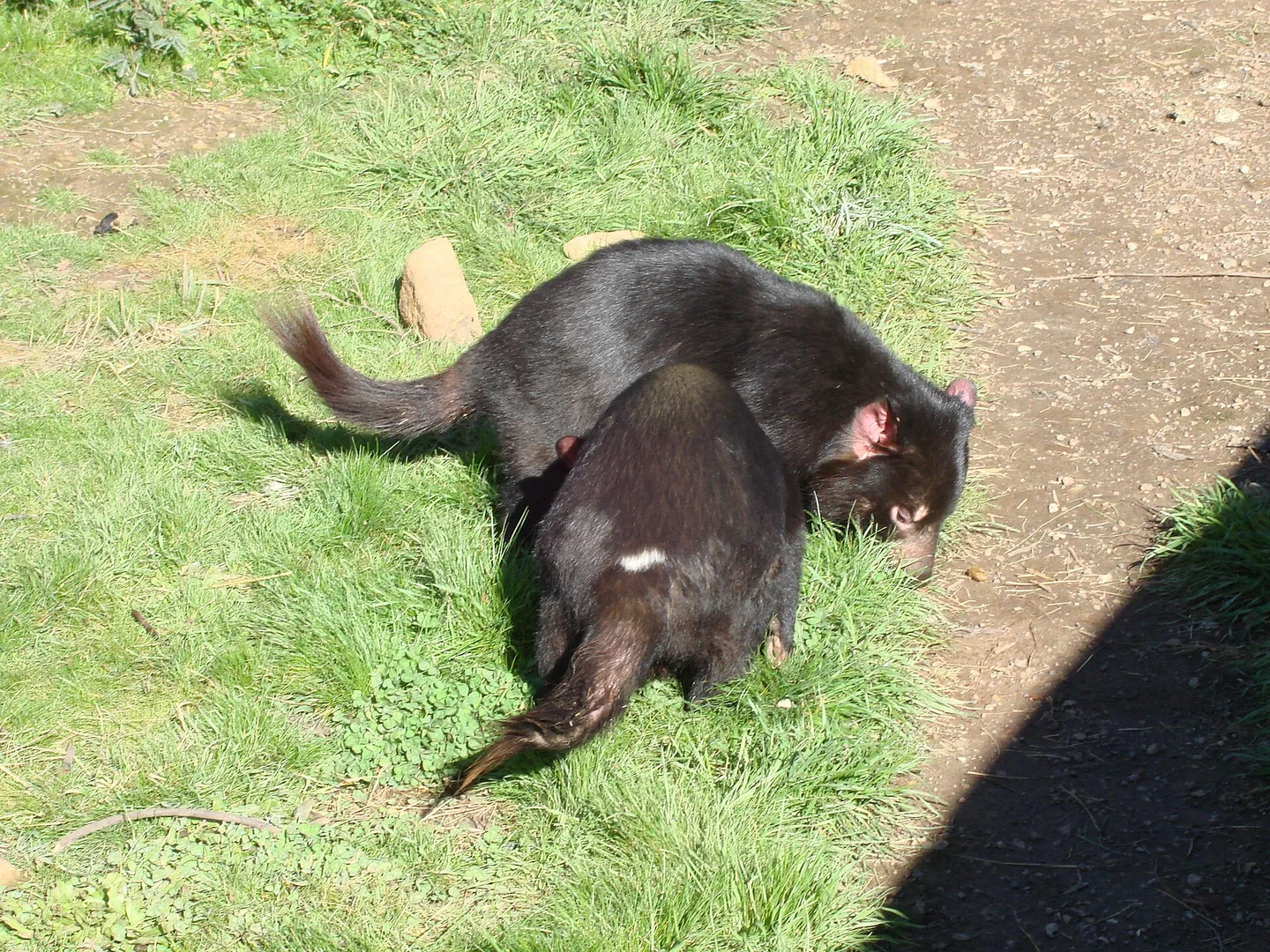
At feeding sites, aggressive encounters between devils seldom turn into physical fights, a 1993 field study found, though the few that did left damage and heavy scarring on the muzzle and rump, and adult males were scarred most. A devil’s famous gape, a wide-open yawn, looks threatening but is more likely to signal fear and uncertainty than aggression. Devils also give off a foul odor under stress, may sneeze hard before a fight, and use fierce snarls and high-pitched screams to establish dominance at a carcass. Most of this is bluff, part of a ritual that cuts down on real fighting: after a nose-to-nose confrontation, during which their ears flush red, one or both devils usually back down.
A Cancer That Brought the Species to the Brink
Devil facial tumour disease (DFTD) is a contagious cancer, first detected in 1996. It spreads through biting, which is common when devils mate and feed, and the tumor cells themselves pass from one devil to the next. That makes each tumor a graft, tissue from a different animal, which the immune system should recognize and reject. A 2016 study explains how DFTD slips through: devils have very little genetic variation, and the tumor interferes with MHC molecules, which play a key role in immune responses to tumors and grafts. That appears to leave every devil susceptible. The disease is fatal in nearly every case, and within 20 years of its detection the species had declined by more than 80 percent overall, with local declines of more than 90 percent.
Devils have shown they can respond. In five disease-hit populations tracked for a 2008 study, the cancer killed almost every devil past its first year of adult life, and the share of devils reaching breeding age unusually early rose 16-fold. The 2016 study also found matching signs of natural selection in three separate populations on genes linked in humans to immune function or cancer risk, which suggests devils are evolving resistance that could help the species survive.
Published Updated
Traits
Intel
& FAQ
Guess
first
How big is a Tasmanian Devil, really? Slide, lock in, and see what the sources say. Every answer is a figure from this page, quoted from where it came from.
Sources
- 01Tasmanian Devil. San Diego Zoo Wildlife Alliance.
- 02Sarcophilus harrisii (Tasmanian devil). Animal Diversity Web, University of Michigan.
- 03Sarcophilus harrisii - Tasmanian Devil. Species Profile and Threats Database, Australian Government Department of the Environment.
- 04Tasmanian Devils FAQs. Department of Natural Resources and Environment Tasmania, 2022.
- 05Pemberton & Renouf (1993). A Field-Study of Communication and Social-Behavior of the Tasmanian Devil at Feeding Sites. Australian Journal of Zoology.
- 06Wroe, McHenry & Thomason (2005). Bite club: comparative bite force in big biting mammals and the prediction of predatory behaviour in fossil taxa. Proceedings of the Royal Society B: Biological Sciences.
- 07Siddle et al. (2007). Transmission of a fatal clonal tumor by biting occurs due to depleted MHC diversity in a threatened carnivorous marsupial. Proceedings of the National Academy of Sciences.
- 08Jones et al. (2008). Life-history change in disease-ravaged Tasmanian devil populations. Proceedings of the National Academy of Sciences.
- 09Epstein et al. (2016). Rapid evolutionary response to a transmissible cancer in Tasmanian devils. Nature Communications.
- 10Hawkins et al. (2008). Sarcophilus harrisii. The IUCN Red List of Threatened Species 2008: e.T40540A10331066.
What the sources say: 82 claims checked word for word against these sources →