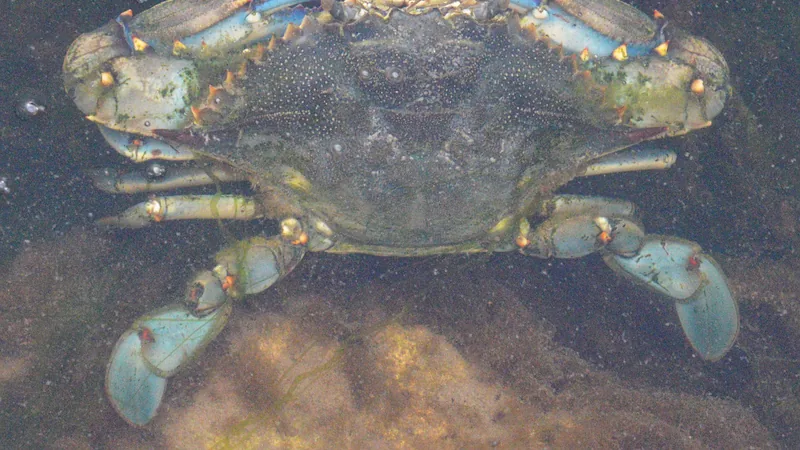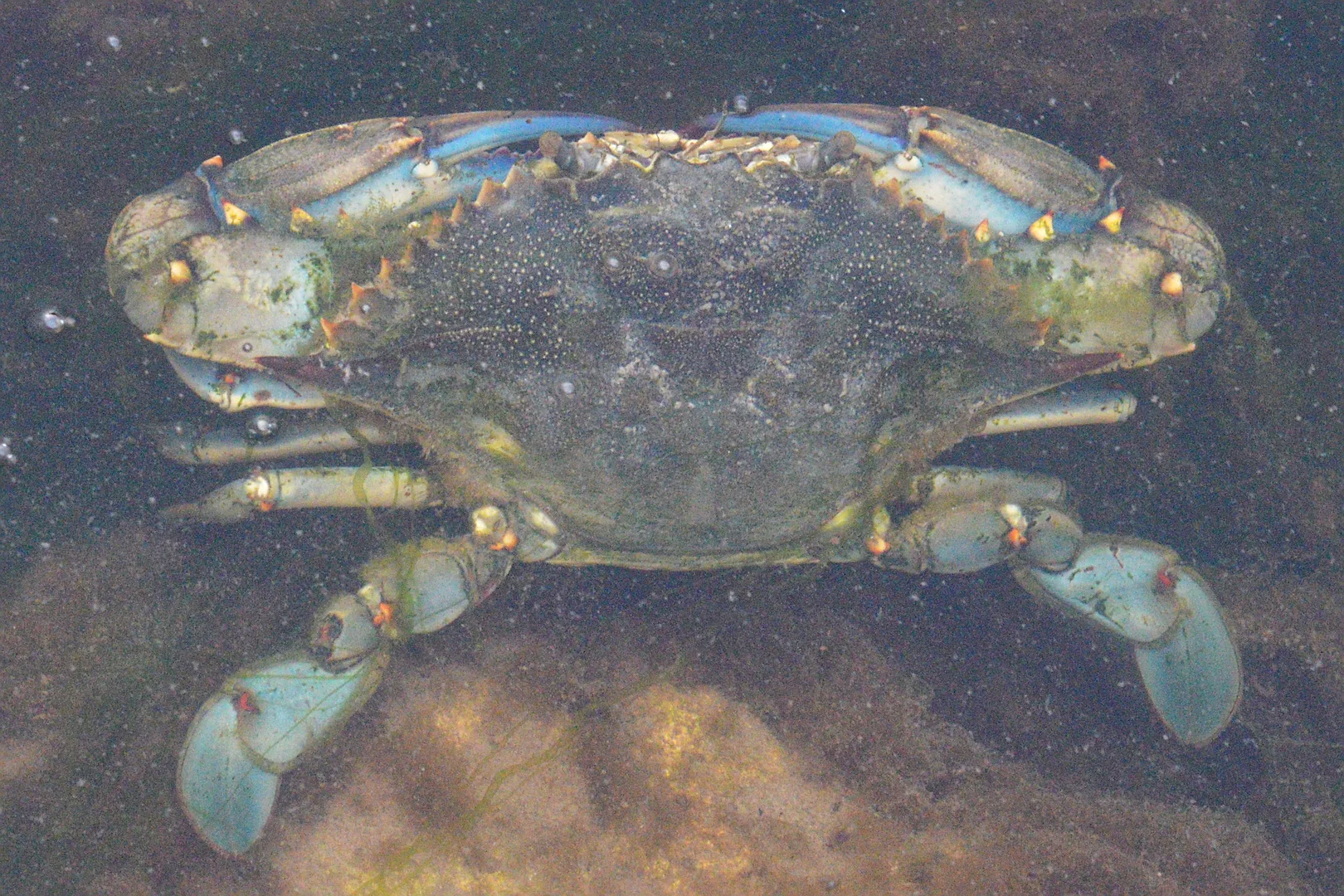
Atlantic Blue Crab ( Callinectes sapidus ) in Alcúdia, Spain.
Field
notes
Beautiful savory swimmer
The Atlantic blue crab, Callinectes sapidus, is a crab built to swim. Its Latin name translates as “beautiful savory swimmer”, and behind its three pairs of walking legs are swimming legs that look like paddles. The shell, called the carapace, is blue to olive green, the claws are bright blue, and mature females have red tips on theirs.
Doubler Before a female’s final molt, a male cradles her for a few days in a pose called a doubler. After mating he stays with her until her shell hardens, which also keeps another male from mating with her.
Size, weight and lifespan
A blue crab’s shell can reach about 9 inches across, measured tip to tip, though crabs are usually harvested before they get that big. A typical crab at maturity weighs about a third of a pound. The largest blue crab caught in the Chesapeake Bay weighed 1.1 pounds and measured 10.72 inches tip to tip.
Blue crabs generally live 3 or 4 years and mature in 12 to 18 months. Crabs grow faster in warmer water. In the Gulf of America a crab may be mature within a year, but in the Chesapeake Bay it may take 18 months.
Growing means shedding
A blue crab molts as it grows, shedding its hard shell. Because it loses hard parts in the process, a crab’s age is hard to determine.
A blue crab’s menu is wide: clams, oysters, mussels, smaller crustaceans, freshly dead fish and plant and animal debris, plus smaller and soft-shelled blue crabs. Predators include large fish, some fish-eating birds such as great blue herons, and sea turtles.
Chesapeake Bay females travel to the Bay’s mouth to spawn, and one brood can hold anywhere from 750,000 to 3,200,000 eggs.
From Nova Scotia to Argentina
Blue crabs are native to the Atlantic coast of the Americas, from Nova Scotia to Argentina, and that includes the Gulf of America. SeaLifeBase lists them as introduced in the Eastern Atlantic, Mediterranean Sea, Black Sea and Indo-Pacific.
In the Chesapeake Bay, male crabs tend to prefer the fresher waters of Maryland and the upper tributaries, while females like the saltier waters of the main Bay. As the water cools, crabs bury themselves in the sediment of the deeper Bay for winter. According to NOAA, no fishery in the Chesapeake Bay is worth more.
Published
Traits
Intel
& FAQ
Guess
first
How big is a Atlantic Blue Crab, really? Slide, lock in, and see what the sources say. Every answer is a figure from this page, quoted from where it came from.