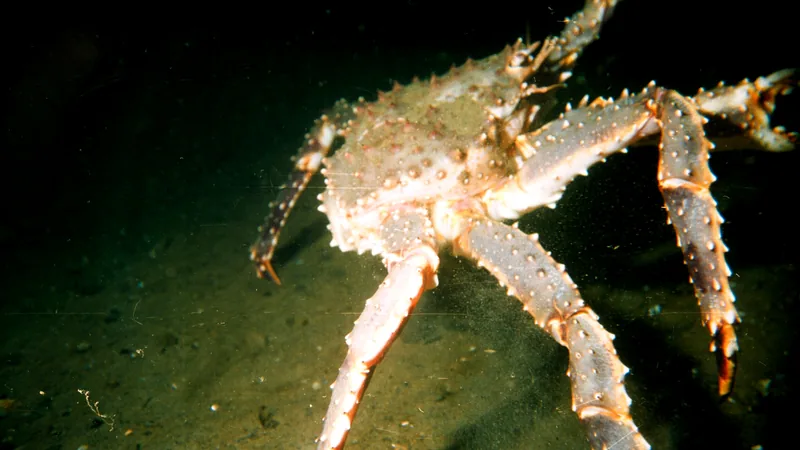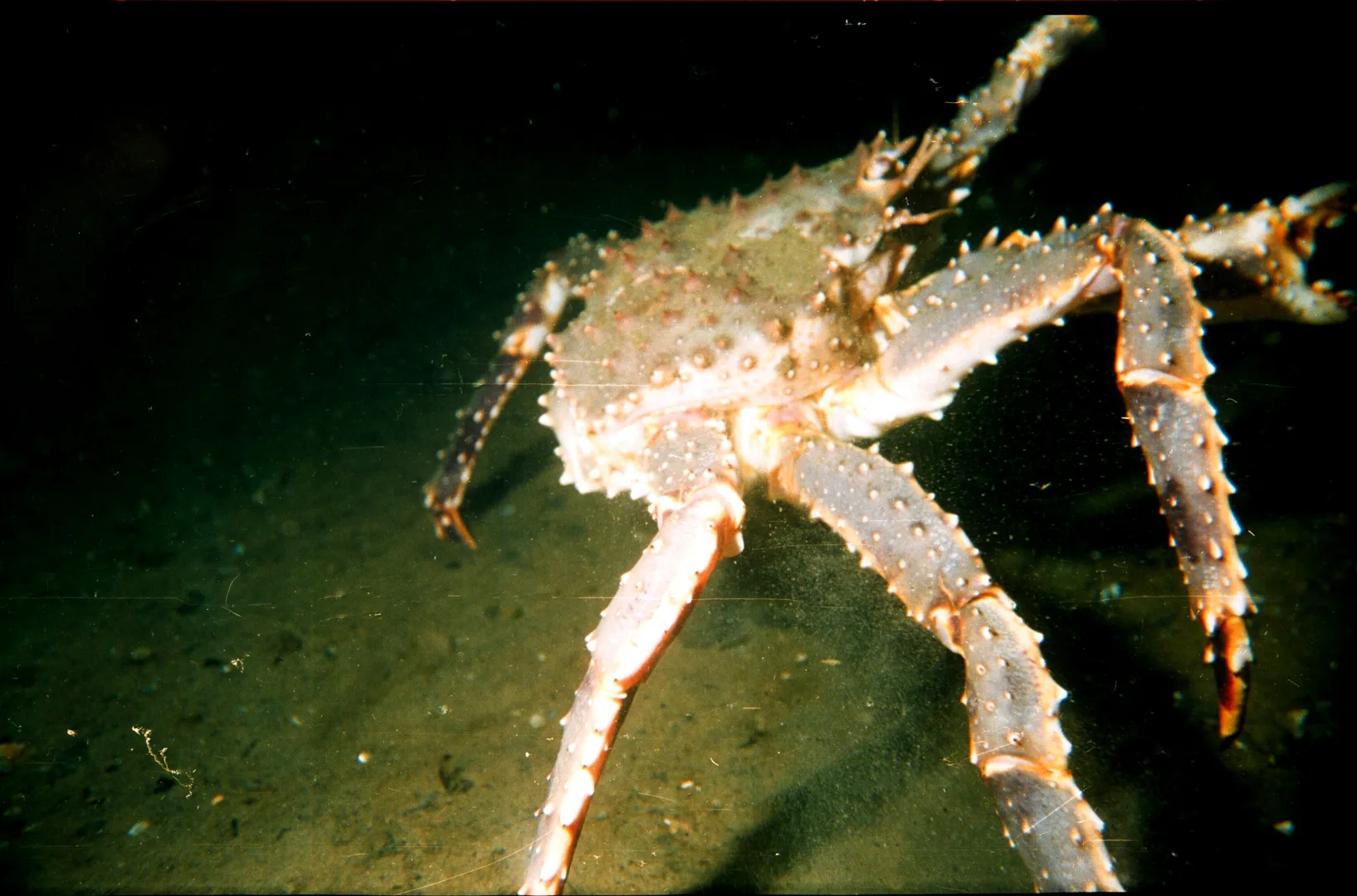
Large male red king crab (Paralithodes camtschaticus) in the Barents Sea at Kola Bay at Belokanenka, Lat.
Field
notes
Crab mobs that mound up by day
Juveniles under 2 years old live in shallow, cluttered seabed to avoid being preyed on by fish and other crabs. Think shell hash, cobble, algae and bryozoans, which are branching, coral-like animals. Older juveniles form pods that travel together. They mound up during the day and feed at night.
Safety in numbers Pods can hold tens of thousands of crabs. They are likely an anti-predator strategy, similar to schooling in fish.
Mature crabs move into deeper water, typically less than 650 feet along the continental shelf, to feed. Females come back to the shallows to hatch their eggs.
Armor with a soft spot
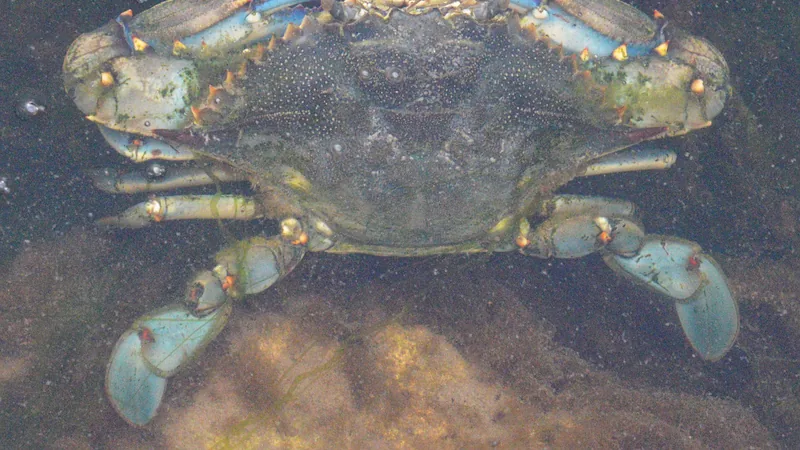
This is the largest of the commercially harvested crabs. It grows up to 24 pounds with a leg span of 5 feet, and males grow faster and larger than females. Its body is brownish to bluish red and covered in sharp spines. The claws are different shapes. One is large and heavy-duty, for crushing prey. The smaller one handles food more delicately.
The shell has a catch. A red king crab can only grow by molting (shedding its old shell and growing a new one). Until the new shell hardens, the crab is soft and vulnerable to predators. Large crabs have few predators except right after a molt. As of 2013 there was no method to age a red king crab, so its maximum age was unknown, but likely at least 20 years.
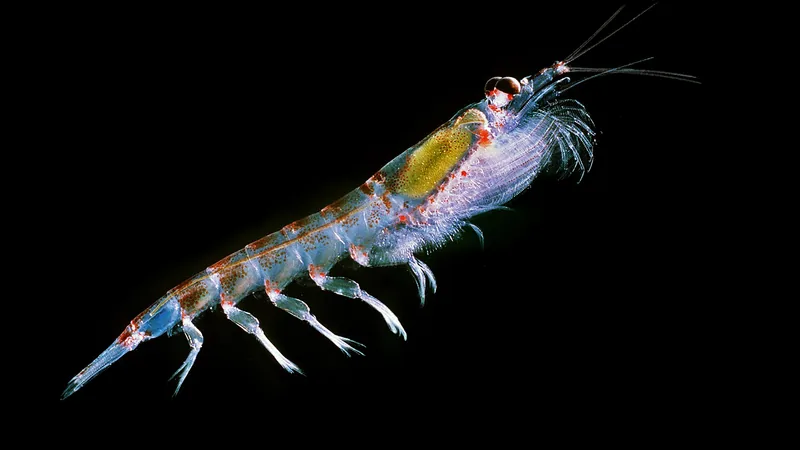
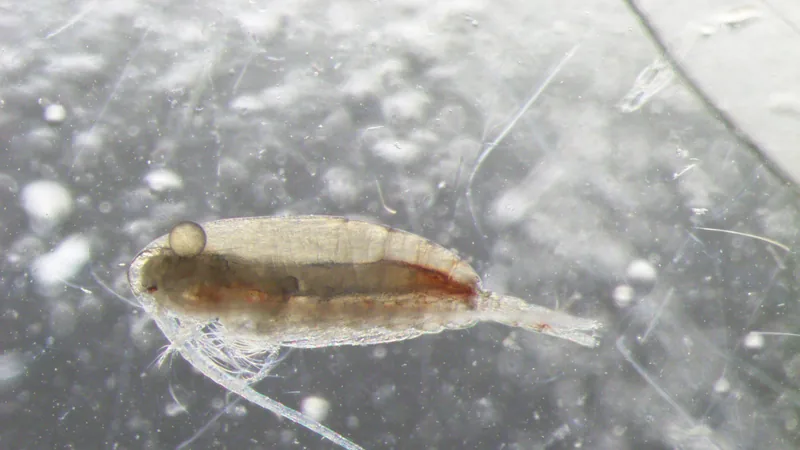
The crab eats almost anything it can find and crush with its claws. Bigger crabs go for worms, clams, mussels, barnacles, other crabs, fish, sea stars, sand dollars and brittle stars. Females breed once a year and release 50,000 to 500,000 eggs, and the larvae hatch looking like tiny shrimp.
From the Bering Sea to the Barents Sea
In North American waters, this crab lives in the Bering Sea and Aleutian Islands, along the Gulf of Alaska and south to British Columbia. It was also introduced to the Barents Sea from the North Pacific in the 1960s, where a 2011 review called it invasive. Reduced benthic diversity and biomass, meaning less life on the seabed, have been recorded in invaded areas.
At home in Alaska, it is a fishery. Managers use the “three S’s”: size, sex and season. In the 2025 stock assessment, the Bristol Bay stock was not overfished, though the fishery was closed for the 2021/2022 and 2022/2023 seasons because of a low abundance of mature females.
Published
Traits
Intel
& FAQ
Guess
first
How big is a Red King Crab, really? Slide, lock in, and see what the sources say. Every answer is a figure from this page, quoted from where it came from.
Sources
- 01Red King Crab. NOAA Fisheries.
- 02Falk-Petersen, Renaud & Anisimova (2011). Establishment and ecosystem effects of the alien invasive red king crab (Paralithodes camtschaticus) in the Barents Sea–a review. ICES Journal of Marine Science.
- 03Long et al. (2013). Effects of Ocean Acidification on Juvenile Red King Crab (Paralithodes camtschaticus) and Tanner Crab (Chionoecetes bairdi) Growth, Condition, Calcification, and Survival. PLoS ONE.
- 04Paralithodes camtschaticus (red king crab). Animal Diversity Web, University of Michigan.
What the sources say: 40 claims checked word for word against these sources →