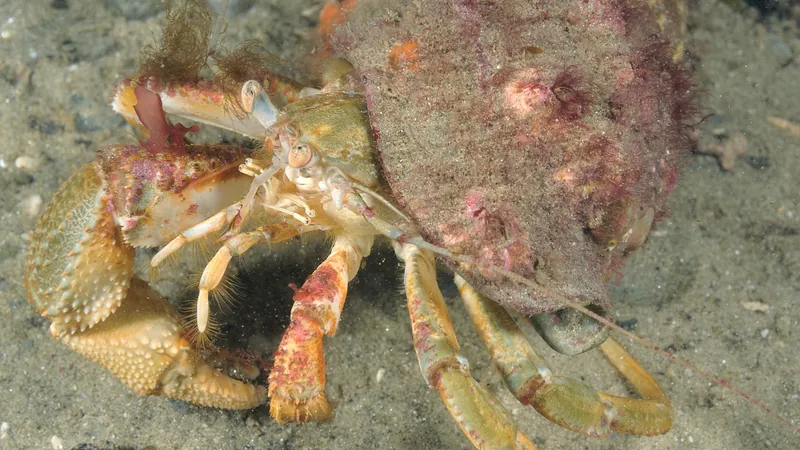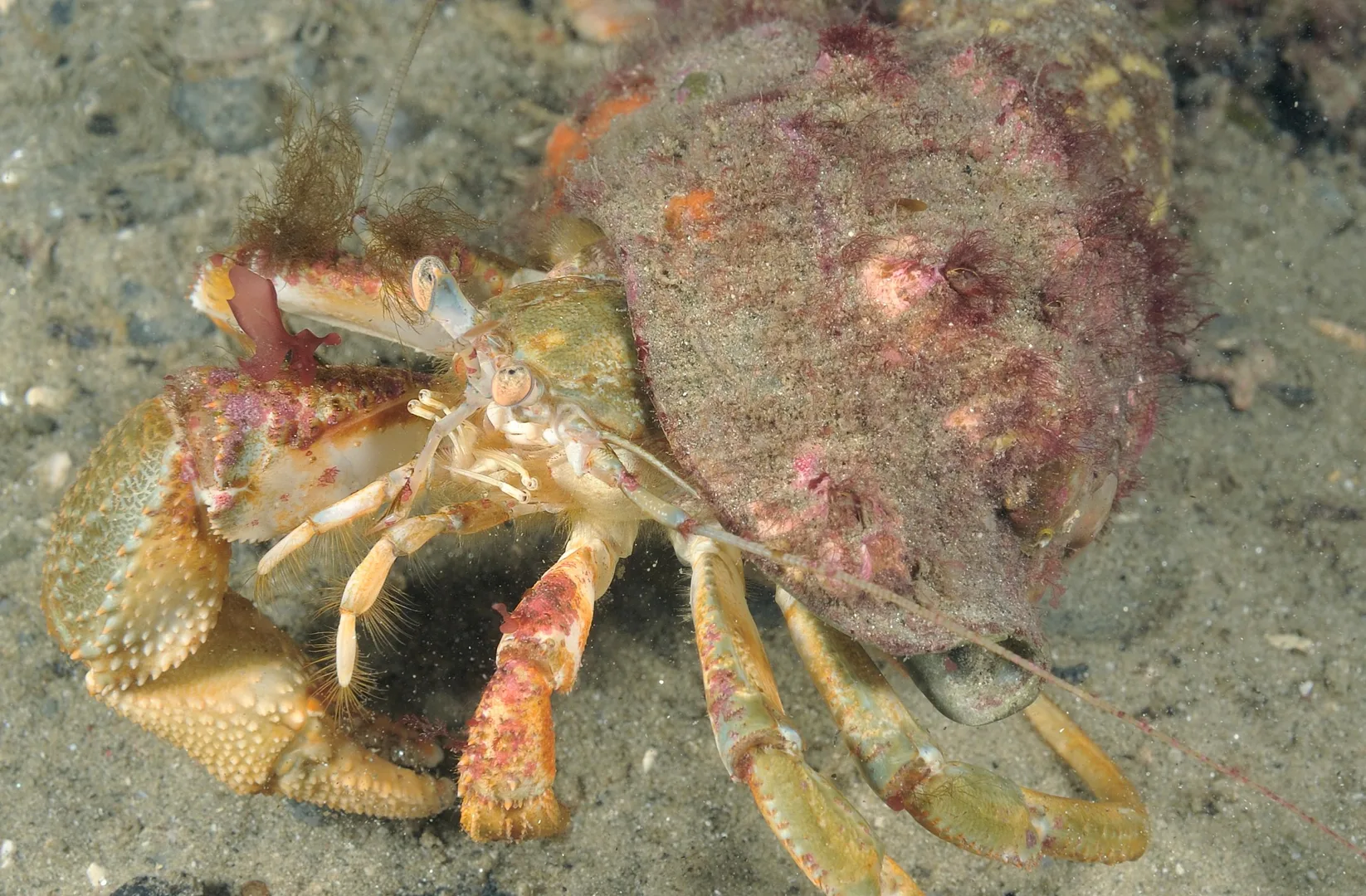
On the seabed in the Bay of Brest, France, its shell furred with a colonial hydroid.
Field
notes
A soft body in a borrowed home
The common hermit crab (Pagurus bernhardus) has a front encased in a carapace of three thick layers and a soft abdomen, the tail end, coiled to the right. It lives in the abandoned shells of animals such as edible periwinkles and dog whelks. Its last two pairs of walking legs are greatly reduced and hold the shell in place.
The Wildlife Trusts give its body length as 3.5 cm. Animal Diversity Web records a maximum body length of 8 cm and an average weight of 7.3 g, within a range of 0.13 to 54 g. As it grows, it moves into ever larger shells. The fit matters: a shell that is too large does not give the best protection, and one that is too small restricts growth. Animal Diversity Web says the crab is known to live for up to four years in the wild.
Knock, knock, get out
Crabs may attack each other to claim a shell. Before any physical fight, they trade visual displays: a crab either raises its body high off the ground or lowers it in submission. If neither backs down, one crab may crawl onto its opponent’s shell and rap on it with its claws. The Wildlife Trusts describe the aggressor drawing the owner out and fighting until one emerges victorious.
Rap battle Over 500 raps have been observed in a single shell fight.
Around half of these fights end with the attacker swapping shells with its opponent. Larger crabs, and those with larger claws, are usually more successful than small and medium ones.
A fussy house hunter
Shell selection has been extensively studied in this crab. It is able to remember shells it has rejected before. A crab with no shell, or one in a shell that gives too little protection or space, decides to move very quickly.
When researchers exposed crabs to anthropogenic (human-made) noise during shell selection, the crabs approached the shell faster, spent less time investigating it and entered it faster.
Scavenger of the northeast Atlantic
This crab lives in the near-shore North Atlantic waters of northwestern Europe, from the White Sea to the British Isles, and as far south as Portugal. It lives on most seabeds, including rocky and shell bottoms, seagrass beds and sandy or silty sediments, but not mud. It is most often found at depths up to 80 m, and The Wildlife Trusts record it from rocky shores down to 150 m.
It is a scavenger, eating scraps of dead animals, plants and microscopic bivalves, and it is known to turn cannibal when resources run low. It is nocturnal.
Published
Traits
Intel
& FAQ
Guess
first
How big is a Common Hermit Crab, really? Slide, lock in, and see what the sources say. Every answer is a figure from this page, quoted from where it came from.
Sources
- 01Pagurus bernhardus (common hermit crab). Animal Diversity Web, University of Michigan.
- 02Hermit crab. The Wildlife Trusts.
- 03Walsh, Arnott & Kunc (2017). Noise affects resource assessment in an invertebrate. Biology Letters.
- 04Crump et al. (2020). Microplastics disrupt hermit crab shell selection. Biology Letters.
What the sources say: 49 claims checked word for word against these sources →