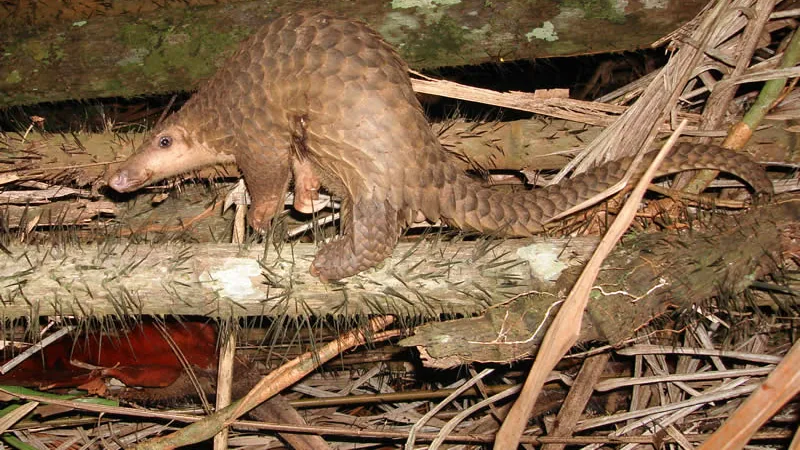
A wild giant ground pangolin (Smutsia gigantea) on an infrared camera trap at night
Field
notes
The Biggest Pangolin Alive
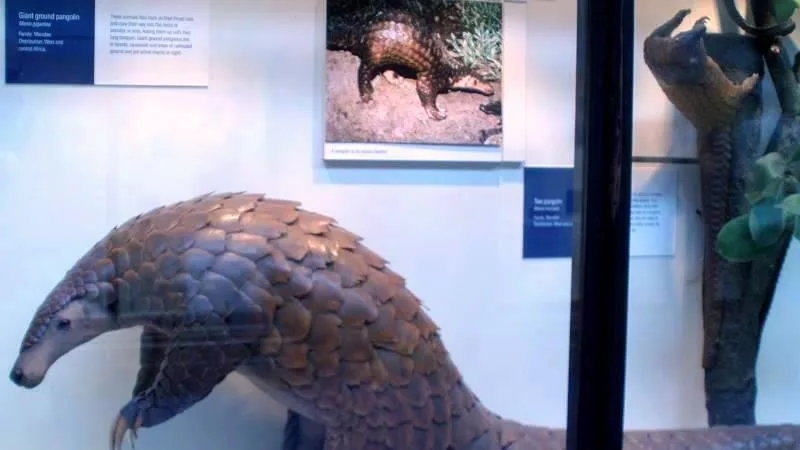
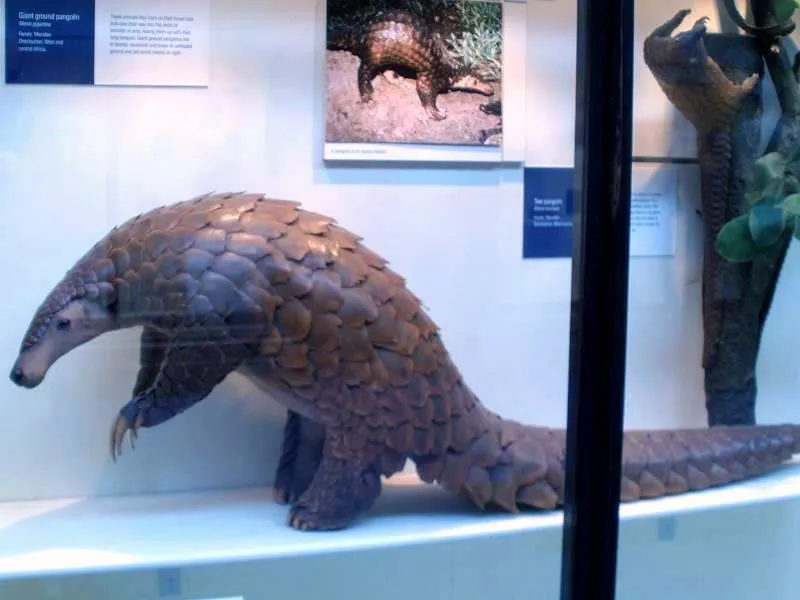
The giant pangolin (Smutsia gigantea) is the largest living pangolin species. It weighs 30 to 35 kilograms and averages about 1.5 meters long. Its back, tail and the outside of its legs are covered in overlapping grey-brown scales made of keratin, the same material as your fingernails. Its belly has no scales.
If it can’t reach its burrow in time, a giant pangolin curls into a tight ball with only its scales showing. Once rolled up, it is virtually impossible to uncurl, and by tightening its muscles it can cause deep cuts with its scales. It can also squirt a foul-smelling liquid from its rear end to drive predators away.
No Teeth and a Very Long Tongue
Giant pangolins have no teeth and none of the muscles used for chewing. They dig into underground ant and termite nests with three large, curved claws on each front foot. Then they trap the insects on a tongue up to 70 centimeters long, coated in sticky saliva. A hard, layered lining in the stomach crushes the insects’ tough outer skeletons.
Where the Tongue Goes Pulled back in, a giant pangolin’s tongue runs beneath its chest and windpipe all the way down to its abdomen. Part of it folds into the neck, leaving a bulge on the outside.
It lives only where ants and termites, its only food, are available all year round. Its home is rainforest, swamp forest and wooded savanna across Central and West Africa, and it prefers moist places close to water. It digs its own burrows, which can be several meters deep, or moves into ones another animal has abandoned. It sleeps there through the day, forages alone at night and never climbs trees.
Rare, Hunted and Still Turning Up
Poaching (illegal hunting) and habitat loss are causing severe population declines. Giant pangolins are thought to be extinct in Rwanda, and scientists have projected they could vanish from some countries within two decades, even with no further habitat loss. Pangolins are thought to be among the most trafficked mammals in the world, mainly for their meat and for scales used in traditional medicine. The species also remains poorly studied, with big gaps in basic facts about its biology.
Even so, it is still being found. In 2018, three separate records placed giant pangolins in the mountain forests of western Kenya, about 500 kilometers east of the nearest confirmed population in Uganda. In 2023, camera traps (cameras that fire automatically when an animal passes) rediscovered the species in Senegal’s Niokolo-Koba National Park, 24 years after its last documented sighting there in 1999.
Published Updated
Traits
Intel
& FAQ
Guess
first
How big is a Giant Ground Pangolin, really? Slide, lock in, and see what the sources say. Every answer is a figure from this page, quoted from where it came from.
Sources
- 01Manis gigantea (giant pangolin). Animal Diversity Web, University of Michigan.
- 02Giant pangolin (Smutsia gigantea). IUCN SSC Pangolin Specialist Group.
- 03Nixon et al. (2019). Smutsia gigantea. The IUCN Red List of Threatened Species 2019: e.T12762A123584478.
- 04Mwale et al. (2017). Forensic application of DNA barcoding for identification of illegally traded African pangolin scales. Genome.
- 05Montblanc et al. (2026). First hematological and biochemical findings in a rehabilitated giant pangolin (Smutsia gigantea) from Southern Cameroon. Frontiers in Veterinary Science.
- 06Sandri et al. (2022). Three spatially separate records confirm the presence of and provide a range extension for the giant pangolin Smutsia gigantea in Kenya. Oryx.
- 07Ndiaye et al. (2024). Rediscovery of the endangered giant pangolin (Smutsia gigantea) in Senegal after 24 years. African Journal of Ecology.
What the sources say: 68 claims checked word for word against these sources →