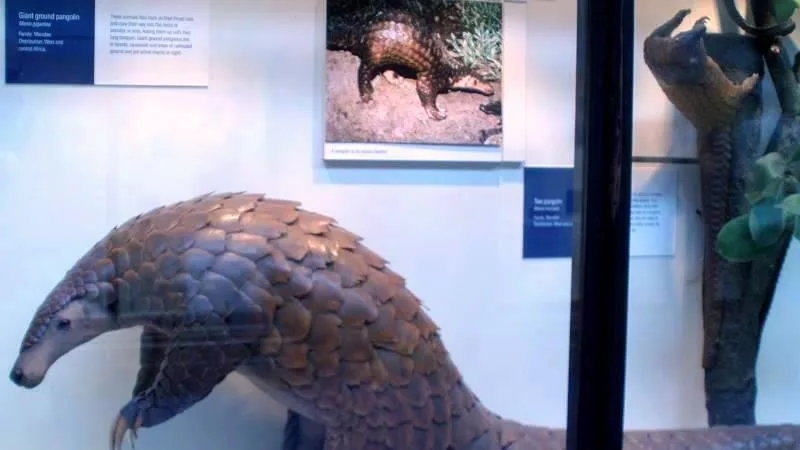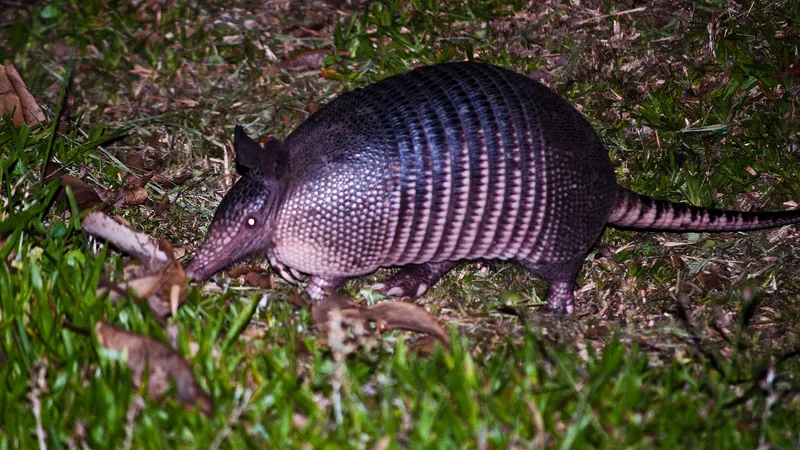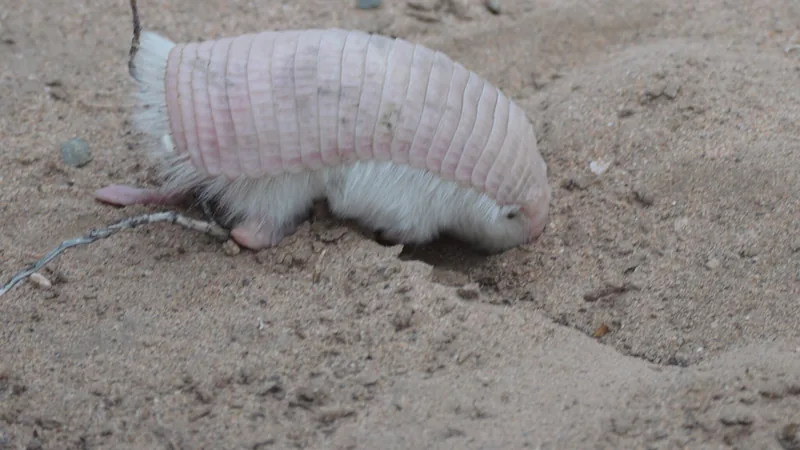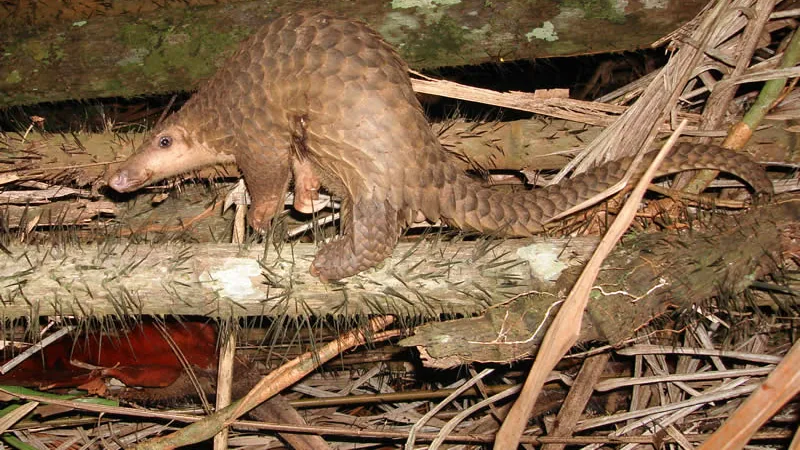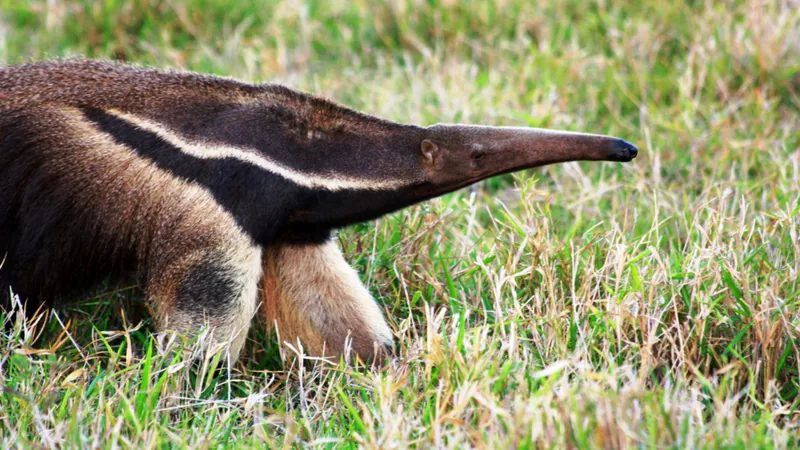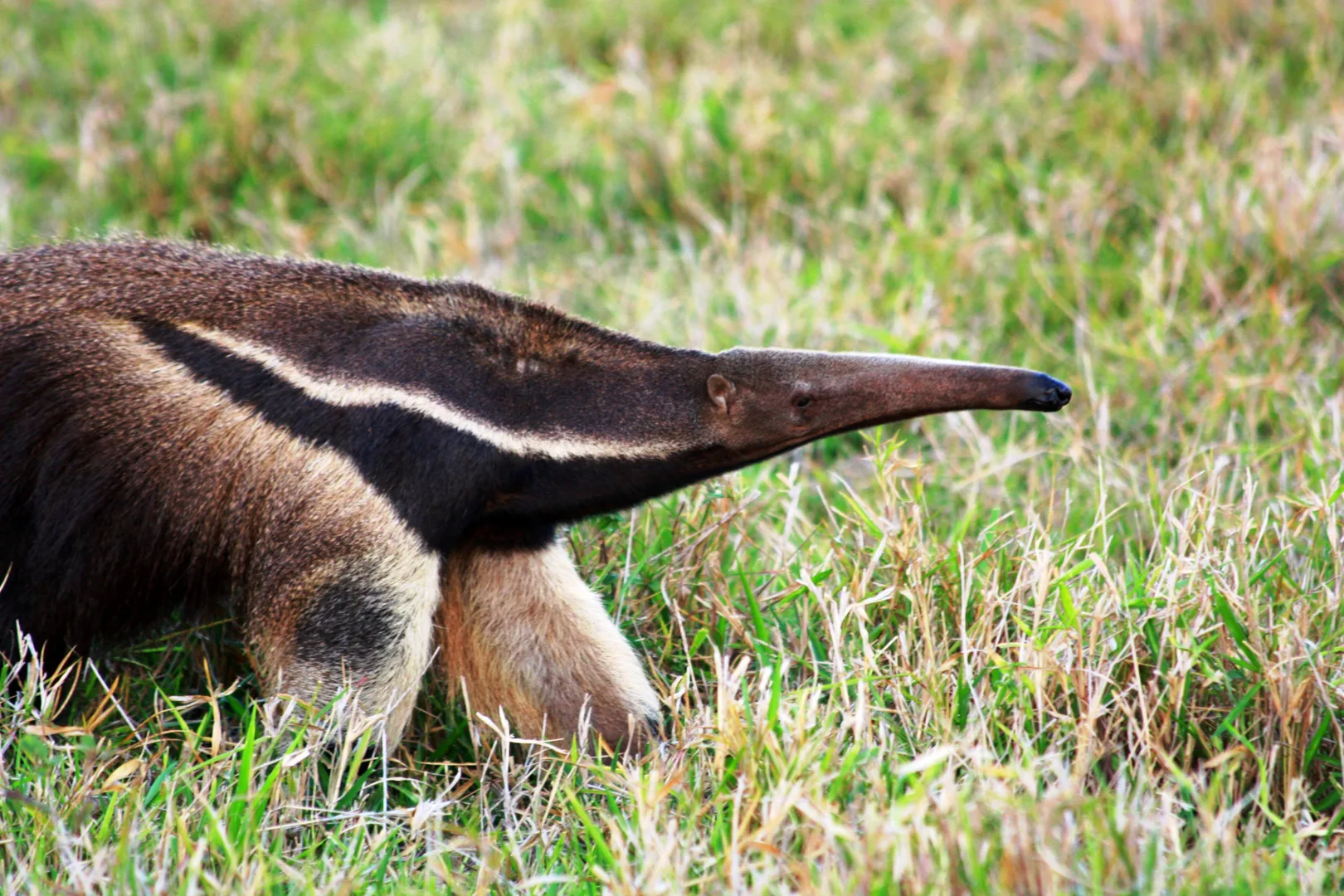
The anteater can be found in multiple habitats, including grassland and rainforest.
Field
notes
A tongue with no teeth to help
A giant anteater has no teeth. It eats with a 2-foot (60 cm) tongue that is coated in sticky saliva and can flick in and out up to 150 times per minute. That tongue is attached to the sternum, the flat bone in the middle of the chest.
Research has found that it can tell the species of ant or termite by smell before it tears a nest apart. It rips open ant and termite nests with its powerful forelimbs and claws, then takes in the insects with its sticky tongue.
An anteater is not immune to ant bites, so it feeds at a colony for a minute or so before moving on. Even so, it can eat up to 30,000 ants and termites each day.
Nose power A giant anteater’s sense of smell is 40 times more powerful than ours.
Big, shaggy and built to shuffle
This is the largest of the four anteater species. It reaches 6 to 8 feet (1.8 to 2.4 m) long, counting both nose and tail, and weighs 60 to 100 pounds (27 to 45 kg). The hair on its legs and tail resembles the texture of a horse’s mane.
The front claws are sharp. The anteater protects them by tucking them into its palms and walking on its front knuckles. The usual gait is a slow shuffle, yet when it has to, it can gallop at over 30 miles per hour (48 km/h).
Its body runs cool too. At 32.7 degrees Celsius (91 degrees Fahrenheit), it has one of the lowest body temperatures of any mammal, presumably in response to a low-calorie diet of insects.
Rear up, claws out
The anteater avoids threats if it can. If it cannot, it rears up, steadies itself on its large tail and uses its powerful claws. Its size makes it invulnerable to all but the largest predators, jaguars and pumas primarily.
Where it lives and how long
Giant anteaters live in wetlands, grasslands and tropical forests throughout Central and South America. They are considered extinct in Guatemala, Uruguay and El Salvador. The IUCN Red List rates the species Vulnerable.
How long a wild anteater lives is unknown. In captivity, an AnAge entry reports one estimated at 31 years old when it died.
Published Updated
Traits
Intel
& FAQ
Guess
first
How big is a Giant Anteater, really? Slide, lock in, and see what the sources say. Every answer is a figure from this page, quoted from where it came from.
Sources
- 01Haddad et al. (2014). Human Death Caused by a Giant Anteater (Myrmecophaga tridactyla) in Brazil. Wilderness & Environmental Medicine.
- 02Giant anteater. Smithsonian's National Zoo and Conservation Biology Institute.
- 03Giant Anteater. San Diego Zoo Wildlife Alliance.
- 04Myrmecophaga tridactyla (giant anteater). Animal Diversity Web, University of Michigan.
- 05AnAge entry for Myrmecophaga tridactyla. AnAge: The Animal Ageing and Longevity Database, Human Ageing Genomic Resources.
- 06Miranda et al. (2025). Myrmecophaga tridactyla. The IUCN Red List of Threatened Species 2025: e.T14224A210444314.
What the sources say: 44 claims checked word for word against these sources →