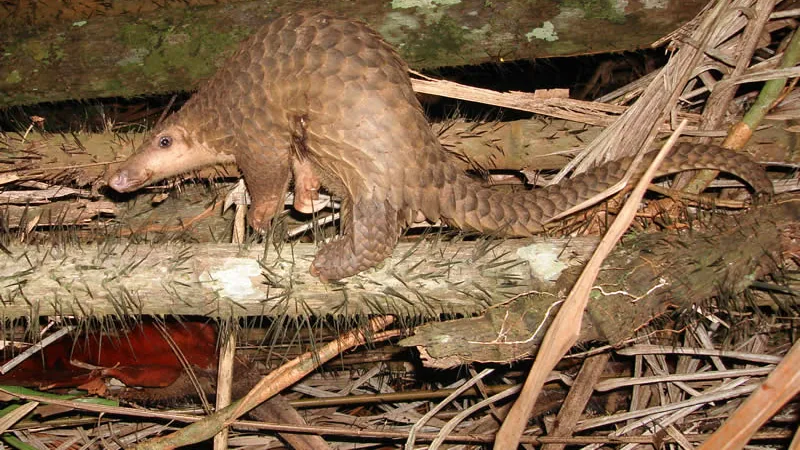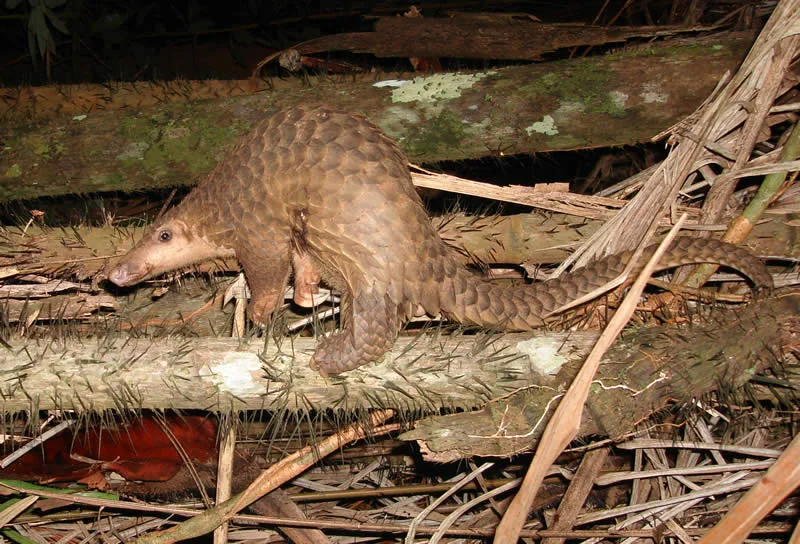
Sunda pangolin (Manis javanica) in Borneo
Field
notes
Scales Derived From Hair
Unlike other placental mammals, pangolins have skin covered in large, overlapping keratinized scales. In the Sunda pangolin these scales are derived from hairs, and a 2016 genome study proposed that their evolution likely involved genes related to hair formation. Sunda pangolins are 79 to 88 centimetres long, tail included, and males are typically larger than females. A study at Wildlife Reserves Singapore counted captive pangolins as adult above 4 kilograms for females and 6 for males. In a separate study of captive cubs, the females’ average weight levelled off at 5.4 kilograms by 16.4 months old, which the authors took as physical maturity.
A Missing Immunity Gene The same genome study found IFNE, a gene important in skin and mucosal immunity and intact in 71 other mammal species, disabled by mutations in both the Malayan (another name for the Sunda) and Chinese pangolins. The authors proposed that the scales may compensate for the immunity the skin would normally provide.
Rolled Into a Tight Ball
A Sunda pangolin’s known predators include leopards and pythons. When threatened, it swishes its tail about with the pointed scales erect. If that doesn’t work, it curls up into a tight ball with its soft belly protected within. Pangolins curl into near-impregnable balls this way using a well-developed neuromuscular system, the genome study notes. If the ball is unrolled, the pangolin’s last resort is to squirt a foul-smelling liquid while emptying its bowels at the same time.
Finding Food by Smell
A Sunda pangolin has no teeth. Its tongue extends about 25 centimetres and is coated in sticky saliva that helps it collect termites and ants. The tongue passes through the chest cavity and anchors to the pelvis, and the skeleton is adapted to fit it, including the lack of a collarbone. In a small 2020 study, two pangolins found the baited one of two containers by smell alone, while one given only sight or only sound did not. The single pangolin tested on all three senses may be able to follow prey scent trails to their source, but the researchers found no evidence it could start a hunt from distant prey odours. An adult pangolin may eat an estimated 70 million insects a year, and its forefeet carry large digging claws.
Hunted for Scales and Meat
The Sunda pangolin is Critically Endangered. It ranges across Brunei, Cambodia, Indonesia, Laos, Malaysia, Myanmar, Singapore, Thailand and Vietnam, in primary and secondary forest, open savanna and thick bush, and is often found in gardens and plantations. It is hunted for its skin, scales and meat, and its parts are used as medicine. The IUCN’s Pangolin Specialist Group calls it the mammal most frequently found in illicit trade in Asia.
In 2020, researchers reported SARS-CoV-2-related coronaviruses in Malayan pangolins seized in anti-smuggling operations in southern China, and suggested pangolins should be considered possible hosts in the emergence of new coronaviruses. A separate study swabbed 334 Sunda pangolins confiscated in Peninsular Malaysia and Sabah between 2009 and 2019, and none tested positive for a coronavirus. Its authors concluded that the related viruses found in pangolins were more plausibly caught after the animals entered the trade network, and that Sunda pangolins are likely incidental rather than reservoir hosts.
Published Updated
Traits
Intel
& FAQ
Guess
first
How big is a Sunda Pangolin, really? Slide, lock in, and see what the sources say. Every answer is a figure from this page, quoted from where it came from.
Sources
- 01Manis javanica (Malayan pangolin). Animal Diversity Web, University of Michigan.
- 02Challender et al. (2019). Manis javanica. The IUCN Red List of Threatened Species 2019: e.T12763A123584856.
- 03Sunda pangolin (Manis javanica). IUCN SSC Pangolin Specialist Group.
- 04Choo et al. (2016). Pangolin genomes and the evolution of mammalian scales and immunity. Genome Research.
- 05Ahmad et al. (2021). Hematology and serum biochemistry of captive Sunda pangolin (Manis javanica) in Wildlife Reserves Singapore. Journal of Veterinary Medical Science.
- 06Yan et al. (2022). Weaning period and growth patterns of captive Sunda pangolin (Manis javanica) cubs. PLOS ONE.
- 07DiPaola, Yindee & Plotnik (2020). Investigating the use of sensory information to detect and track prey by the Sunda pangolin (Manis javanica) with conservation in mind. Scientific Reports.
- 08Lam et al. (2020). Identifying SARS-CoV-2-related coronaviruses in Malayan pangolins. Nature.
- 09Lee et al. (2020). No Evidence of Coronaviruses or Other Potentially Zoonotic Viruses in Sunda pangolins (Manis javanica) Entering the Wildlife Trade via Malaysia. EcoHealth.
What the sources say: 50 claims checked word for word against these sources →