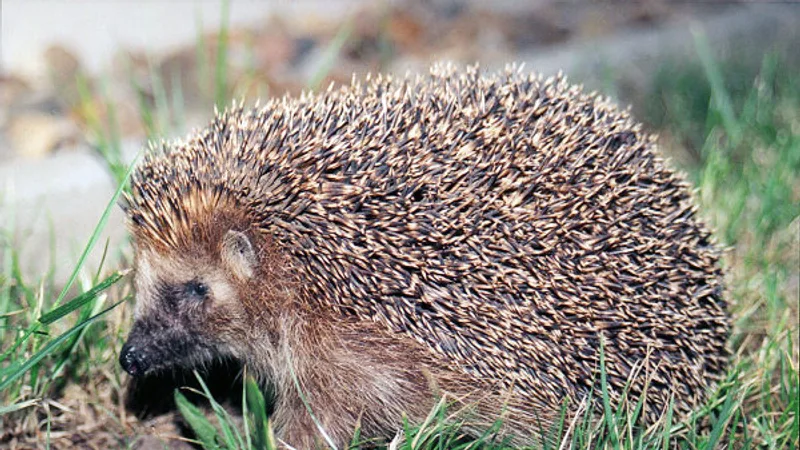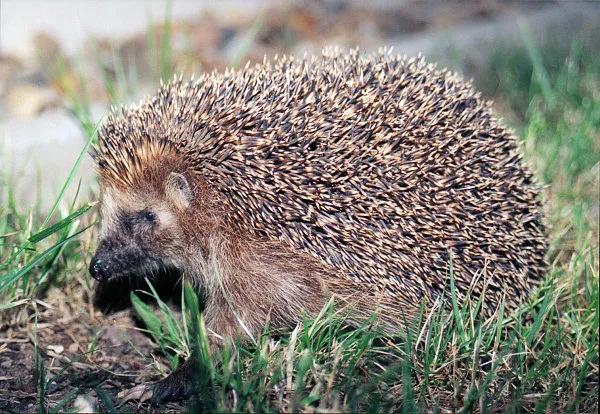
A European hedgehog (Erinaceus europaeus) in grass.
Field
notes
Rolling Into a Ball
Threaten a European hedgehog (Erinaceus europaeus) and it curls into a ball, protecting its face and vulnerable underbelly. A sheet of muscle called the panniculus carnosus covers its back, and contracting it pulls the hedgehog into that ball. At the same time, the muscles linked to each of its roughly 6,000 hollow keratin spines contract too, leaving every spine standing on end.
The ball can protect a hedgehog from most natural enemies. Badgers and foxes may be able to wedge their noses into the crease where the top and bottom of the spiny coat meet, and predators have been known to drop a balled-up hedgehog from a height to stun or injure it long enough to reach its exposed underbelly.
On the Move at Night
Hedgehogs are 22 to 28 cm long, and adults weigh between 450 and 1,500 g. By day a hedgehog usually rests in a shallow nest of twigs, leaves and grass. It is mostly active at night or after heavy rain, and travels 1 to 2 kilometres a night. Although hedgehogs are usually thought of as slow, they can move at up to 40 metres a minute. When foraging they tend to follow linear features, meaning long, narrow strips of landscape. A hedgehog uses its keen sense of smell to find food: ground-dwelling invertebrates (animals without backbones), especially worms, beetles, slugs, caterpillars, millipedes and earwigs, plus birds’ eggs and carrion (dead animals).
Frothy and Unexplained Occasionally, some hedgehogs produce large amounts of frothy saliva and spread it over their spines. The behavior has a name, self-anointment, but its purpose is still a mystery.
Hibernation, and Losing Ground
In Britain, hedgehogs hibernate between November and the end of March, when food is scarce, staying largely inactive to save energy. Stored fat keeps them insulated and gives them the energy to wake up when necessary, and hibernating hedgehogs take periodic breaks to forage.
Hedgehogs are found throughout western Europe, including mainland Britain and Ireland, and north as far as Scandinavia. They live especially along field edges and hedgerows, often in gardens and parks, and are absent from large conifer plantations, marshes and moorland. In Britain there is considerable evidence of a dramatic decline, with around a third of the population lost since the millennium. Worldwide, the species is now listed as Near Threatened on the IUCN Red List. Hedgehogs live about two years on average, and a small percentage reach five.
Published Updated
Traits
Intel
& FAQ
Guess
first
How big is a European Hedgehog, really? Slide, lock in, and see what the sources say. Every answer is a figure from this page, quoted from where it came from.
Sources
- 01Hedgehog. People's Trust for Endangered Species, Facts and Figures.
- 02Erinaceus europaeus (western European hedgehog). Animal Diversity Web, University of Michigan.
- 03Gazzard & Rasmussen (2024). Erinaceus europaeus. The IUCN Red List of Threatened Species 2024: e.T29650A213411773.
What the sources say: 46 claims checked word for word against these sources →