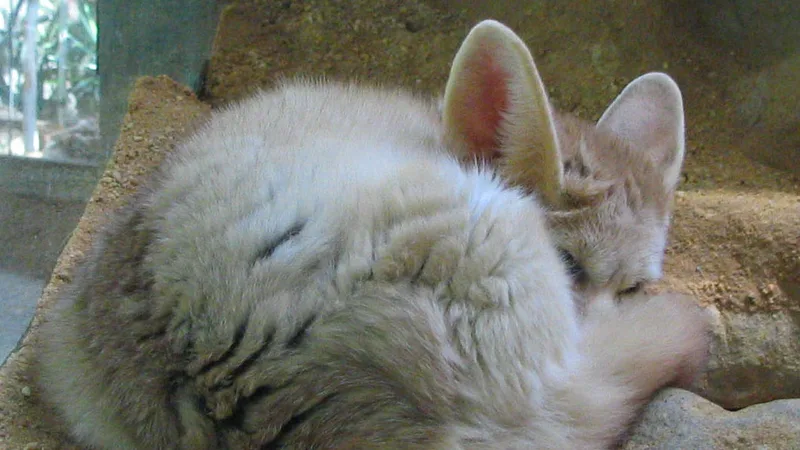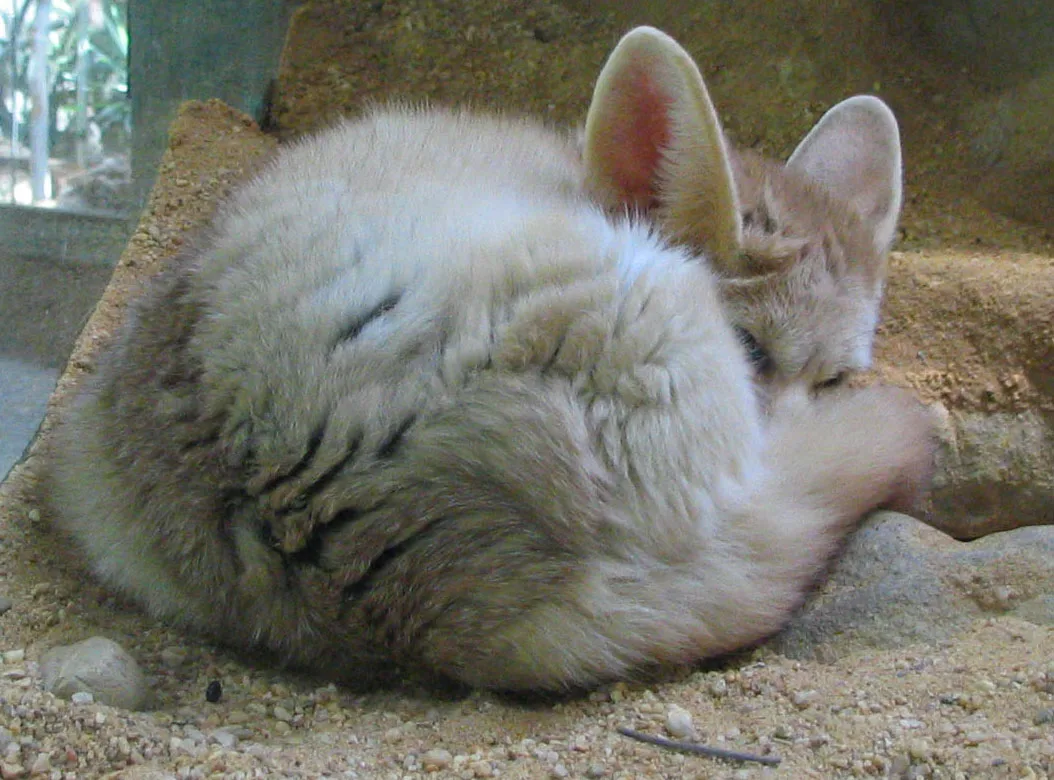
A wild fennec fox at its burrow in the dunes near Merzouga, Morocco.
Field
notes
Ears Built to Cool and Hunt
The fennec fox (Vulpes zerda) has the largest ears relative to body size of any member of the dog family, and they can grow 4 to 6 inches (10.2 to 15.2 centimeters) long. Those ears help the fox listen for prey underground, and they also dissipate excess heat of the desert. Its enlarged auditory bullae, the bony chambers around the middle ear, also help it locate prey moving under the sand.
The Smallest Canid on Earth
It is the smallest of all canids: its body is 14 to 16 inches (35.6 to 40.6 centimeters) long, plus a 7-to-12-inch (18-to-30 cm) tail, and it usually weighs 0.9 to 1.4 kilograms (2 to 3 pounds). San Diego Zoo puts the weight a little higher, at about 1.6 kilograms (3.5 pounds). San Diego Zoo lists a life span of 10 years in the wild and 13 in zoos, while the Smithsonian says fennec foxes may live up to 11 years in human care. Heavily furred paws give traction in the sand and protect the fox from the hot ground, and a thick, sandy-colored coat reflects sunlight by day and keeps it warm at night.
Extreme panting helps a fennec fox keep its temperature regulated when the heat climbs. Its breathing rate can rise from 23 breaths a minute to as many as 690.
Getting Water From Food
In the wild, fennec foxes eat insects, especially grasshoppers and locusts, plus small rodents, lizards, birds and their eggs, and round it out with roots, fruit and leaves. Those plant foods help them hydrate, and a fennec fox can go for long periods without drinking water. Most of the water it needs comes from the plants it eats. Hunting happens alone and at night: the fox listens for prey under the sand with its huge ears, then digs with all four feet to reach its meal. It can kill prey larger than itself: there are documented cases of fennec foxes taking down fully grown rabbits.
Family Burrows Under the Dunes
Fennec foxes are monogamous and mate for life, and they burrow into sand dunes during the day to avoid the extreme heat. They can live in family groups of up to ten individuals, and there have been some instances of several family groups sharing one complex den. Their tunnels can reach up to 32 feet (10 meters) long, and it is not uncommon for a den to have multiple entrances and exits, which give a safe escape from an outside threat. Litters of two to five kits arrive after a gestation of about 50 days. A 2023 study of the fennec fox studbook notes that wild fennec foxes “produce a single litter in March or April,” yet the 220 captive-born litters it examined were born in every month of the year. The species ranges across North Africa’s Sahara Desert, east to the Sinai Peninsula and Arabia, and the IUCN rates it Least Concern.
Published Updated
Traits
Intel
& FAQ
Guess
first
How big is a Fennec Fox, really? Slide, lock in, and see what the sources say. Every answer is a figure from this page, quoted from where it came from.
Sources
- 01Vulpes zerda (fennec fox). Animal Diversity Web, University of Michigan.
- 02Fennec Fox. San Diego Zoo Wildlife Alliance.
- 03Fennec fox. Smithsonian's National Zoo and Conservation Biology Institute.
- 04Siciliano-Martina et al. (2023). Factors influencing the timing and frequency of litters in captive fennec foxes (Vulpes zerda). Animal Reproduction Science.
- 05Wacher, Bauman & Cuzin (2015). Vulpes zerda. The IUCN Red List of Threatened Species 2015: e.T41588A46173447.
What the sources say: 48 claims checked word for word against these sources →