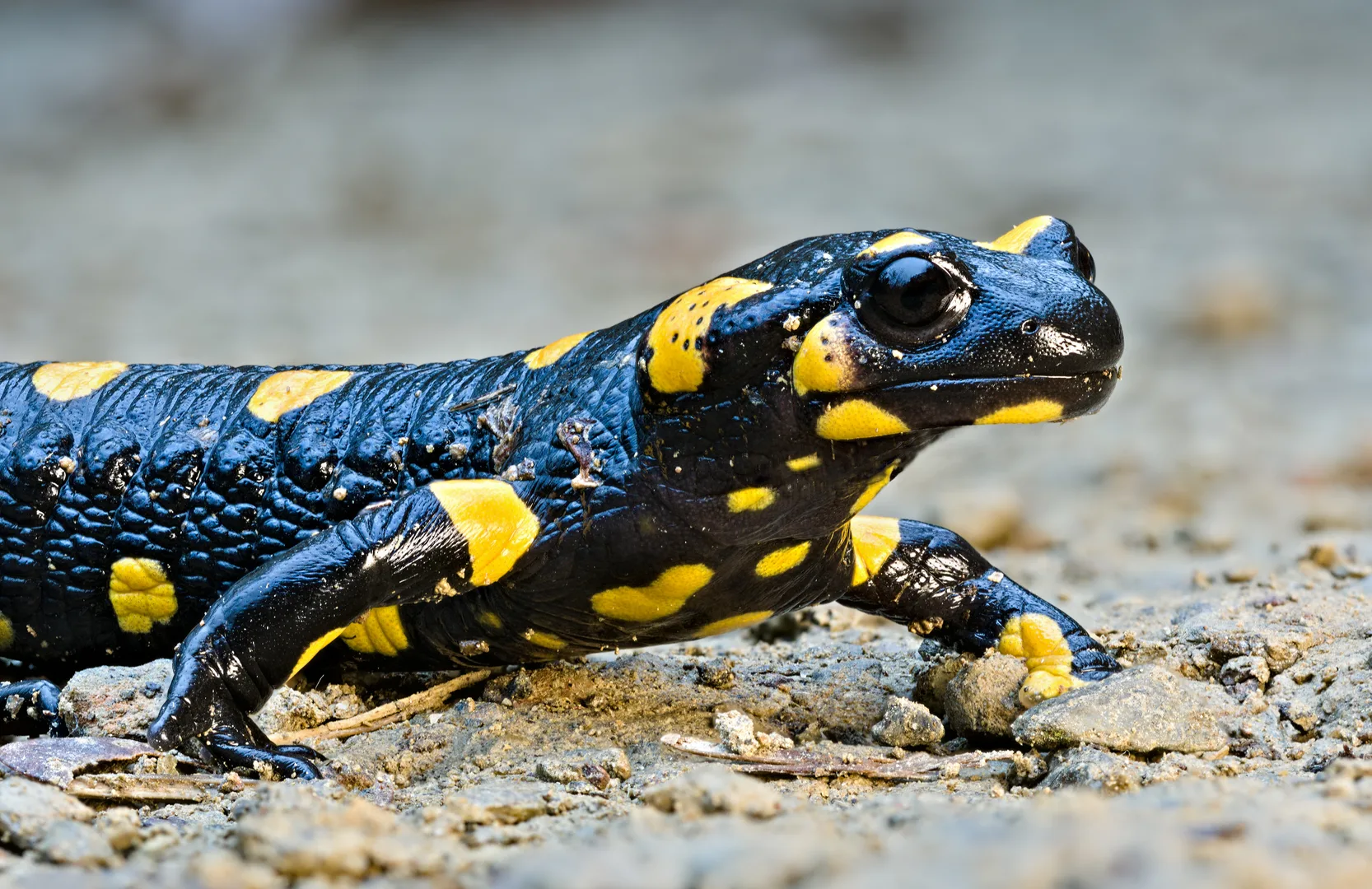
Fire salamander (Salamandra salamandra) on Orle hill, Slovenia
Field
notes
Poison Behind Both Eyes
The Fire Salamander (Salamandra salamandra) wears its warning as a uniform: black skin marked with yellow or orange spots, splotches or bands. Animal Diversity Web’s account puts it at 15 to 25 centimeters long, with some individuals exceeding 30, and AnAge lists an adult weight of 19.1 grams. Its maximum recorded lifespan is 24 years, in captivity, and one study found individuals returning to the same cave to hibernate for up to 20 years. It occurs all over Europe from Spain to Greece, spending much of its time beneath rocks or logs or in crevices in shaded woodland, and is mainly active on mild nights. Older accounts extend its range into northern Africa and the Middle East, but a mitochondrial DNA study of the genus found six major lineages, and suggested S. salamandra was the only one to recolonize Central Europe after the last glaciation.
It hunts soft-bodied prey such as earthworms and slugs, and harder-bodied beetles, centipedes and millipedes. When some light is available it uses movement as its cue and ignores stationary prey. In the dark, with its vision impaired, it hunts by smell, and will attack prey that isn’t moving as long as it can detect its odor.
A Spray Gun Behind Each Eye Large parotoid glands behind the eyes and rows of poison glands down the body secrete neurotoxins, and the two major alkaloids in the skin secretion are samandarine and samandarone. Instead of relying on escape, the salamander is capable of actively spraying these chemicals at predators to discourage an attack.
Chemistry the Color Doesn’t Explain
Alkaloid synthesis appears to take place in the liver, testes and ovaries as well, while the larvae are entirely free of alkaloids. Fire salamanders are textbook examples of warning coloration, but a study of three populations in the Solling area of Lower Saxony, Germany found no correlation between how much yellow a salamander wore and the alkaloid content of its parotoid glands. The yellow varied with sex, males showing more, and with location.
Born Live, With Cannibalism in the Womb
The common mode is ovoviviparity: the female retains the developing eggs and later deposits many small larvae in water, usually already quite advanced. Some populations go further. Their females are viviparous, producing only a few large young that are fully metamorphosed at birth and nourished by the mother, and cannibalism inside the womb is one of the traits that characterize that derived strategy.
A New Fungus Arrives
In the Netherlands, at the edge of its range, the fire salamander was restricted to three small populations in the far south, and their numbers fell 96 percent from 2010, a decline its researchers could not pin on any known cause. In 2013, scientists isolated a new chytrid fungus, Batrachochytrium salamandrivorans, from a fire salamander population whose steep decline had brought the species to the edge of local extinction. It caused erosive skin disease and rapid death in fire salamanders infected in the lab. After it arrived in a Belgian population, two years of monitoring showed a rapid collapse with no sign of recovery, largely due to the survivors’ lack of added resistance and a demographic shift that prevented compensation for the deaths. The IUCN now lists the species as Vulnerable.
Published Updated
Traits
Intel
& FAQ
Guess
first
How big is a Fire Salamander, really? Slide, lock in, and see what the sources say. Every answer is a figure from this page, quoted from where it came from.
Sources
- 01Salamandra salamandra. Animal Diversity Web, University of Michigan.
- 02Salamandra salamandra. AnAge: The Animal Ageing and Longevity Database, Human Ageing Genomic Resources.
- 03Salamandra salamandra. The IUCN Red List of Threatened Species 2023: e.T59467A219148292.
- 04Mebs & Pogoda (2005). Variability of alkaloids in the skin secretion of the European fire salamander (Salamandra salamadra terrestris). Toxicon.
- 05Preißler et al. (2019). More yellow more toxic? Sex rather than alkaloid content is correlated with yellow coloration in the fire salamander. Journal of Zoology.
- 06Steinfartz, Veith & Tautz (2000). Mitochondrial sequence analysis of Salamandra taxa suggests old splits of major lineages and postglacial recolonizations of Central Europe from distinct source populations of Salamandra salamandra. Molecular Ecology.
- 07Buckley et al. (2007). Heterochrony, cannibalism, and the evolution of viviparity in Salamandra salamandra. Evolution & Development.
- 08Martel et al. (2013). Batrachochytrium salamandrivorans sp. nov. causes lethal chytridiomycosis in amphibians. Proceedings of the National Academy of Sciences.
- 09Spitzen-van der Sluijs et al. (2013). Rapid enigmatic decline drives the fire salamander (Salamandra salamandra) to the edge of extinction in the Netherlands. Amphibia-Reptilia.
- 10Stegen et al. (2017). Drivers of salamander extirpation mediated by Batrachochytrium salamandrivorans. Nature.
What the sources say: 42 claims checked word for word against these sources →