AnimalTracks.wiki
AmphibiansProfile 148

Common Frog

Rana temporaria

The frog that lives as far north as the Arctic Circle and sits out winter under rocks or buried in pond mud.

Danger tierLowEffectively harmless to people.
IUCN status [LC]Least ConcernPopulation stable and widespread in natural habitats.Source: IUCN Red List
Vibe checkJulianna BarwickGlacial Ambient & Drone SoundscapesListen ↓

Field
notes

Checked against 5 sources ↓

Cold-proof from pond to Arctic

This frog copes well with cold climates. The common frog (Rana temporaria) lives across Great Britain, Europe and northwestern Asia, and Animal Diversity Web says it reaches the Arctic Circle in Scandinavia. In Britain it gets through winter tucked under rocks, in compost heaps, or down in the pond, buried in mud and plants. Froglife says it does not hibernate as such, and on a mild day it may pop out to forage.

Small, smooth and many-coloured

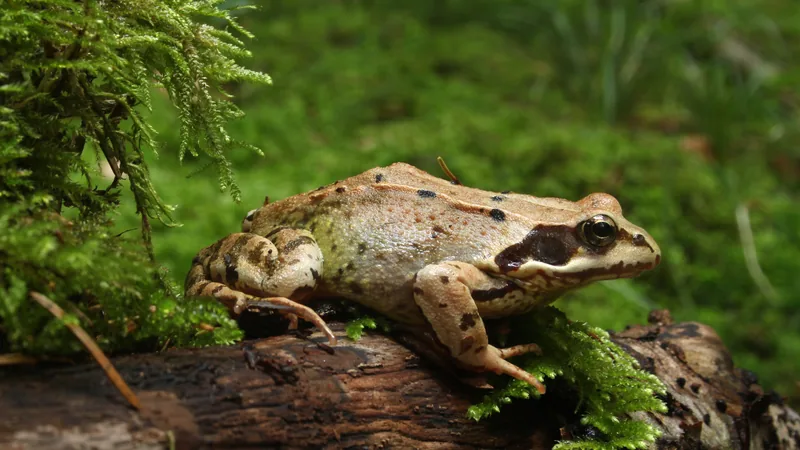
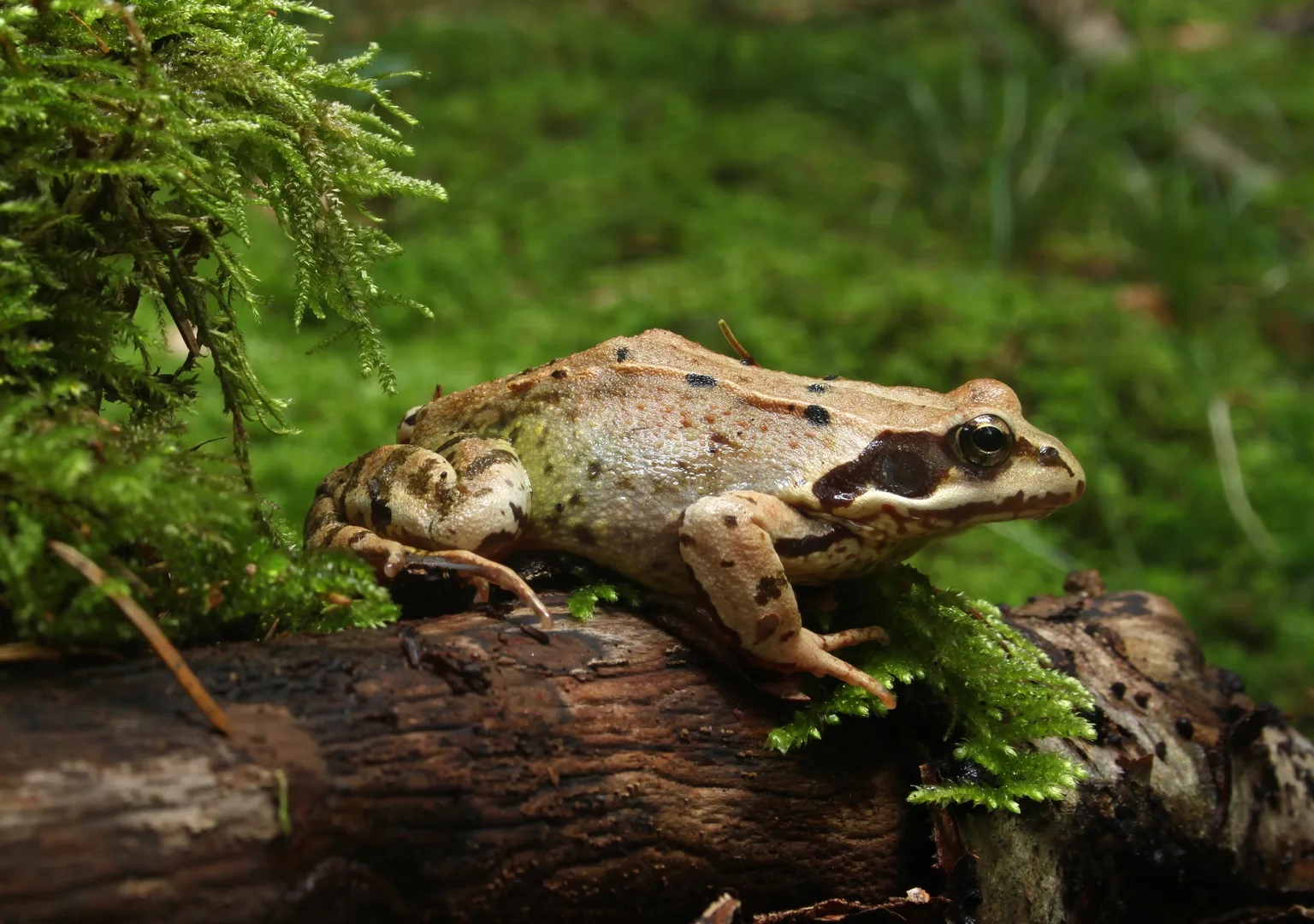
In Britain, males grow up to 9 cm long and females up to 13 cm. Animal Diversity Web gives an average mass of 22.7 g. The skin is smooth and the legs are long, built for jumping away fast. They are usually olive-green or brown with a dark mask behind the eye, but yellow, pink, red, lime-green, cream and black frogs turn up too. In breeding season males develop blue patches on the back and throat.

Pond rafts Froglife says a British spawn raft often holds up to 2,000 eggs, each small black egg wrapped in a clear jelly capsule about 1 cm across.

A fast spring

In Britain, adults leave their winter spots in early spring and head straight to a pond. Males may piggyback on a female on the way there. Eggs go in as early as January in south-west England, and two to four weeks later, depending on the weather, the tadpoles hatch. Tadpoles start black, then pick up gold-brown speckles. They eat algae and water fleas. After about 16 weeks they grow back legs, then front legs, and leave the water as tiny froglets, usually in early summer. Frogs reach breeding age at 2 to 3 years old. AnAge lists 27 years as the maximum longevity for the species, and says frogs in the wild may live up to 14 years.

Night shift hunters

Adults mostly feed at night on a wide variety of invertebrates, especially slugs and snails. Away from breeding time, a frog may wander as far as 500 metres from its pond. They find worms by smell. The common frog is rated Least Concern by the IUCN, but Froglife lists habitat degradation and introduced disease as threats, and calls garden ponds extremely important to it, especially in towns.

Published

Traits

Intel
& FAQ

01How long can a common frog live?

Wild frogs may live up to 14 years, according to AnAge, which gives 27 years as the maximum for the species. By its figures, males and females both mature at about 3 years old.

Source: AnAge: The Animal Ageing and Longevity Database, Human Ageing Genomic Resources

02How many eggs does a common frog lay?

Common frogs lay their spawn in rafts, and Froglife says a raft often holds up to 2,000 eggs. In the UK the tadpoles hatch two to four weeks later, depending on the local weather.

Source: Froglife

03How big is a common frog?

Froglife's British figures put males at up to 9 cm long and females at up to 13 cm.

Source: Froglife

04Where do common frogs go in winter?

In Britain, the winter hideouts are under rocks, in compost heaps or at the bottom of ponds. Froglife says it is not hibernation as such. In milder spells they may come out to forage.

Source: Froglife

Guess
first

How big is a Common Frog, really? Slide, lock in, and see what the sources say. Every answer is a figure from this page, quoted from where it came from.

  1. ?
  2. ?
  3. ?

Sources

More Amphibians

Amphibia

Permeable respiratory skin, transformative larval metamorphosis, and potent toxic alkaloids.

Axolotl in natural environment

Axolotl

Ambystoma mexicanum

The smiling cyber-amphibian that keeps its larval gills as an adult and can regrow whole legs and parts of its own brain and heart.

Regrows whole limbs, its tail and spinal cord, and parts of its heart and brain; heals deep skin wounds without a scar; keeps its larval gills as a breeding adultView →
▸ Anamanaguchi & Hatsune MikuHyperpop & Kawaii Future Bass
Young cane toad with red-flecked warty skin crouched on white mesh netting

Cane Toad

Rhinella marina

Unstoppable neotropical chemical tank, turned loose in Queensland in 1935 to eat cane beetles, armed with shoulder glands whose toxins often kill the Australian native predators that try to eat it.

Large parotoid glands on the shoulders secrete toxins when the toad is under threat, which may cause profuse salivation, twitching, vomiting, shallow breathing and collapse of the hind limbs in predators, and even death in some of them, including dogs.View →
▸ Midnight OilAussie Garage Punk & Pub Rock
Glossy black fire salamander with bold yellow spots walking over pale gravel

Fire Salamander

Salamandra salamandra

Black-and-yellow woodland amphibian whose glands behind the eyes secrete toxic alkaloids it can spray at attackers.

Glands behind the eyes and down the body that secrete toxic alkaloids, which it can actively spray at an attacker.View →
▸ Lake MaliceElectronic Metalcore & Nu-Metal
Emerald glass frog (Espadarana prosoblepon) crouched on a broad green leaf

Glass Frog

Centrolenidae

See-through belly skin that shows off a beating heart, green bones, and a liver that can hide most of the frog's red blood cells.

Resting glass frogs in a 2022 study packed about 89% of their red blood cells into their livers, becoming two to three times more transparent.View →
▸ Clams CasinoGlacial Ambient & Drone Soundscapes

Clade factCutaneous respiration allows many amphibians to absorb oxygen and water directly through porous skin layers.

Explore all 17 →

Head-to-head showdowns

Simulated face-offs, biological power gauges, and 3-round combat

Down the Rabbit Hole

Associative matches based on weird shared evolutionary traits