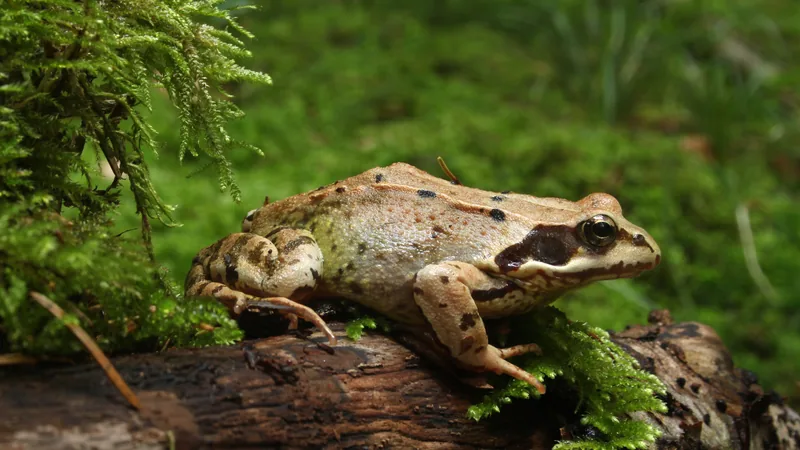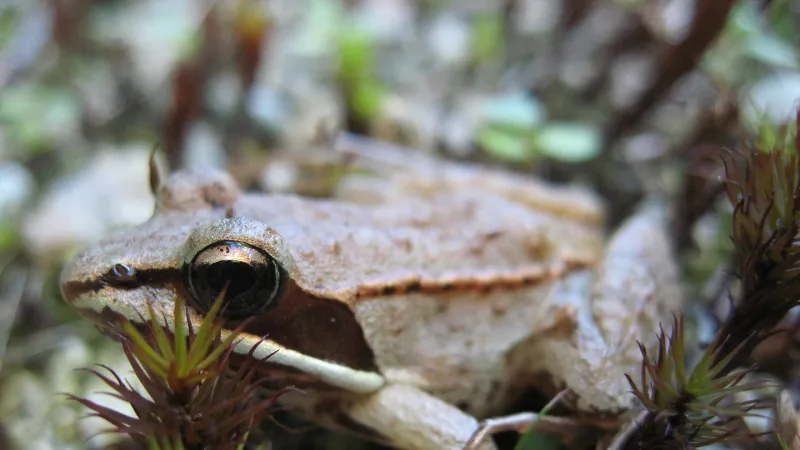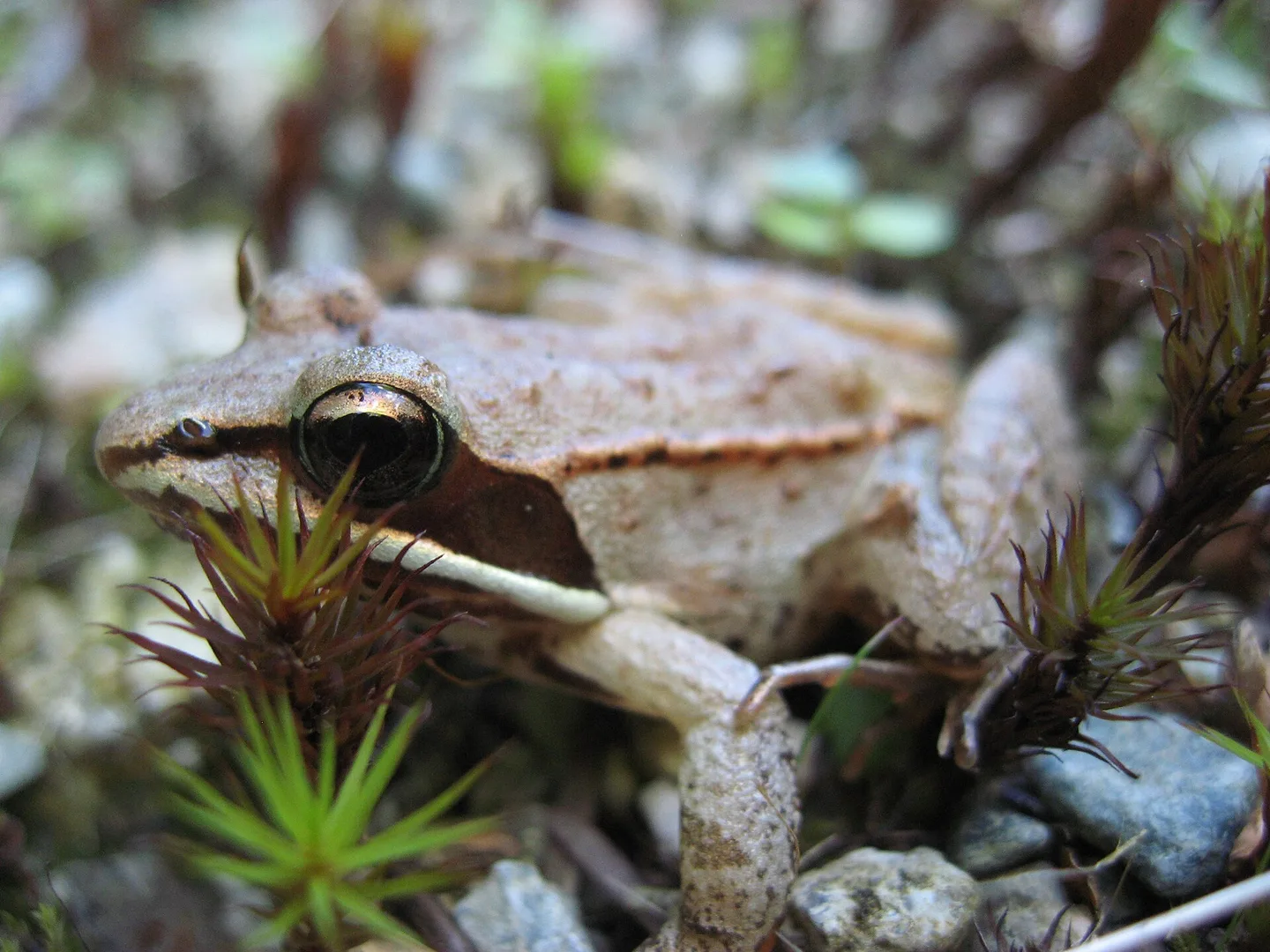
A young wood frog among moss
Field
notes
The Frog That Turns to Ice
In winter, the wood frog (Lithobates sylvaticus) freezes while it hibernates. As much as 35 to 45 percent of its body turns to ice beneath the skin, and its breathing, blood flow, and heartbeat stop. Ice forming inside its cells would be deadly. When ice starts forming in its outer tissues, the frog’s liver rapidly manufactures large amounts of glucose and distributes it through the body. That sugar, combined with specialized proteins, keeps the water inside each cell from crystallizing while ice fills the spaces outside it.
Liver and Heart Thaw First When a frozen wood frog starts to warm up, its liver and heart melt before the rest of its body, letting its vital functions restart while the rest of the frog is still thawing.
Six Months Frozen in Interior Alaska
Wood frogs in Interior Alaska survive freezing to more extreme limits and durations than the populations studied in southern Canada and the Midwestern United States. Tracked into their natural hibernacula, they stayed frozen for 193 days on average, through average minimum temperatures of -14.6°C and as low as -18.1°C, and all 18 of the frogs tracked survived the winter. Their muscles held glucose levels 13 times higher, and their hearts 10 times higher, than frogs frozen in a laboratory. Researchers think that extra glucose builds up through the repeated freezing and thawing these frogs go through in early autumn.
A Robber’s Mask on the Forest Floor
Wood frogs live in tundra, bogs, and coniferous or deciduous forest, found from northern Georgia to Alaska. They are found farther north than any other reptile or amphibian in North America, reaching north of the Arctic Circle. Adults run 3.8 to 8.2 centimeters long, average about 8 grams, and usually live no more than three years in the wild. A black patch runs from each wood frog’s eardrum to the base of the front leg, earning the species the nickname “robber’s mask,” against skin that’s usually rust-brown or tan, but sometimes green or gray. Adults eat small invertebrates, especially spiders, beetles, moth caterpillars, slugs, and snails.
First to Call, Camouflaged as Eggs
Wood frogs are the first frogs of the year to start calling, often before the ice is completely off their breeding ponds, filling the air with a chorus of duck-like quacking some describe as “a lot of chuckling.” Each female lays a globular mass of 1,000 to 3,000 eggs, 10 to 13 centimeters across. Numerous small green algae then turn the jelly around the eggs green, which makes a great camouflage.
Published Updated
Traits
Intel
& FAQ
Guess
first
How big is a Wood Frog, really? Slide, lock in, and see what the sources say. Every answer is a figure from this page, quoted from where it came from.
Sources
- 01Lithobates sylvaticus (wood frog). Animal Diversity Web, University of Michigan.
- 02Wood Frog. National Wildlife Federation.
- 03Larson et al. (2014). Wood frog adaptations to overwintering in Alaska: New limits to freezing tolerance. Journal of Experimental Biology.
- 04Storey (1997). Organic Solutes in Freezing Tolerance. Comparative Biochemistry and Physiology Part A: Physiology.
- 05Lithobates sylvaticus. The IUCN Red List of Threatened Species 2022: e.T58728A193382501.
What the sources say: 41 claims checked word for word against these sources →