Falco peregrinus - 01
Field
notes
A Guided Missile With Feathers
A peregrine falcon hunts with a stoop, a steep, controlled dive onto its prey, and it is one of the world’s fastest birds. In level flight it reaches up to 150 km/h (93 mph), but diving on prey it tucks its wings tight to its body, and studies report it going faster than 320 km/h (200 mph). Estimates of its top diving speed run as high as 565 km/h, though one aerodynamics study points out that speeds this high have never been accurately measured. That study’s mathematical model of an ideal 1 kg falcon found that by shrinking its wingspan while pulling out of a vertical dive, it could generate 18 times its own body weight in lift, against 1.7 times at full wingspan, and would lose 60 metres of altitude doing it.
Attack paths measured in captive-bred peregrines chasing lures closely fit the guidance law used in missiles, called pure proportional navigation, which steers by how fast the line of sight to the target is turning. The stoop ends with a massive blow delivered in mid-air. A peregrine catches prey with its talons, but it generally kills with its beak, severing the bones of the neck.
Built Like a Falling Knife
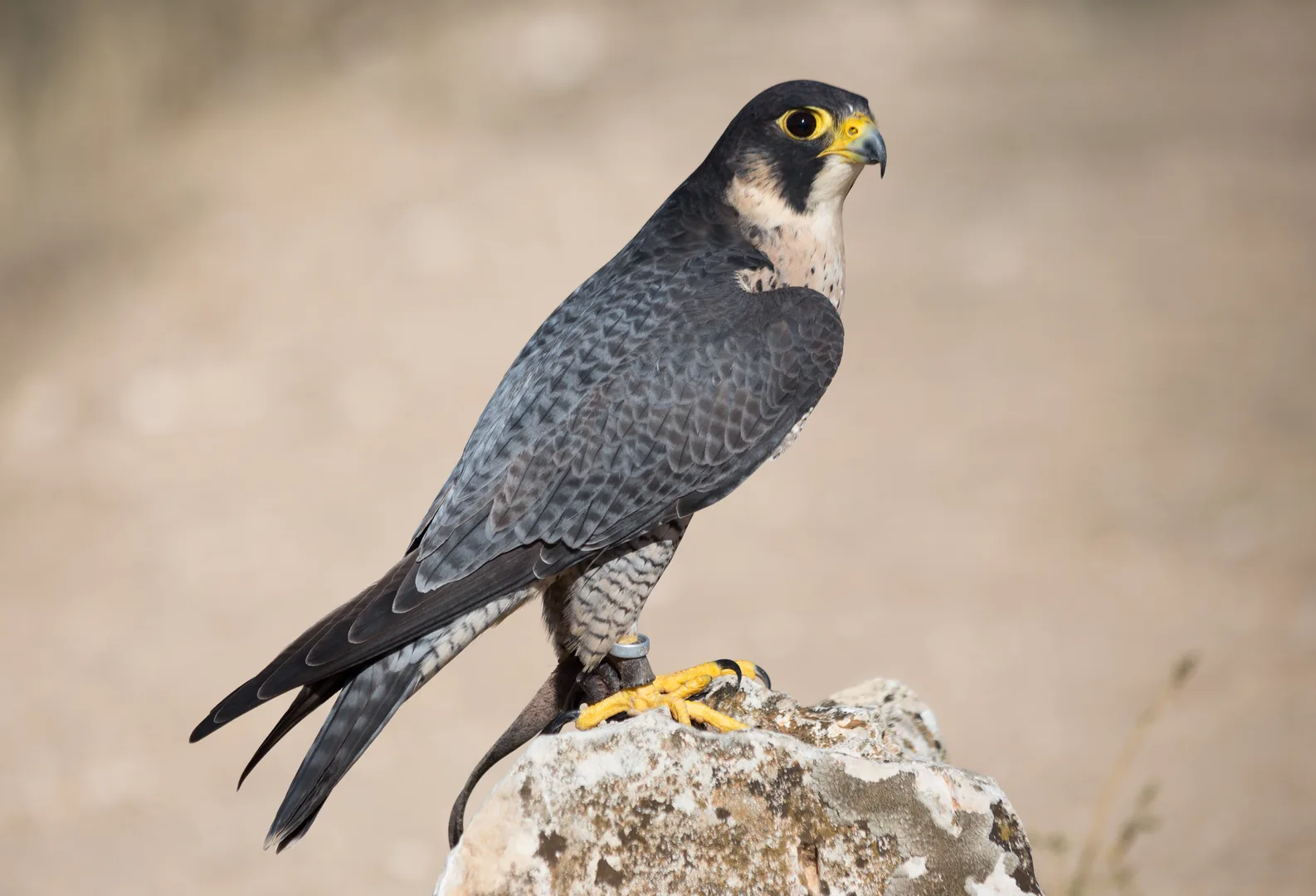
A peregrine measures 36 to 49 cm long with a wingspan of 80 to 114 cm and weighs 330 g to 1.5 kg, and females are typically 40 to 50 percent heavier than males. British ringing records put a peregrine’s typical life expectancy at 7 years once it reaches breeding age, and the oldest ringed bird lived past 21 years.
A flicker-fusion rate of at least 129 Hz is how many flashes of light a second a peregrine’s eyes can still tell apart, more than a saker falcon’s 102 Hz or a Harris’s hawk’s 81 Hz. Researchers suggest a link to hunting style: the falcons chase fast, agile prey, while the hawk flies more slowly after slower prey.
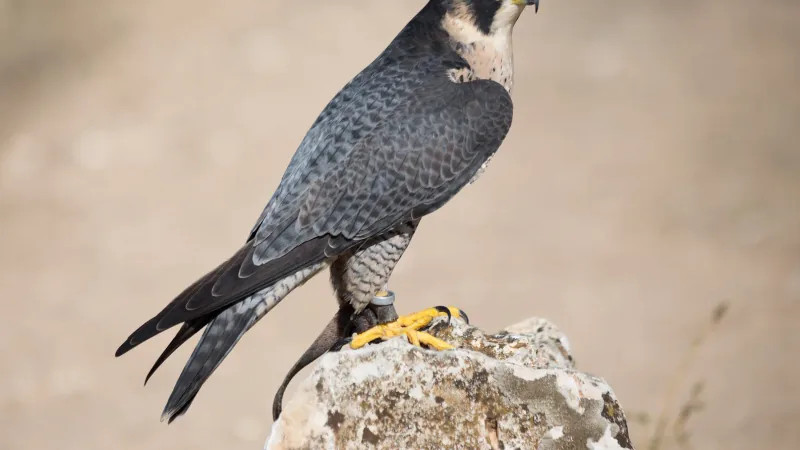
Do the dark cheek stripes, called malar stripes, cut sun glare? A 2021 study found peregrine stripes are larger and darker where average sunlight is stronger, strong support for the idea in this species, but a 2023 study found no universal support in other falcons. A 2025 study of 12 falcon species found stripe size and darkness did not differ with hunting style, habitat or migration, suggesting other jobs such as thermoregulation (keeping body temperature steady) or camouflage also play a role.
Cliffs, Skyscrapers and Whatever Flies Past
Peregrines live on every continent except Antarctica and are most common in tundra and coastal areas. They nest on cliff faces and crevices, and have begun to move into cities, where tall buildings make good nest sites and pigeons are plentiful. Birds make up 77 to 99 percent of their prey, with pigeons and doves the most important by weight, alongside shorebirds, waterfowl, grouse and songbirds. Bats are the mammal they catch most often.
A Comeback Written in Eggshells
Two pesticides, DDT and dieldrin, reduced the falcons’ ability to build eggshells with enough calcium, making the shells thin and more likely to break. Peregrine numbers crashed in the mid-20th century, and every breeding pair in the eastern United States vanished. Captive breeding, releases into the wild and limits on pesticide use brought them back, and the IUCN now lists the species as Least Concern worldwide.
Published Updated
Traits
Intel
& FAQ
Sources
- 01Falco peregrinus (peregrine falcon). Animal Diversity Web, University of Michigan.
- 02Peregrine Falcon Program. New York State Department of Environmental Conservation.
- 03Peregrine Falcon. Audubon Guide to North American Birds.
- 04Peregrine. BTO BirdFacts, British Trust for Ornithology.
- 05Ponitz et al. (2014). Diving-Flight Aerodynamics of a Peregrine Falcon (Falco peregrinus). PLoS ONE.
- 06Tucker (1998). Gliding Flight: Speed and Acceleration of Ideal Falcons During Diving and Pull Out. Journal of Experimental Biology.
- 07Mills et al. (2018). Physics-based simulations of aerial attacks by peregrine falcons reveal that stooping at high speed maximizes catch success against agile prey. PLOS Computational Biology.
- 08Potier et al. (2019). How fast can raptors see? Journal of Experimental Biology.
- 09Polak & Ottenburghs (2025). Migration, Habitat and Hunting Style Do Not Affect the Malar Stripe of Different Falcon Species. Ecology and Evolution.
- 10Westrip et al. (2022). Falco peregrinus. The IUCN Red List of Threatened Species 2022: e.T45354964A210513652.