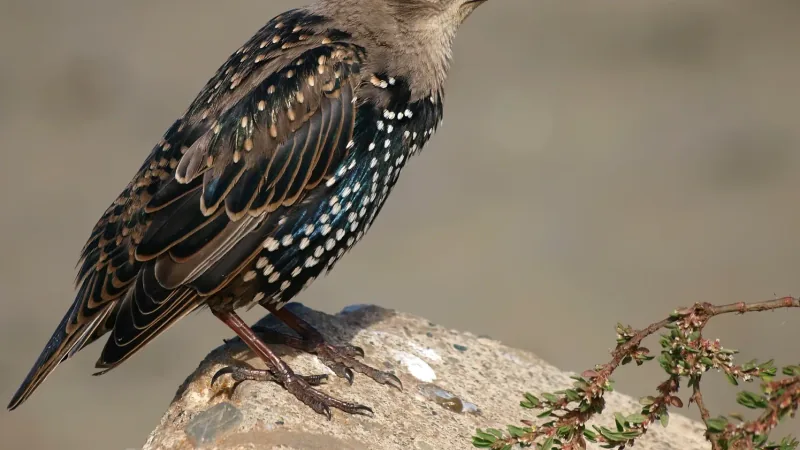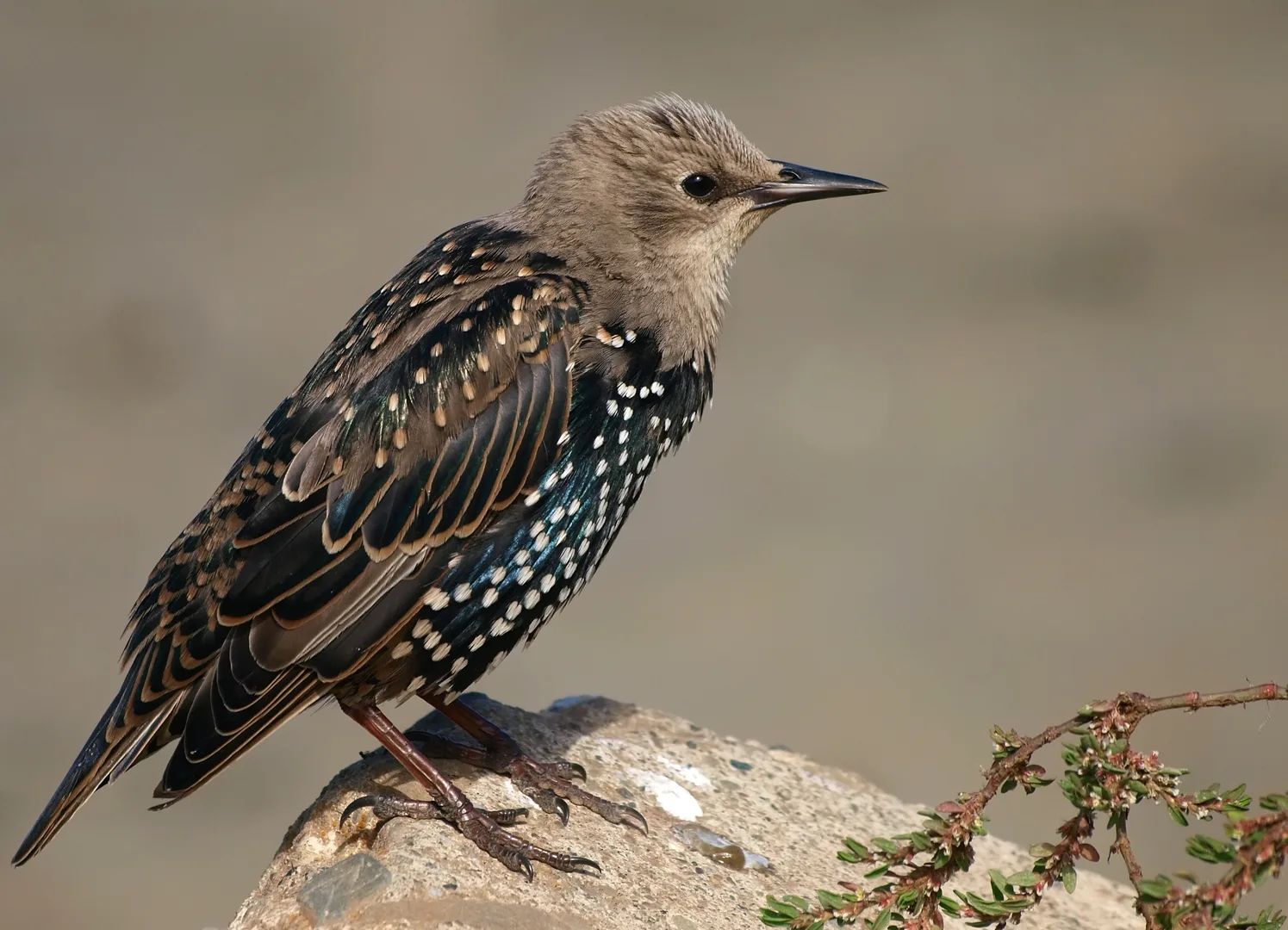
Common starling (Sturnus vulgaris) in breeding plumage, Toulouse, France.
Field
notes
A Common Bird With an Uncommon Coat
The European starling (Sturnus vulgaris) is a small bird with a big wardrobe change. It grows to about 21.5 centimetres long and an adult typically weighs around 85 grams. The dark-looking bird is colourful up close: its breeding plumage is iridescent green, blue and purple, and in winter it is spotted with silver. A starling that reaches breeding age has a typical life expectancy of 5 years, but BTO’s record for a ringed bird, set in 2001, is 17 years, 7 months and 25 days. The species is native mainly across Europe, North Africa and Asia, from Central Siberia in the east to the Azores in the west. Starlings were introduced to North America in 1890.
Prying Open a Meal
The starling mainly feeds on soil invertebrates. For food protected by a tough skin or shell, it uses a technique called open-bill probing: it pushes its bill into the food, then pries it open by widening its beak to expose what is inside. The animals it eats most often are centipedes, spiders, moths and earthworms, and its most popular plant foods are berries, seeds, apples, pears, plums and cherries. Vertebrates are on the menu too. On 7 May 2021, beside a ditch in Cambridge, England, a female starling was filmed spending some time trying to subdue a smooth newt before swallowing it. That single observation is the first definitive evidence of the species preying on smooth newts.
A Sky Full of Getaways
In Britain and Ireland, starling numbers increase dramatically in winter as birds arrive from northern Europe, and the larger roosts can number over a million birds. Over two winters in Rome, researchers filmed peregrine falcons hunting flocks of thousands of starlings near two urban roosts. They distinguished six patterns of collective escape, among them a sudden “flash expansion” and a “wave event”. The pattern depended partly on the threat: a wave event was most likely when the falcon attacked at medium speed, while flash expansion was more frequent when it approached fast and attacked from above rather than from the side or below. Flash expansion came only after an attack, never before one, and about a quarter of attacks were followed by one.
Two Sound Sources, One Voicebox
Two sound sources, one bird. The songbird syrinx, or voicebox, holds two independent sound sources. In a male starling the left one produces mostly low frequencies, while the right one is used for higher notes.
Starlings are accomplished mimics as well. They often copy the songs or sounds of other birds and animals, such as frogs, goats and cats, and even mechanical sounds. Males’ songs are highly variable: they warble, click, whistle, creak, chirrup and gurgle. Globally, the IUCN Red List of Threatened Species rates the European starling Least Concern. In the UK, where it’s native, BTO figures show the breeding population fell 61% between 1995 and 2024.
Published Updated
Traits
Intel
& FAQ
Guess
first
How big is a European Starling, really? Slide, lock in, and see what the sources say. Every answer is a figure from this page, quoted from where it came from.
Sources
- 01Sturnus vulgaris (common starling). Animal Diversity Web, University of Michigan.
- 02Starling, Sturnus vulgaris: BirdFacts. British Trust for Ornithology.
- 03Sturnus vulgaris. The IUCN Red List of Threatened Species 2021: e.T22710886A166360937.
- 04Prince, Riede & Goller (2011). Sexual dimorphism and bilateral asymmetry of syrinx and vocal tract in the European starling (Sturnus vulgaris). Journal of Morphology.
- 05Storms et al. (2019). Complex patterns of collective escape in starling flocks under predation. Behavioral Ecology and Sociobiology.
- 06Shimbov & Allain (2022). Smooth newt Lissotriton vulgaris preyed upon by European starling Sturnus vulgaris. The Herpetological Bulletin.
What the sources say: 56 claims checked word for word against these sources →