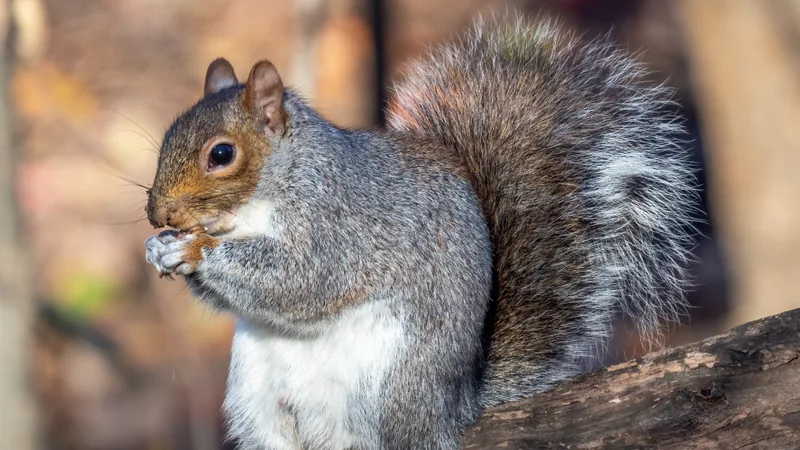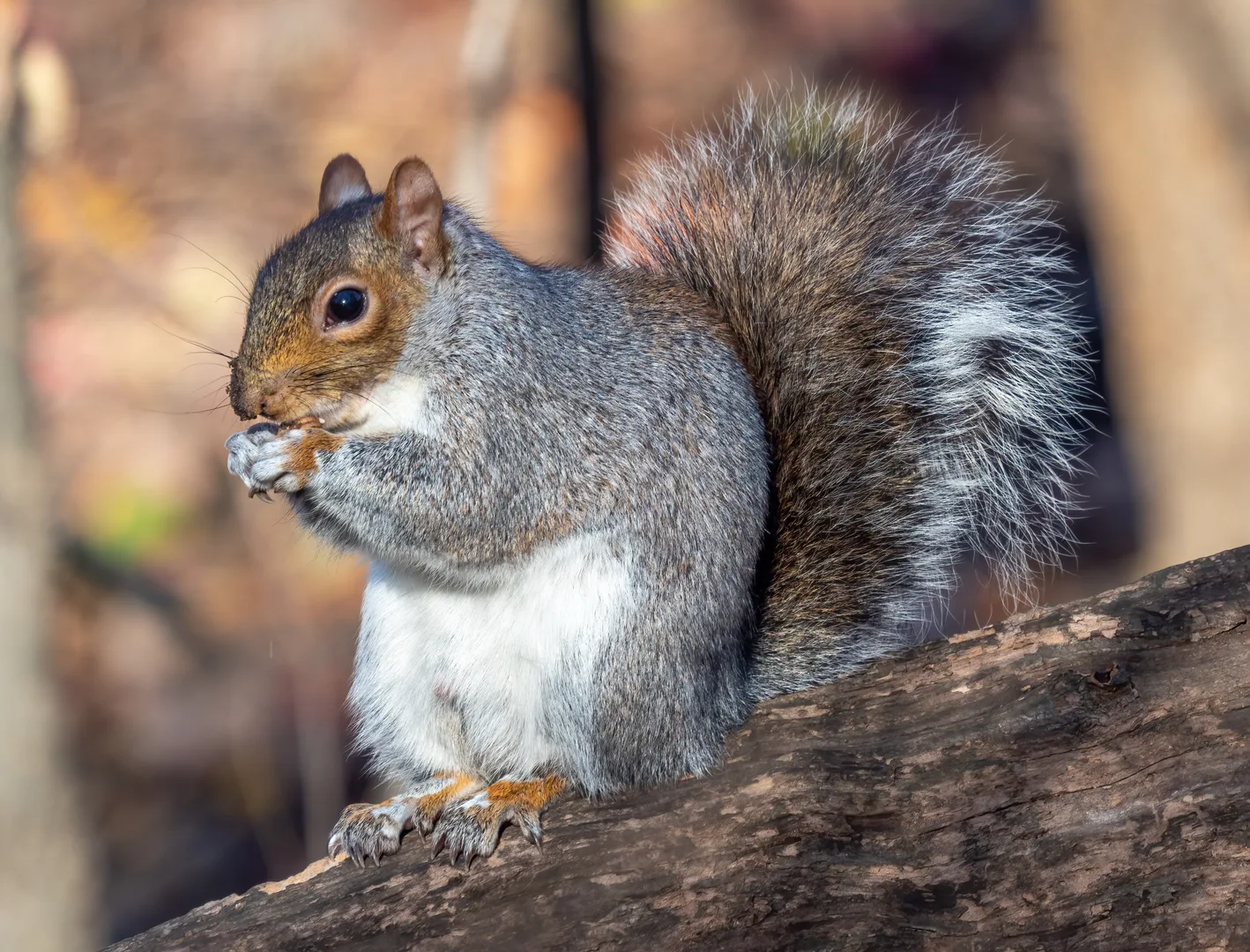
Eating on a branch, United States
Field
notes
Fake burying, real hoarding
Gray squirrels (Sciurus carolinensis) bury food in winter caches. They use scatter hoarding, hiding food in many small caches instead of one big pile, and they find the caches again using memory and smell. The Natural History Museum in London says spreading the stash out is thought to reduce the damage when another squirrel steals from it.
Then comes the trick, which the museum calls deceptive caching.
Decoy holes With other squirrels nearby, greys have been known to dig a cache hole and cover it again with nothing buried inside.
The museum says this may act as a distraction that keeps carefully foraged food from being stolen right away. Their seed caching may also help spread tree seeds.
Built light, built agile
An adult is a medium-sized tree squirrel. It measures 380 to 525 mm in total length, with a tail of 150 to 250 mm. Its mass runs from 338 to 750 g, and the average is about 540 g. Adult size comes at 9 months old.
AnAge, a longevity database, lists 23.6 years in captivity as the maximum, though it rates the sample size as small.
Predators include bobcats, coyotes and red-tailed hawks. They give warning calls, and their agility in the trees makes them hard to catch. They nest in a ball of leaves and twigs, or a tree den, and do not hibernate.
What’s on the menu
Nuts lead the menu, along with flowers and buds, from more than 24 oak species, 10 hickory species, and pecan, walnut and beech trees. The menu also includes fungi, insects in summer, and sometimes bird eggs and nestlings. The museum calls squirrels opportunistic feeders.
From Carolina to Britain
Its native home stretches across the eastern United States, a little beyond the Mississippi to the west, and up into Canada. Dark, melanistic squirrels are common in the north of that range. The species has also been introduced to Italy, Scotland, England and Ireland.
In the UK, the Wildlife Trusts estimate about 2.5 million grey squirrels against around 140,000 red squirrels. Greys were introduced from North America, possibly as early as the 1870s, and are now far more common in most areas. They win a bigger share of the food than reds, steal from their caches and can carry squirrelpox virus, which greys resist but which can infect and kill reds. The museum says they have displaced the native red squirrel in the UK and parts of Europe.
Published
Traits
Intel
& FAQ
Guess
first
How big is a Eastern Gray Squirrel, really? Slide, lock in, and see what the sources say. Every answer is a figure from this page, quoted from where it came from.
Sources
- 01Sciurus carolinensis. Animal Diversity Web.
- 02AnAge entry for Sciurus carolinensis. Human Ageing Genomic Resources, AnAge.
- 03Squirrels in the UK: What they're up to, when and why. Natural History Museum, London.
- 04Cassola (2018). Sciurus carolinensis. The IUCN Red List of Threatened Species 2018: e.T42462A276917738.
What the sources say: 49 claims checked word for word against these sources →