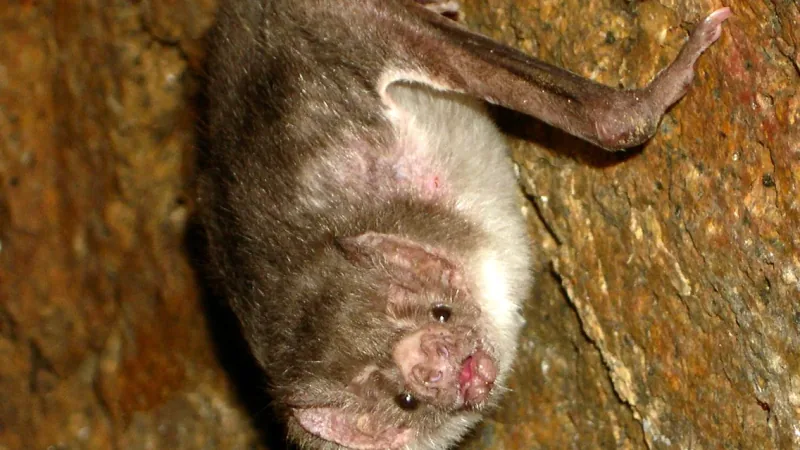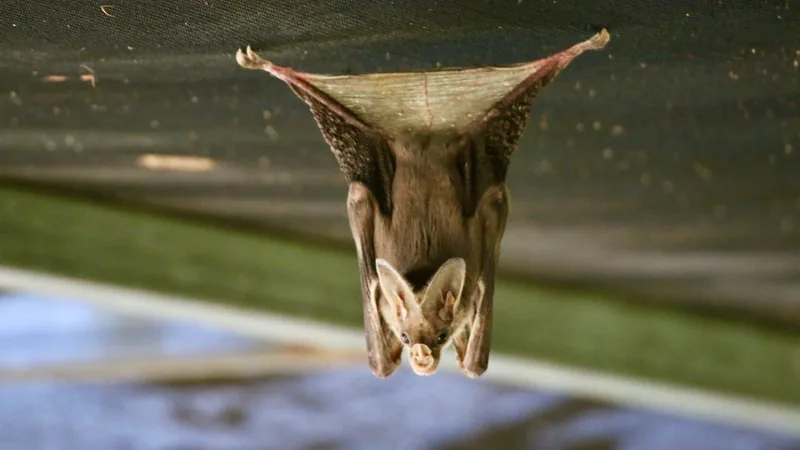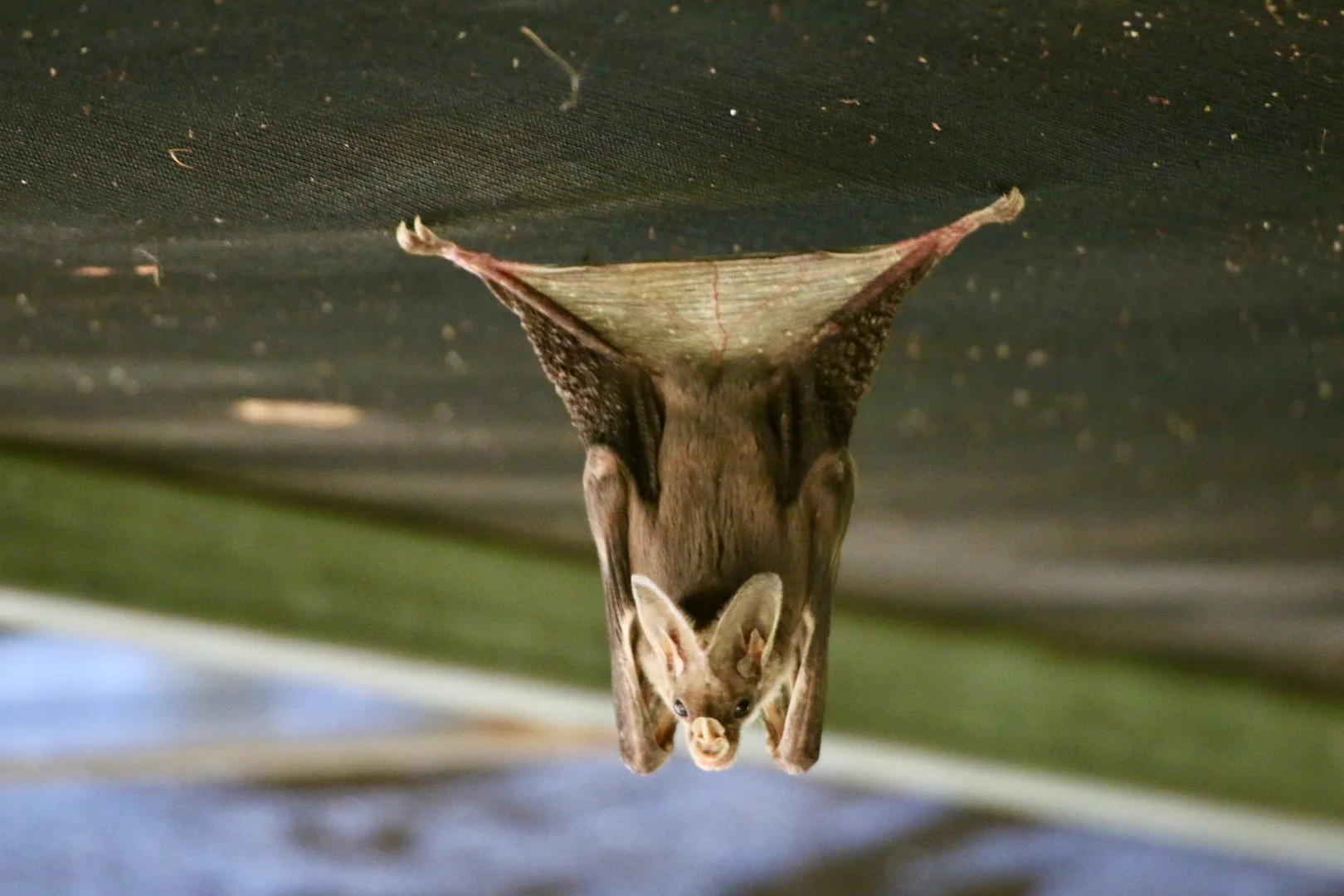
Ghost bat roosting in the wild, Northern Territory, Australia.
Field
notes
Australia’s Only Meat-Eating Bat
The Ghost Bat (Macroderma gigas) is Australia’s only carnivorous bat, and the largest microbat in Australia. It has a head and body length of 10 to 13 centimetres, a forearm length of 10 to 11 centimetres, a wingspan of 60 centimetres, and weighs up to 150 grams. By day ghost bats roost in caves, rock crevices and disused mine adits, in scattered colonies from the Pilbara and Kimberley in Western Australia through the Northern Territory’s Top End to eastern and western Queensland.
Two Ways to Hunt
A ghost bat perches in vegetation to ambush prey passing on the ground or in the air, and it also gleans prey from surfaces such as the ground while in flight. Tagged bats in one study watched from vantage points and made brief sallies, mostly for insects on the ground, though they were also seen hawking flying insects. They moved to a new vantage point about every 15 minutes, and their foraging areas averaged 61 hectares, centred an average of 1.9 kilometres from the day roost.
Passive listening A ghost bat’s outer ear boosts incoming sound by up to 30 decibels between 5 and 8 kilohertz, and researchers link its highly sensitive low-frequency hearing to hunting by passive listening. Its eyes stand out too: in a comparison of six echolocating bat species, the ghost bat had the longest eyes and the sharpest estimated vision of the group.
Bones and All
Ghost bats prey on frogs, reptiles, birds, large insects, small mammals and other bats, swooping to kill with powerful bites, then flying to a feeding site to eat. A study of bird remains found ghost bats may take prey up to about two-thirds their own mass, but they prefer smaller birds: almost 70 percent of the bird species recorded weighed under 35 grams. Flesh, bones, teeth, fur, small feathers and the hard shells of insects all get eaten, and in a 1970 account, captive ghost bats fed boneless meat soon became distressed. Prey remains from middens under ghost bat roosts in Western Australia’s Pilbara region have identified nine other bat species on the menu there.
A Vulnerable Colony Dweller
Permanent roosts are generally deep natural caves or disused mines with a relatively stable 23 to 28 degrees Celsius and 50 to 100 percent humidity. Ghost bats are easily disturbed and may abandon a roost where disturbance occurs. Females breed at two to three years of age and give birth to a single pup, which starts flying at about seven weeks. Wild lifespan is unknown, though it is likely somewhat shorter than the 22.6 years one captive bat reached. In 2014 the population was estimated at fewer than 10,000 mature ghost bats, with a continuing decline. By 2016, populations in Kakadu National Park were believed to have fallen by more than 90 percent since cane toads arrived there in 2001: bats have been found dead with chewed toads in their throats, and genetic work indicates the ghost bat cannot tolerate the toads’ toxins. The key threat is habitat loss from mining, and collisions with fences, especially barbed wire, are known to kill substantial numbers. The species is listed as Vulnerable on the IUCN Red List.
Published Updated
Traits
Intel
& FAQ
Guess
first
How big is a Ghost Bat, really? Slide, lock in, and see what the sources say. Every answer is a figure from this page, quoted from where it came from.
Sources
- 01Macroderma gigas (ghost bat) Conservation Advice. Threatened Species Scientific Committee, Australian Government Department of the Environment, 2016.
- 02Ghost Bat. Australian Museum, 2023.
- 03Macroderma gigas (Australian false vampire bat). Animal Diversity Web, University of Michigan.
- 04AnAge entry for Macroderma gigas. AnAge: The Animal Ageing and Longevity Database, Human Ageing Genomic Resources.
- 05Pettigrew et al. (2008). Peak Density and Distribution of Ganglion Cells in the Retinae of Microchiropteran Bats: Implications for Visual Acuity (Part 1 of 2). Brain, Behavior and Evolution.
- 06Guppy & Coles (1988). Acoustical and neural aspects of hearing in the Australian gleaning bats,Macroderma gigas andNyctophilus gouldi. Journal of Comparative Physiology A.
- 07Boles (1999). Avian prey of the Australian Ghost Bat Macroderma gigas (Microchiroptera: Megadermatidae): prey characteristics and damage from predation. Australian Zoologist.
- 08Start, McKenzie & Bullen (2019). Notes on bats in the diets of Ghost Bats (Macroderma gigas: Megadermatidae) in the Pilbara region of Western Australia. Records of the Western Australian Museum.
- 09Armstrong et al. (2021). Macroderma gigas. The IUCN Red List of Threatened Species 2021: e.T12590A209530568.
What the sources say: 52 claims checked word for word against these sources →