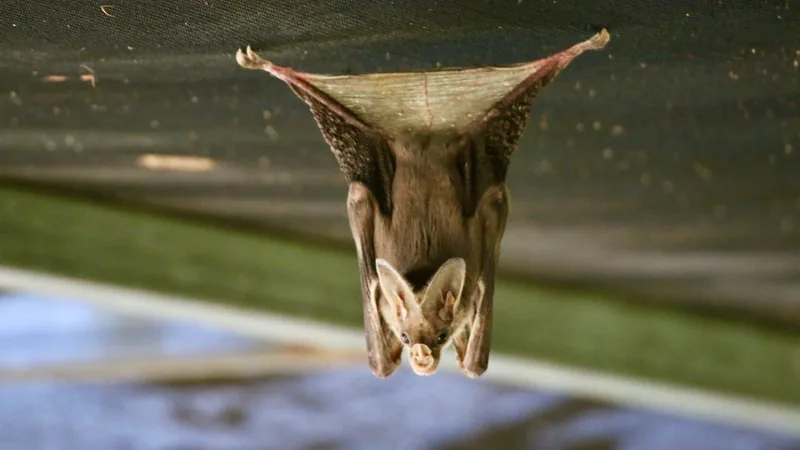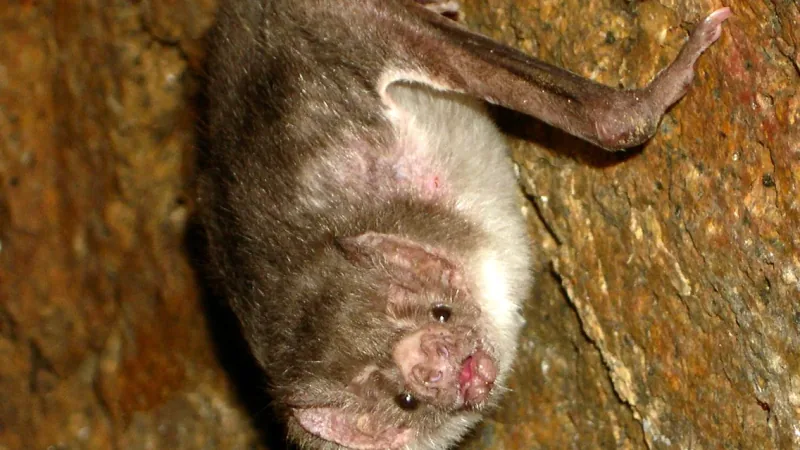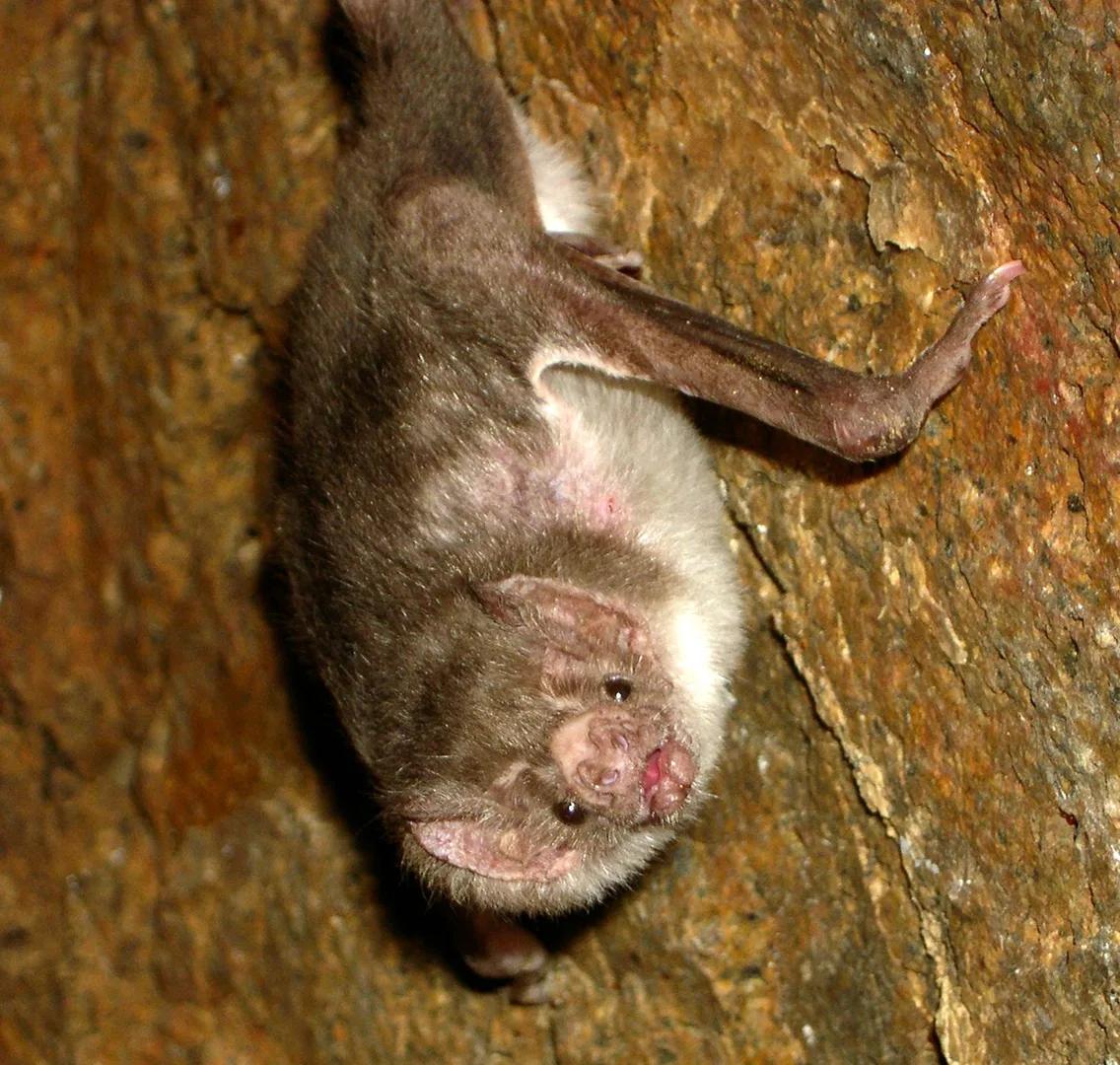
Common vampire bats roosting at Rio Negro, Mato Grosso do Sul, Brazil.
Field
notes
One of Only Three Blood-Feeding Mammals
The common vampire bat (Desmodus rotundus) does not look monstrous. It weighs 15 to 50 grams, with a wingspan of 35 to 40 centimeters and a body 7 to 9 centimeters long. What makes it strange is its diet: it is one of only three mammals that must feed on blood, a habit called sanguivory, and it eats nothing else.
It ranges through warm tropical and subtropical country from southern Mexico down to northern Argentina and Chile, roosting alongside tens to thousands of others in caves, tree hollows, old mine shafts and abandoned buildings. It feeds mainly on mammal blood, from wild tapirs to livestock such as cattle, horses and pigs. In captivity, one vampire bat lived to 29.2 years old.
A Heat-Guided, Barely-Felt Bite
Finding a meal starts with heat. The bat detects infrared radiation to locate hotspots on warm-blooded prey, through nerve fibers running to pit organs on its face. Among vertebrates, only vampire bats, pit vipers, boas and pythons can sense infrared. A protein called TRPV1, which still detects painful heat elsewhere in the bat’s body, has its trigger point lowered to about 30 degrees Celsius in these facial nerves.
The bat usually lands near its host and walks or hops up to it, then makes a 3-millimeter incision in the skin. Proteins in its saliva keep the wound from clotting while it laps up the blood, rather than sucking it. The bite is relatively painless and rarely wakes a sleeping animal.
Built to Run
Bats have become so specialized for flight that they have almost lost the ability to move on land at all. Vampire bats are an important exception. The common vampire bat walks, hops and runs, and its run is a bounding gait powered by its wings instead of its hind legs, an ability that seems to have evolved independently within the bat lineage. Its complex moves on the ground, which include vertical jumps that launch it into flight, are tied to its unusual way of feeding.
A Launch Like a Catapult In a flight-starting jump, the push against the ground can peak at 9.5 times the bat’s own body weight within about 30 milliseconds, launching it at an average of about 2.4 meters a second.
On the ground, it can run at up to 2.5 miles an hour.
A Buddy System With Teeth
Blood is a bad fuel to run low on. Two nights without a blood meal and a vampire bat starves to death, biologist Gerald Wilkinson wrote in 1990, unless it can get a roostmate to share. Common vampire bats often regurgitate food to roost-mates that fail to feed.
A 2013 study that fasted 20 vampire bats one at a time found that this sharing is not explained by kinship alone. How much food a bat had received from a particular partner was the best predictor of how much it gave back to that bat, 8.5 times more important than relatedness. Donors also started the sharing more often than the hungry bats did, which does not fit the idea that they were pestered into it.
Published Updated
Traits
Intel
& FAQ
Guess
first
How big is a Common Vampire Bat, really? Slide, lock in, and see what the sources say. Every answer is a figure from this page, quoted from where it came from.
Sources
- 01Desmodus rotundus (vampire bat). Animal Diversity Web, University of Michigan.
- 02Common Vampire Bat. Bat Conservation International.
- 03AnAge entry for Desmodus rotundus. AnAge: The Animal Ageing and Longevity Database, Human Ageing Genomic Resources.
- 04Barquez et al. (2015). Desmodus rotundus. The IUCN Red List of Threatened Species 2015: e.T6510A21979045.
- 05Zepeda Mendoza et al. (2018). Hologenomic adaptations underlying the evolution of sanguivory in the common vampire bat. Nature Ecology & Evolution.
- 06Gracheva et al. (2011). Ganglion-specific splicing of TRPV1 underlies infrared sensation in vampire bats. Nature.
- 07Schutt et al. (1997). The Dynamics of Flight-Initiating Jumps in the Common Vampire Bat Desmodus Rotundus. Journal of Experimental Biology.
- 08Riskin & Hermanson (2005). Independent evolution of running in vampire bats. Nature.
- 09Carter & Wilkinson (2013). Food sharing in vampire bats: reciprocal help predicts donations more than relatedness or harassment. Proceedings of the Royal Society B: Biological Sciences.
- 10Wilkinson (1990). Food Sharing in Vampire Bats. Scientific American.
What the sources say: 58 claims checked word for word against these sources →