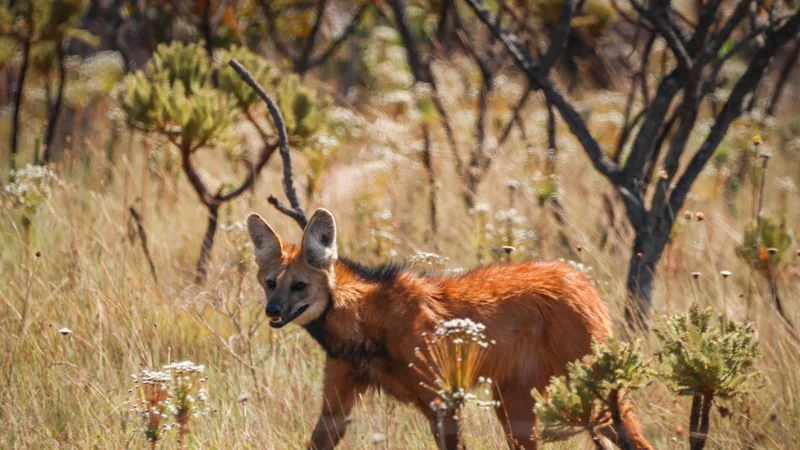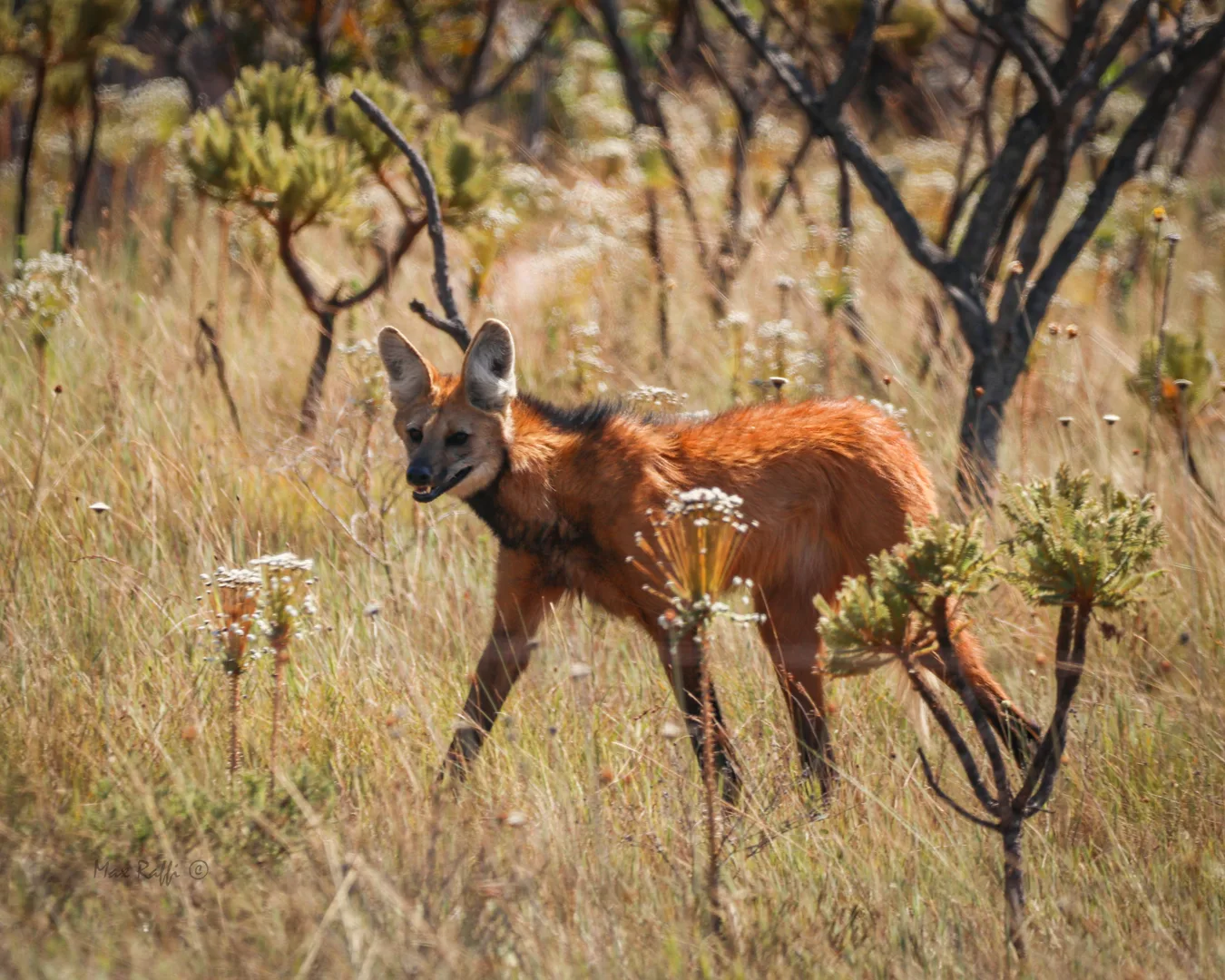
A maned wolf in Chapada dos Veadeiros National Park, Brazil.
Field
notes
The Maned Wolf (Chrysocyon brachyurus) is the largest canid of South America, and it looks more like a long-legged fox than a wolf. It stands about 90 centimeters (3 feet) tall at the shoulder, weighs about 23 kilograms (50 pounds), and carries a long, golden-red coat and a mane of long hairs that can stand erect, black at the front. No one knows how long a wild one lives; in human care, the median life expectancy is just 6.5 years, with a maximum of 12 to 15. Despite the look, genetic studies show it is neither fox nor true wolf but a distinct species, the only member of its genus.
Stilt Legs and Big Ears
In tall grass, those legs let it move through and see over the top, while it rotates its large ears to listen for prey. It taps the ground with a front paw to flush prey out and pounces to catch it; it may also dig after prey that has burrowed in, or leap to snatch a bird or insect from the air.
Maned wolves live in monogamous pairs sharing a territory of about 26 square kilometers (10 square miles), yet each hunts, travels, and rests alone, keeping close to its mate only in the breeding season. They mark the territory’s borders with powerful-smelling urine and droppings. Their size protects them: only pumas and domestic dogs have been reported to kill one.
Fruit, Small Prey, and a Kidney Worm
It does not kill or eat large prey, and its teeth show it: the upper carnassials (shearing teeth) are reduced and the canines long and slender. It is an omnivore that eats seasonally abundant fruits and vegetables and is particularly interested in lobeira, “fruit of the wolf,” a small tomato-like berry; with other fruits and vegetables, it makes up half the maned wolf’s diet. A study of 105 droppings collected in central Brazil found lobeira fruit, rodents, and birds made up 61.5 percent of the 304 food items recorded, while by estimated weight eaten, lobeira fruit and armadillos made up 63.7 percent.
A fruit against a worm Lobeira may provide medicinal aid against the giant kidney worm, a parasite whose effects have destroyed the right kidney of the typical wild maned wolf, leaving it only one that works.
A Cerrado Animal Running Out of Cerrado
Maned wolves range across central and eastern South America, through northern Argentina, Bolivia, Paraguay, southern Peru, and South and Central Brazil, in the cerrado, a patchwork of wet and dry forest, grassland, savanna, marsh, and wetland. The IUCN lists the species as Near Threatened. Fewer than 5,000 are thought to survive outside Brazil, and habitat analysis suggests as many as 20,000 may remain inside it. Habitat destruction for farms and highways is the main threat, and the cerrado has been reduced to 20 percent of its original size. Free-ranging maned wolves in a remote area of Bolivia have also been exposed to infectious and parasitic agents of domestic carnivores, including canine distemper, canine parvovirus, and rabies.
Published Updated
Traits
Intel
& FAQ
Sources
- 01Chrysocyon brachyurus (maned wolf). Animal Diversity Web, University of Michigan.
- 02Maned wolf. Smithsonian's National Zoo and Conservation Biology Institute.
- 03Paula & DeMatteo (2015). Chrysocyon brachyurus. The IUCN Red List of Threatened Species 2015: e.T4819A88135664.
- 04Austin et al. (2013). The origins of the enigmatic Falkland Islands wolf. Nature Communications.
- 05Motta-Junior et al. (1996). Diet of the maned wolf, Chrysocyon brachyurus, in central Brazil. Journal of Zoology.
- 06Deem & Emmons (2005). EXPOSURE OF FREE-RANGING MANED WOLVES (CHRYSOCYON BRACHYURUS) TO INFECTIOUS AND PARASITIC DISEASE AGENTS IN THE NOËL KEMPFF MERCADO NATIONAL PARK, BOLIVIA. Journal of Zoo and Wildlife Medicine.
- 07The "Maned" Event. San Diego Zoo Wildlife Alliance.