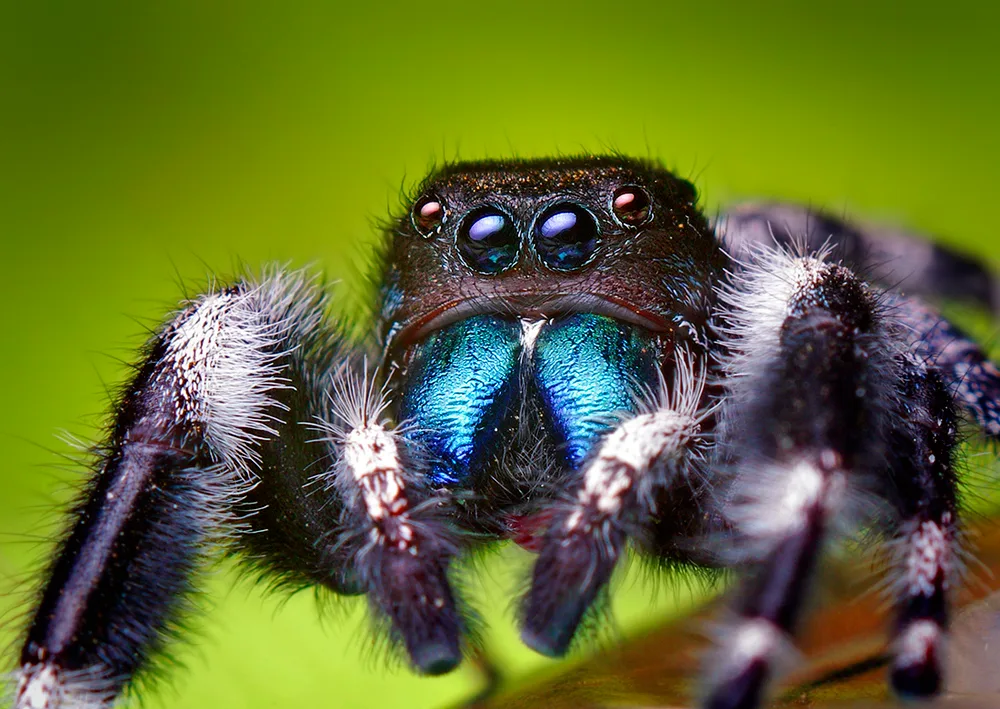
Adult male bold jumping spider (Phidippus audax)
Field
notes
A brain the size of a poppy seed
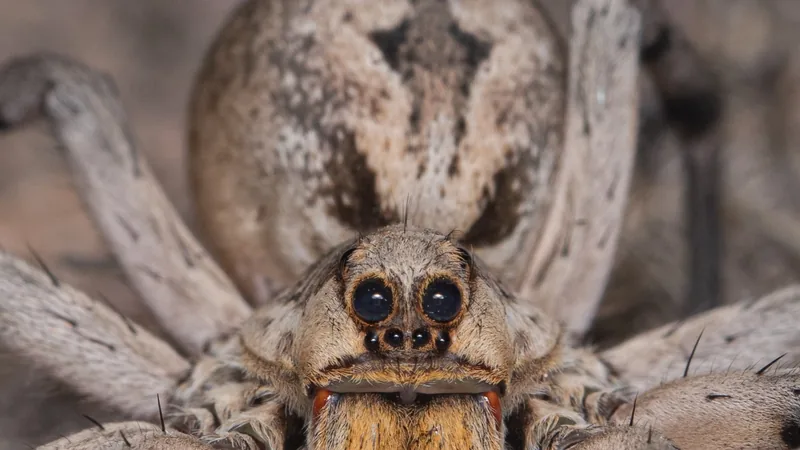
The bold jumping spider, Phidippus audax, belongs to a family that sees through four pairs of eyes. In jumping spiders, forward-looking spatial resolution surpasses that of all insects and even some mammals, processed by a brain roughly the size of a poppy seed.
The forward-facing eyes in the middle of the front are the largest of the eight. When a person looks at the spider, they are the ones that look back.
Eyes with different jobs In jumping spiders, high-acuity and motion vision are processed by different pairs of eyes. The principal eyes track targets with their movable retinae, while the immobile anterior lateral eyes have a larger field of view and lower resolution.
Stalk, pounce, tether
Jumping spiders require daylight to hunt their prey, and this one hunts by day, not at night. It watches a target with its sharp vision, sneaks up on it and pounces. The powerful hind legs propel the leap.
It adjusts the plan to the prey. Flies get a different angle of approach and a different jump distance than caterpillars. In lab tests, spiders pursued large insects at significantly slower rates (more cautiously) than small ones.
A jump comes with a safety line. When a bold jumping spider leaps, it releases a line of webbing, and if the jump fails, the line catches the spider before it falls.
The menu is a wide variety of insects and other spiders. In Idaho, the species was seen preying on hobo spiders.
Small, hairy and green-jawed
The bold jumping spider is black and hairy. Females measure 8 to 19 millimeters and males 6 to 13. Its genus holds the largest-bodied of the jumping spiders.
White, yellow or orange spots mark the top of the abdomen, and they are orange on younger spiders. The chelicerae, the fang-bearing mouthparts, frequently have an iridescent green hue. Males have “eyebrows,” tufts of hairs over the eyes.
The male courts with a display particular to the species. He lifts certain legs and shows off his colored spots. If the female approaches too rapidly, he jumps away.
From prairie to porch rail
The species occurs across North America, from southeastern Canada west to British Columbia and south to Florida, the Gulf Coast and northern Mexico. Its natural habitats are grasslands, prairies and open woodlands, and it is frequently found in backyards and gardens. It can be found on windowsills, tree trunks and deck railings in daylight.
It overwinters nearly mature, then becomes adult in April and May. The species is venomous, but its bite is not dangerous to humans.
Published
Traits
Intel
& FAQ
Guess
first
How big is a Bold Jumping Spider, really? Slide, lock in, and see what the sources say. Every answer is a figure from this page, quoted from where it came from.
Sources
- 01Phidippus audax. Animal Diversity Web, University of Michigan.
- 02Bold Jumper Spider. Penn State Extension.
- 03Menda et al. (2014). Visual Perception in the Brain of a Jumping Spider. Current Biology.
- 04Spano, Long & Jakob (2012). Secondary eyes mediate the response to looming objects in jumping spiders (Phidippus audax, Salticidae). Biology Letters.
- 05Vickers et al. (2014). Scavenging throughout the life cycle of the jumping spider, Phidippus audax (Hentz) (Araneae: Salticidae). Journal of Arachnology.
- 06Freed (1984). Foraging behaviour in the jumping spider Phidippus audax: bases for selectivity. Journal of Zoology.
What the sources say: 47 claims checked word for word against these sources →