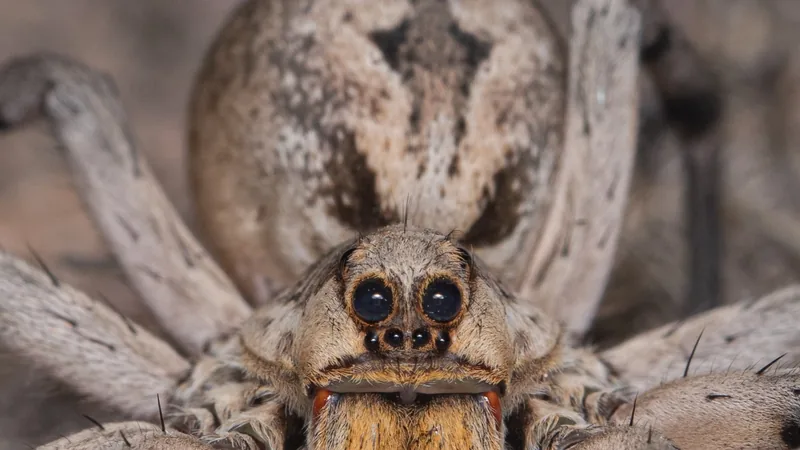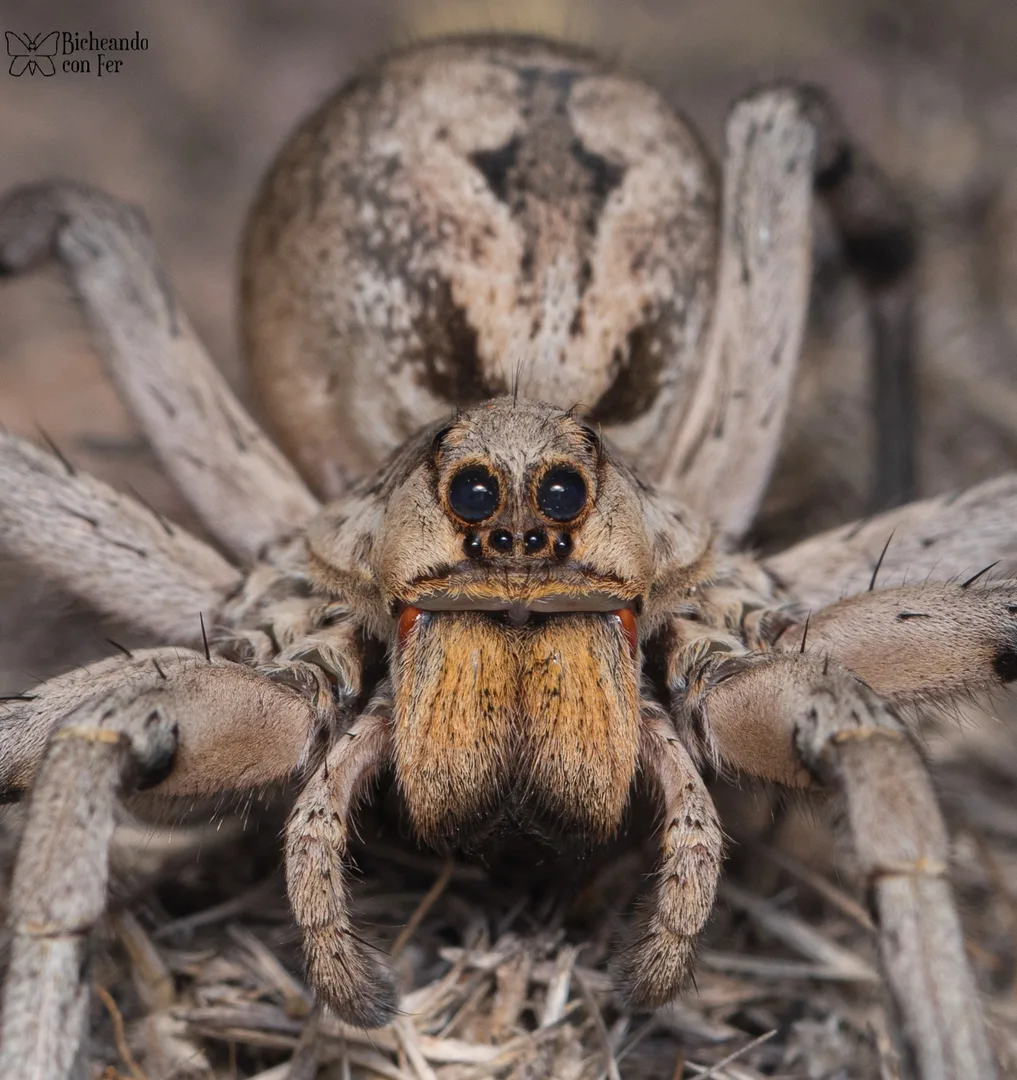
Frontal view of a female Hogna carolinensis .
Field
notes
Night hunter, no web
The Carolina wolf spider (Hogna carolinensis) is native to the continental US and Mexico. It is nocturnal, which means active at night, and one team collected adults in Oklahoma between 9 pm and midnight. This species does not form webs. Its hunting style is called “sit and pursue”.
Ground into small pieces
Frogs are on its menu. When a spider eats, it chews: Carolina wolf spiders feed by mastication, grinding their prey into small pieces. In a lab trial, a spider that finished a meal discarded a small ball of chewed prey. Prey remains are mostly exoskeleton, which spiders cannot digest.
Fat stays on the plate Spiders extracted essentially none of the lipids present in frogs and most of the lipids present in crickets.
Lipids are fats. Frogs and crickets held similar masses of them, yet the spiders took over 75% of the fat in crickets and almost none in frogs. The study’s authors could not say whether the spiders were unable or unwilling to take it. Frogs paid off another way, though: spiders took in about three times as much lean tissue, the part left once fat is removed, from frogs as from crickets.
Two grams, one to three years
Adult females in an Oklahoma study averaged 26.05 mm in length and 1,973.5 mg, just under 2 g. Females are the heavier sex. They are estimated to live two to three years and use burrows until they reproduce, while a male lasts about a year.
A spider grows by shedding its skin, and each stage between molts is an instar. One lab-reared female was followed to adulthood and reached it at her twelfth instar.
Babies on board
A mother carries her young. Spiderlings leave the egg sac and climb onto the top of her abdomen, where they stay until their yolk supply is used up, 5 days. They disperse on day 6.
Early contact seems to matter. At 16 days old, spiderlings kept with their mother and siblings were more efficient at capturing moving crickets than spiderlings raised alone. They also made significantly fewer blind alley errors in a maze.
Published
Traits
Intel
& FAQ
Guess
first
How big is a Carolina Wolf Spider, really? Slide, lock in, and see what the sources say. Every answer is a figure from this page, quoted from where it came from.
Sources
- 01Hunsucker et al. (2025). Comparing Nutrient Intake by Wolf Spiders (Hogna carolinensis) Consuming Frogs (Acris blanchardi) and Crickets (Gryllodes sigillatus). Ecology and Evolution.
- 02Herzog, Reeves & Wilder (2025). Testing for Differences in Consumer-Based Nutrient Cycling Between Male and Female Wolf Spiders (Hogna carolinensis). Ecology and Evolution.
- 03Alfaro, Griswold & Miller (2018). Comparative spigot ontogeny across the spider tree of life. PeerJ.
- 04Punzo & Ludwig (2002). Contact with maternal parent and siblings affects hunting behavior, learning, and central nervous system development in spiderlings of Hogna carolinensis (Araeneae: Lycosidae). Animal Cognition.
- 05Hogna carolinensis (Walckenaer, 1805), Taxonomic Serial No. 857994. Integrated Taxonomic Information System (ITIS).
What the sources say: 57 claims checked word for word against these sources →